 Skip to content
Compared with ordinary lead-acid batteries, valve-regulated sealed lead-acid batteries have a long design life (15~20 years), and are relatively simple to use and maintain, but their actual service life is much lower than the design life, and some can only be used for 2~3 years. years are even shorter. The reasons for the short life of VRLA batteries are as follows: one is the product quality problem, the second is determined by the special structure of VRLA batteries, and the third is improper use and maintenance methods.
Due to the above reasons, the lead acid battery failure modes are more than those of ordinary lead batteries. The common lead acid battery failure modes are vulcanization and water loss. Positive grid corrosion, internal short circuits, thermal runaway, early capacity loss and corrosion of negative grid busbars, etc.
Vulcanization
Part of the active material on the positive and negative plates of the lead battery gradually becomes the lead sulfate product with coarse particles, which cannot be converted into a reversible reaction between lead dioxide and spongy lead during charging, which is called sulfation of the plate. referred to as vulcanization.
In the case of normal use of lead-acid batteries, most of the active materials on the plate will become soft and fine lead sulfate crystals after discharge. These small crystals are evenly distributed in the porous active material, which is easy to charge during charging. It works in contact with the electrolyte and restores to the original active substances lead dioxide and spongy lead.

Phenomenon of vulcanization
① Phenomenon during discharge
a. Decrease in capacity: The active material of the vulcanized battery has become coarse-grained crystals and cannot be restored to the charged state of lead dioxide and spongy lead, so the capacity is much lower than the normal capacity, and its capacity is much lower than normal when discharged Discharge the battery first.
b. Low terminal voltage: The terminal voltage of the battery is related to the density of the electrolyte, while the density of the electrolyte of the vulcanized battery is low, and it cannot be recovered even during the charging process, so the terminal voltage is correspondingly low.
c. Low electrolyte density: Sulfation occurs when the battery is in a state of discharge for a long time or is insufficiently charged, so the density of the electrolyte will become lower and lower. For ordinary lead-acid batteries, the above phenomena can be observed, but the valve-regulated sealed lead-acid battery is a sealed structure, so only the first two phenomena can be observed.
② Phenomenon during charging
a. The terminal voltage rises quickly: due to the large internal resistance of the vulcanized battery, the terminal voltage of the battery rises faster than the normal battery during constant current charging. The charging method used by the valve-regulated sealed lead-acid battery is the current-limiting and constant-voltage method, so the first stage of charging of the valve-regulated sealed lead-acid battery will end soon.
b. Premature water decomposition: Because the terminal voltage rises rapidly during charging, it will soon reach the water decomposition voltage of 2.3V.
If it is an ordinary lead-acid battery, there will be outgassing. The sealing structure of the valve-regulated sealed lead-acid battery makes it impossible to observe the phenomenon of water decomposition, and the constant voltage of the current limiting constant voltage method is about 2.3V, and there will be no decomposition of a large amount of water, but due to the vulcanization of the battery It is not easy to charge into electricity after, so that almost all the current of the second-stage constant voltage charging is used for water decomposition.
The density of the electrolyte increases slowly: the charging reaction of the lead battery will release sulfuric acid, but the normal charging reaction of the sulfide battery cannot occur, so the density of the electrolyte increases slowly or even does not increase.
③ Changes in internal resistance. The main reason for the increase of the internal resistance of the sulfide battery is that the coarse PbSO4 particles block the micropores and cause a large concentration polarization, which increases the polarization internal resistance of the battery. When the vulcanization of the battery is serious, resulting in a loss of more than 50% of the battery capacity, it will cause a rapid increase in the internal resistance of the battery.
④ The color and state of the plate. The lead sulfate produced by vulcanization is white and hard particles, and its volume is larger than that of lead, so the surface of the negative plate of the battery is rough, and the surface of the plate is uneven. Because vulcanization mainly occurs on the negative plate, in ordinary lead-acid batteries, it can be found by observing the color of the negative plate, that is, the negative plate is gray-white, and in severe cases, there are white spots on the surface. The VRLA battery can only be found by dissecting the battery.
Reasons for vulcanization
There are many reasons for the vulcanization of valve-regulated sealed lead-acid battery plates, but they are all directly or indirectly related to the long-term discharge or under-charge of the battery. It can be summed up as follows.
① Long-term discharge state. This is the direct cause of the sulfidation of the battery. Many other reasons (such as Items ⑧~⑪) indirectly cause battery vulcanization, which is also caused by discharging the battery and causing the battery to be in a discharged state for a long time without being charged in time.
②Insufficient charging for a long time. The part of the active material that has not been charged is vulcanized due to being in a discharged state for a long time.If the float voltage is too low or the temperature drops, the float voltage of the valve-regulated sealed lead-acid battery is not lifted, which will cause the battery to be in a state of insufficient charge for a long time, resulting in a vulcanization failure of the battery.
③ Often overdischarge or small current deep discharge. This will convert the active substances deep in the plate into lead sulfate, which must be overcharged to recover, otherwise vulcanization will occur due to the lack of timely recovery.
④ It is not charged in time after discharge. Lead-acid batteries are required to be charged in time within 24 hours after discharge, otherwise they will. It is vulcanized and cannot be fully charged within the specified time.
⑤ The equalizing charge is not carried out in time. In the process of using the lead-acid battery, there will be unbalanced phenomenon. The reason is that the battery has been slightly vulcanized, and it must be balanced to eliminate the vulcanization, otherwise the vulcanization will become more and more serious.
⑥ No regular charging and maintenance during storage. Lead-acid batteries lose their capacity due to self-discharge during storage.
Regular charging and maintenance is required, otherwise the battery will be discharged for a long time.
⑦The amount of electrolyte decreases. For ordinary lead-acid batteries, the electrolyte level decreases, exposing the upper part of the plate to the air; for valve-regulated sealed lead-acid batteries, it is the loss of water that reduces the saturation of the electrolyte in the diaphragm, making the plate ineffective. In contact with the electrolyte, the active material is vulcanized because it cannot participate in the reaction.
⑧ Internal short circuit. The active material in the short-circuit portion is in a discharged state for a long time because the charging reaction cannot occur.
⑨ Serious self-discharge. Self-discharge will quickly turn the recovered lead or lead dioxide into discharged lead sulfate. If the self-discharge is serious, it will not be able to charge.
⑩ The density of the electrolyte is too high. If the density is too high, the self-discharge rate of the battery is accelerated, and it is easy to form coarse crystals in the inner layer of the electrode plate. In addition, too high density will lead to misunderstanding that the battery is sufficient and over-discharging during discharge, and mistakenly think that the battery has reached the end of charging when charging, but is actually under-charged, which eventually leads to vulcanization.
⑪ The temperature is too high. If the temperature is too high, the self-discharge rate of the battery will be accelerated, and it is easy to form coarse crystals in the inner layer of the electrode plate.
Vulcanization treatment
① Overcharge method. When the degree of vulcanization of the lead-acid battery is slight, the overcharging method can be used. That is, a special charge-discharge instrument is used to overcharge the vulcanized battery for a long time alone.
② Repeated charge and discharge method. When the degree of vulcanization of the lead-acid battery is serious and cannot be recovered by the overcharging method, the repeated charging and discharging method can be used. If there is a special charge-discharge instrument for repairing backward batteries for valve-regulated sealed lead-acid batteries, it can be directly used for reverse charge-discharge treatment. In fact, valve-regulated sealed lead batteries with severe vulcanization are often accompanied by water loss. Therefore, if the effect of capacity recovery is not good, you can try to open the battery and add suitable.
Amount of pure water, and then deal with the vulcanization failure. If there is no special charge and discharge instrument, you can open the battery and add an appropriate amount of pure water, and then use the method of treating the vulcanization of ordinary lead-acid batteries.
③ Pulse charging method. Treating vulcanization with pulse charging is a capacity recovery technology that has emerged in recent years, and this method must be carried out with special pulse charging equipment. There are two methods of repairing using this instrument, online and offline.
a. Online repair: connect the protector that can generate the pulse source to the positive and negative poles of the battery in parallel, and when the power is connected, there will be a pulse output to the battery. The characteristic of this repair method is that it requires less energy and can be connected in parallel at both ends of the battery all the year round, but the repair speed is relatively slow. This method can not only repair the vulcanized battery, but also can inhibit the vulcanization of the normal battery. b. Off-line repair: The repairing instrument can generate fast pulses, the pulse current is relatively large, and the frequency of pulses is relatively high, mainly used to repair vulcanized batteries.
Dehydration
Water loss refers to the phenomenon that the electrolyte in the battery decreases due to the oxygen recombination efficiency lower than 100% and the evaporation of water, which leads to the escape of water, which causes the reduction of the amount of water in the battery, which in turn causes the battery discharge performance to drop significantly. Studies have shown that when the water loss in the battery reaches 3.5mL/Ah, the discharge capacity of the battery will be lower than 75% of the rated capacity.
The battery fails when the water loss reaches 25%. Most of the reasons for the decline in the capacity of VRLA batteries are caused by the loss of water in the battery. Once the battery loses water, it will cause the positive and negative plates of the battery to be out of contact with the diaphragm or the acid supply will be insufficient, causing the battery to fail to discharge electricity because the active material cannot participate in the electrochemical reaction.
The phenomenon of dehydration
After the valve-regulated sealed lead-acid battery loses water, because of its sealing and lean electrolyte structure, the loss of water cannot be directly observed with the naked eye like the ordinary lead-acid battery (the container is transparent).
① Changes in internal resistance: When the battery loses water seriously, resulting in a loss of more than 50% of the battery capacity, it will cause a rapid increase in the internal resistance of the battery.
② Phenomenon during discharge: The phenomenon during discharge is basically the same as that of vulcanization, that is, the capacity and terminal voltage of the battery both drop. This is because after the loss of water, part of the electrode plate cannot be effectively contacted with the electrolyte, and part of the capacity is lost, and the discharge voltage also drops.
③ Phenomenon during charging: After the battery loses water, it loses part of its capacity, so the first stage of charging ends quickly, that is, the battery cannot be charged.
It can be seen that the phenomenon after the battery loses water is basically the same as the vulcanization phenomenon. In fact, there is a connection between these two failures, that is, sulfidation will accelerate the loss of water, and the loss of water must be accompanied by the occurrence of sulfidation. Under normal circumstances, as long as the maintenance is carried out in accordance with the relevant regulations, the possibility of vulcanization failure is very small, but the normal operation for a long time will gradually reduce the water content. Therefore, once the capacity decreases and cannot be charged, basically It can be judged that there is too much water loss inside the battery.

Reasons for dehydration
①Incomplete gas recombination: Under normal conditions, the gas recombination efficiency of VRLA batteries cannot reach 100%, usually only 97%~98%, that is, about 2%~3% of the oxygen generated at the positive electrode cannot be Absorbed by the negative electrode and escapes from the inside of the battery. Oxygen is formed by decomposing water during charging, and the escape of oxygen is equivalent to the escape of water. Although 2%~3% oxygen is not much, long-term accumulation will cause serious water loss in the battery.
②Corrosion of positive grid: Corrosion of positive grid consumes water.
③Self-discharge: The oxygen produced by the self-discharge of the positive electrode can be absorbed at the negative electrode, but the hydrogen produced by the self-discharge of the negative electrode cannot be absorbed by the positive electrode, and can only escape through the safety valve, causing the battery to lose water. When the ambient temperature is high, the self-discharge of the battery is accelerated, and the resulting water loss will increase.
④The opening pressure of the safety valve is too low: the valve opening pressure of the battery safety valve is unreasonably designed. When the valve opening pressure is too low, the safety valve will be opened frequently and the speed of water loss will be accelerated.
⑤ Regular equalization charging: During equalizing charging, due to the increased charging voltage, the amount of oxygen evolution increases, and the pressure inside the battery also increases, and part of the oxygen escapes the battery through the safety valve before it can recombine.
⑥ The battery is not tightly sealed: it is equivalent to that the opening pressure of the safety valve is too low, and the cause of water loss is also the same.
⑦The float voltage control is not strict: the working mode of the VRLA battery for communication is full float operation, the float voltage has a certain range requirement, and temperature compensation must be performed, and the choice of its value has a great impact on the battery life. big. If the float voltage is too high or the float voltage is not adjusted correspondingly with the rise of temperature, the battery will lose water faster.
⑧ High ambient temperature: The direct effect of high ambient temperature is to cause the evaporation of water in the battery. When the water vapor pressure reaches the opening pressure of the safety valve, the water will escape through the safety valve. Therefore, the ambient temperature of VRLA batteries is very strict and should be controlled at (20±5)℃.
Measures to reduce battery water loss
① Correct selection and timely adjustment of the float voltage: if the float voltage is too high, the electrolyzed water reaction of the battery will intensify, the gas evolution rate will increase, and the water loss will inevitably increase; if the float voltage is too low, although the water loss in the battery can be reduced speed, but prone to cause plate sulfation. Therefore, the float voltage must be adjusted in time according to the load current of the power system, the frequency of power outages, the temperature of the battery and the age of the battery pack.
②Maintain a suitable ambient temperature: keep the ambient temperature within the range of (20±5)°C as much as possible to keep the internal temperature of the battery not exceeding 30°C and the ambient temperature in the computer room not exceeding 35°C.
③ Regularly check the internal resistance (or conductance) of the battery: Although measuring the conductance of the battery with a conductivity meter can judge the quality of the battery, when the capacity of the battery pack is more than 50% of the rated capacity, the measured conductance value is almost no.
Change, only when the capacity is lower than 50% of the rated capacity, the conductance value of the battery will drop rapidly. Therefore, when the capacity of each single cell in the battery pack is greater than 80% of the rated capacity, the conductance (or internal resistance) cannot be used to estimate the battery capacity and predict the service life of the battery. However, for the same battery, once it is found that the internal resistance is abnormal
increase, it is likely to be caused by dehydration.
Treatment of dehydration
The water loss treatment process is: open the battery cover → add pure water → deal with the vulcanization failure → seal the battery.
①Appropriately add pure water. When the valve-regulated sealed lead-acid battery has a water loss failure, you can try to add pure water. The specific method is as follows.
a. Open the battery cover: Because the VRLA battery is not a fully sealed battery, there is an exhaust channel, so the battery cover and the battery slot are usually only partially bonded together, that is, a gap is left for exhaust. The battery cover can be opened with the appropriate tool as long as the bonding site is found.
b. Add an appropriate amount of pure water: Pay attention to the appropriate amount when adding pure water to the battery, because the valve-regulated sealed lead-acid battery is a lean-liquid battery, adding too much water will block the gas channel and affect the compounding efficiency of oxygen. However, the low oxygen recombination efficiency will cause the excess water to be continuously consumed, and eventually the battery will become a liquid-poor state. However, if you add too much water
If the electrolyte is in a flowing state, the battery placed on the side will leak.
② Deal with the vulcanization failure. Since water loss batteries are accompanied by vulcanization failures, after adding an appropriate amount of pure water, the vulcanization must be eliminated according to the method of dealing with vulcanization failures. After the battery capacity is restored, seal the battery with adhesive. When sealing, pay attention to leaving a certain air gap between the battery cover and the battery slot.
Positive grid corrosion
The corrosion of the positive grid means that the grid becomes thinner or even broken due to the anodic oxidation reaction of the positive grid when the battery is overcharged, which makes the electrical contact between the active material and the grid worse, thereby affecting the charging and discharging performance of the battery.
elephant.
Causes of corrosion of positive grids
The main reason for the corrosion of the positive grid is that the lead on the grid undergoes anodizing reaction when it is charged or overcharged. The relevant chemical reaction equation is:
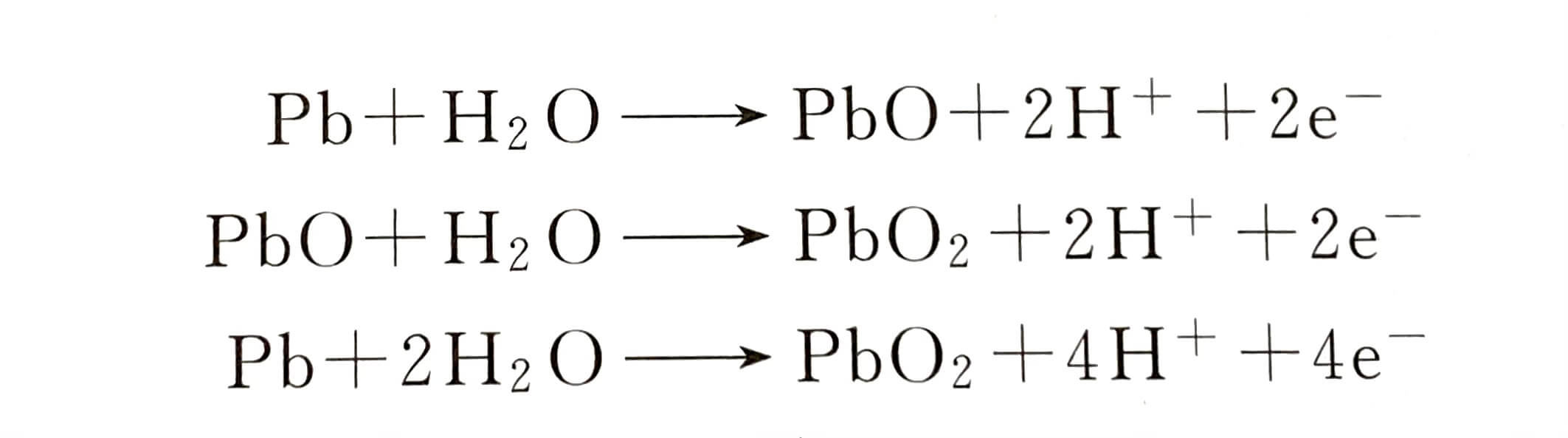
When the grid contains antimony, the following reactions occur simultaneously:

The above reaction will accelerate when the float voltage and temperature are too high, causing the corrosion rate of the positive grid to increase, and the battery will lose water due to the consumption of water by the corrosion reaction.
The phenomenon of positive grid corrosion
When the corrosion of the positive grid is not serious, and the electrical contact between the active material and the grid has not been affected, various characteristics of the battery such as voltage, capacity and internal resistance are not significantly abnormal. However, when the positive grid is corroded so seriously that the grid is partially broken, the battery will experience voltage drop, a sharp decrease in capacity, and an increase in internal resistance during discharge.
If the corrosion also occurs at the pole position to break it, the positive pole will generate heat during discharge.
Prevention of corrosion of positive grid
To slow down the corrosion rate of the positive grid, the following points should be done during use:
a. Do not overcharge frequently.
b. Do not use the battery in a high temperature environment.
c. Adjust the float voltage of the battery according to the ambient temperature. It is worth noting that when the temperature is too low, in order to ensure that the battery is in a charged state, it is necessary to increase the float voltage to a relatively high value, which also has the risk of causing grid corrosion. used in the environment.
Internal short circuit
Internal short circuit refers to the micro-short circuit inside the battery, that is, the phenomenon of local short circuit between the positive and negative electrodes.
The phenomenon of internal short circuit
After the lead-acid battery is short-circuited, the discharge phenomenon is basically the same as the discharge phenomenon during vulcanization, and the phenomenon during charging is different from that of the vulcanized battery.
The phenomenon during charging is: the voltage of the battery is significantly lower than the normal value during the constant current charging and the current limiting stage of the current limiting constant voltage charging; the temperature of the electrolyte is higher (usually higher than that of the vulcanized battery) and the rising speed is fast ; The density of the electrolyte rises very slowly, or even does not rise (in flooded batteries). Therefore, according to the phenomenon during charging, it is possible to distinguish whether the battery has a short-circuit failure or a vulcanization failure.
Causes of internal short circuit
The main reasons for the short circuit of the battery are: the separator is damaged or the plate is bent, causing the separator to be damaged, making the positive and negative.
The plates are connected and short-circuited; the active material has fallen off too much, and the deposits at the bottom are too high, causing the lower edges of the positive and negative plates to be in contact with each other.
Connected and short-circuited; other conductors fell between the positive and negative plates, making the positive and negative plates connected and short-circuited.
Elimination method of internal short circuit
The methods for dealing with short-circuit faults vary according to the specific cause. The specific methods are:
①If the separator is damaged, replace it with a new one;
②If the separator is damaged due to the bending of the polar plate, it can be handled according to the degree of bending: if the polar plate is slightly bent, replace the new separator; if the polar plate is severely bent, replace the polar plate or battery;
③ If the active substance falls off too much and the sediment at the bottom is too high, remove the fallen active substance;
④ When other conductors fall between the positive and negative plates, if it is a transparent container, a plastic stick can be inserted between the positive and negative plates from the injection hole to take out the short-circuit object; if it is an opaque container, you can use the 1h rate first. Discharge the current value to 1.8V, then remove the sealing glue, take out the pole plate and then take out the short-circuit object, and replace it with a new separator if necessary.
The above-mentioned treatment method is suitable for the ordinary lead-acid battery for starting, and now the lead-acid battery for starting is mostly valve-regulated sealed lead-acid battery. It is worth noting that short-circuit batteries are accompanied by vulcanization failures. After the short-circuit failures are eliminated, vulcanization treatment must be carried out.
Thermal runaway
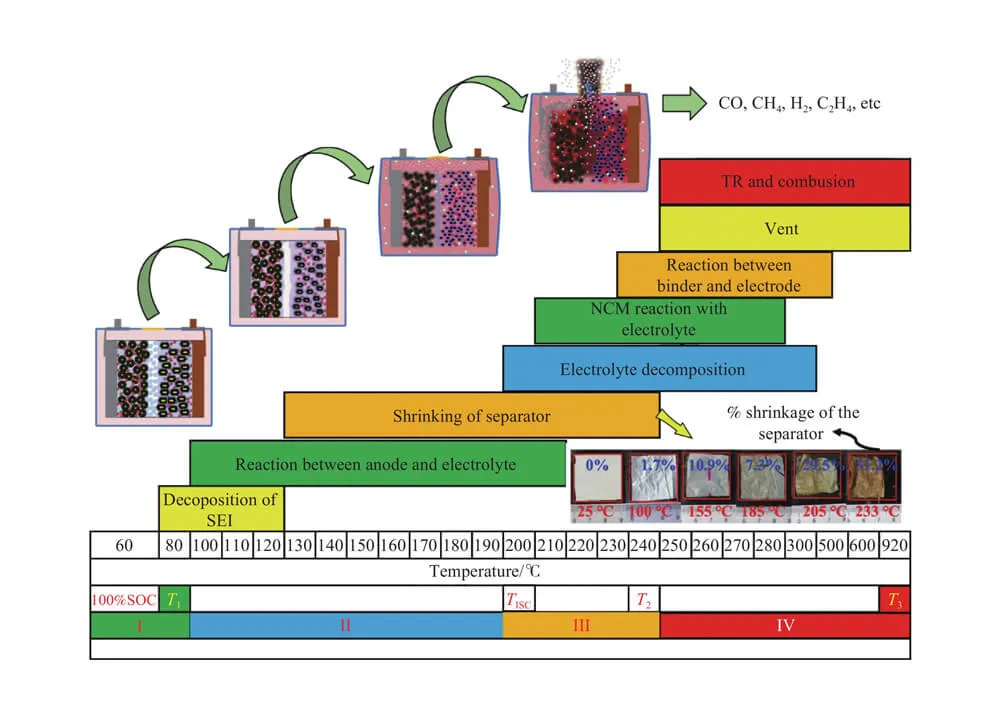
Thermal runaway refers to the phenomenon that the floating charge current of the battery and the temperature have a cumulative mutual increase during constant voltage charging, resulting in the battery being damaged due to excessive temperature.
The phenomenon of thermal runaway
When thermal runaway occurs, the battery temperature is too high. In severe cases, the battery will be deformed and the gas smelling of rotten eggs will be discharged, and there may even be an explosion.
Causes of thermal runaway
①The oxygen recombination reaction is exothermic. The oxygen recombination reaction of the oxygen produced by the positive electrode at the negative electrode is an exothermic reaction. If the heat released by the reaction cannot be released, the temperature of the battery will increase.
②The battery structure is not conducive to heat dissipation. The structural characteristics of valve-regulated sealed lead-acid batteries are sealing, lean electrolyte, and tight fitting of fine glass fiber diaphragms (insulation materials), which are not conducive to heat dissipation. That is, this battery is not like a flooded battery, which can dissipate the heat generated in the battery through exhaust, a large amount of electrolyte and a non-tight arrangement between the plates.
③The ambient temperature is high. The higher the ambient temperature, the less conducive to battery heat dissipation, and the increase in temperature will increase the float current of the battery, and the float current and temperature will increase each other. Therefore, the charging device should have a temperature compensation function, that is, when the temperature rises, the float voltage should be lowered.
④The float voltage is too high. If the float voltage is set too high, the float current will increase and the battery temperature will rise.
Prevention of thermal runaway
The main reasons for thermal runaway are as follows.
①Charging equipment adds temperature compensation and current limiting functions;
②Strictly control the quality of the safety valve and design a reasonable valve opening pressure to dissipate heat through the discharge of excess gas;
③ Install the batteries reasonably and leave an appropriate space between the batteries;
④Place the battery in a well-ventilated room and maintain a suitable indoor temperature.
Early capacity loss
The early capacity loss of the battery refers to the phenomenon that the capacity of the battery decreases in the early stage of service life due to the lack of certain elements in the positive grid or the improper use method.

The phenomenon of early capacity loss
①The negative electrode is normal but the capacity of the positive electrode decreases;
② There is no obvious corrosion of the positive grid or the liquid collector;
③ The positive active material does not soften or fall off;
④ After charging, the positive PbO2 content is normal (PbO2>85%)
⑤ The normal capacity can still be given during low rate discharge;
⑥ The capacity decay rate is fast (up to 5%/cycle, and the slower one is much higher than the traditional normal battery);
⑦ It is reversible, that is, the capacity can be recovered.
Reasons for early capacity loss
①The lack of certain elements in the positive grid. In order to reduce the self-discharge of VRLA batteries, antimony-free or low-antimony alloys (such as lead-calcium alloys) must be used as the material of the positive grid, resulting in early capacity loss of the battery. Caused by the lack of antimony in the alloy. Later, it was found that adding tin to the alloy, that is, using a lead-calcium-tin alloy, can reduce the early capacity loss of the battery. So the lack of certain elements (such as Sb or Sn) in the positive grid will cause early capacity loss.
② Improper use. The following poor use methods will cause early capacity loss of the battery: a. During the cycle of use, the initial charging current density is too low; b. The charging voltage is not high enough during float charging; c. Frequent deep overdischarge;
d. The charge capacity is often greater than 120% of the battery capacity and discharges continuously at a high rate.
Handling of early capacity loss
The capacity of a battery that suffers an early loss of capacity can be recovered. The specific method is: first increase the initial charging current to 0.3~0.5C, then use a small current to make up the charge, and finally store the fully charged battery under the environmental conditions of 40~60℃, and discharge it with a small current less than 0.05C to 0V. When the battery voltage reaches half of the nominal voltage, the discharge rate will be very slow. Repeat this several times to restore the battery capacity.
Corrosion of negative grid and busbar
Under normal circumstances, there is no corrosion problem on the negative grid and busbar of the battery, but in the valve-regulated sealed battery, when the oxygen recombination cycle occurs, the upper space of the battery is filled with oxygen, and when the electrolyte in the diaphragm climbs up the tabs When reaching the busbar, the alloy of the busbar will be gradually oxidized to form lead sulfate. If the busbar electrode alloy is not properly selected or the welding quality is not good, there will be impurities or gaps in the busbar, and the corrosion will deepen along these gaps, causing the tabs to disconnect from the busbar, and the valve-regulated sealed battery will be damaged due to corrosion of the negative plate. invalid.
Factors that cause lead acid battery failure modes
It can be seen from the above that various lead acid battery failure modes of VRLA batteries may be caused by various factors, including usage factors, structural factors, and the influence of other lead acid battery failure modes.
Usage factors
Various adverse usage factors such as high or low float voltage and current, high or low ambient temperature, high electrolyte density, overcharge, overdischarge, improper charging and maintenance methods, etc. will cause one or more In this failure mode, the float voltage is too low, the charging is not timely after discharge, the long-term charging is insufficient, the long-term discharge state, the electrolyte density is too high, the temperature is too high, the electrode plate is exposed, etc., will cause vulcanization.
If the temperature is too high or the float voltage is too high, it will cause water loss or thermal runaway. Because the temperature is too high, the water will evaporate. If the float voltage is too high, that is, the float current is too large, the oxygen recombination efficiency will decrease, and the battery will lose water. The phase increase of temperature and float current will cause thermal runaway.
Excessive temperature and long-term overcharging will lead to corrosion of the positive grid. During cycling, the initial charging current density is too low, the float voltage is too low, deep overdischarge, charging capacity greater than 120%, and continuous high-rate discharge are the causes of early charging. The main factor for capacity loss Overcharging can lead to the formation of lead dendrites on the negative plate of the battery, which can grow along the large pores in the separator perpendicular to the separator and eventually cause micro-shorting of the battery.
Structural factors
The structural features of VRLA batteries such as sealing, lean electrolyte, tight fit, ultra-fine glass fiber diaphragm and antimony-free gold grid may all be potential factors causing a certain lead acid battery failure modes. The sealed structure makes it impossible for the battery to add water to supplement the water loss caused by the evaporation of water and the reduction of oxygen recombination efficiency.
The exposed part gradually increases, and this part of the active material is vulcanized due to the lack of charging; sealing, poor electrolyte, tight assembly and ultra-fine glass fiber structure are not conducive to heat dissipation, and the oxygen composite cycle reaction is an exothermic reaction. When it is high, it is easy to lead to the occurrence of thermal runaway; while the ultra-fine glass fiber structure provides oxygen diffusion channels, it also promotes the growth of lead dendrites along the channel, and eventually leads to the internal short circuit of the battery.
Effects of other failure modes
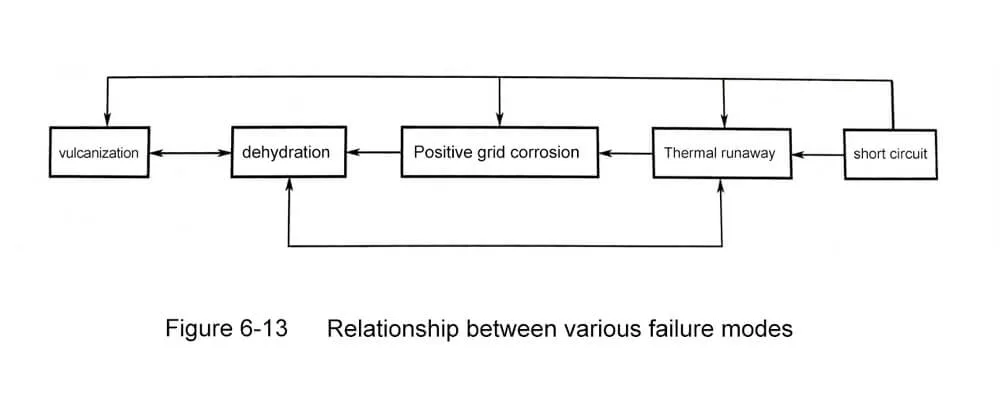
There is a very close relationship between variouslead acid battery failure modes of VRLA batteries. As long as one lead acid battery failure modes occurs, another or several lead acid battery failure modes may appear, as shown in Figure 6-13.



1 thought on “Why do lead acid batteries fail:lead acid battery failure modes”
Like this content!
Comments are closed.