Skip to content
- Voltage based fuel gauge
- Electricity monitoring based on coulomb count
- Learning before full discharge
- Compensated end of discharge voltage
- Electricity monitoring based on coulomb count
- Main parameter related to aging is impedance
- Advantages over a typical fuel gauge
- Battery management product power monitoring
- Question check
Voltage based fuel gauge
Advantages
– Learning without full discharge
– Self-discharge without correction
– Very accurate under small load current conditions
Disadvantages
– Poor accuracy due to internal battery impedance
– Impedance is a function of temperature, aging and state of charge
To sum up, the disadvantage of a voltage-based fuel gauge is its poor accuracy due to the internal impedance of the battery. There is a functional relationship between impedance, temperature, aging state and the capacity percentage of the battery. This functional relationship is quite complicated. Only professional battery personnel can find a relatively approximate functional relationship, but it is difficult to find an accurate functional relationship.
Therefore, this model is quite complicated, and it is difficult for ordinary electronic engineers or software engineers to write very precise relationships. Therefore, the calculation of capacity in software calculation is the most troublesome problem for engineers, so it also has some The advantage, the advantage is that it doesn’t need to be fully discharged to get what the current capacity of the battery is.
Because people who have done batteries know that a battery generally needs to be fully charged and discharged before it leaves the factory. Why charge and discharge it? This is to locate the current capacity of the battery, the full charge capacity of the battery, especially the full charge capacity of the battery, the full charge capacity of different batteries is different,
Of course, you can choose the design capacity of a battery, but the deviation between different batteries and the design capacity is still relatively large. To get this full charge capacity, you still need to do a complete charge and discharge. The requirements of the production process are relatively high, and a lot of direct costs must be added.
In addition, batteries have self-discharge characteristics. The battery is placed there. Even if the load does not work, the battery will discharge itself. After a long time, the power will become less and less, and the voltage will become lower and lower. Then the fuel gauge of voltage monitoring only needs to judge the capacity according to the voltage, so now Report as much capacity as there is voltage,
So you don’t need to care too much about the amount of self-discharge, so this kind of voltage-based fuel gauge can still achieve a certain accuracy if the current is small, but at present, various applications are more and more complex, and the current The changes are also increasing, so it is a bit difficult for voltage-based fuel gauges to meet customer requirements.
Electricity monitoring based on coulomb count
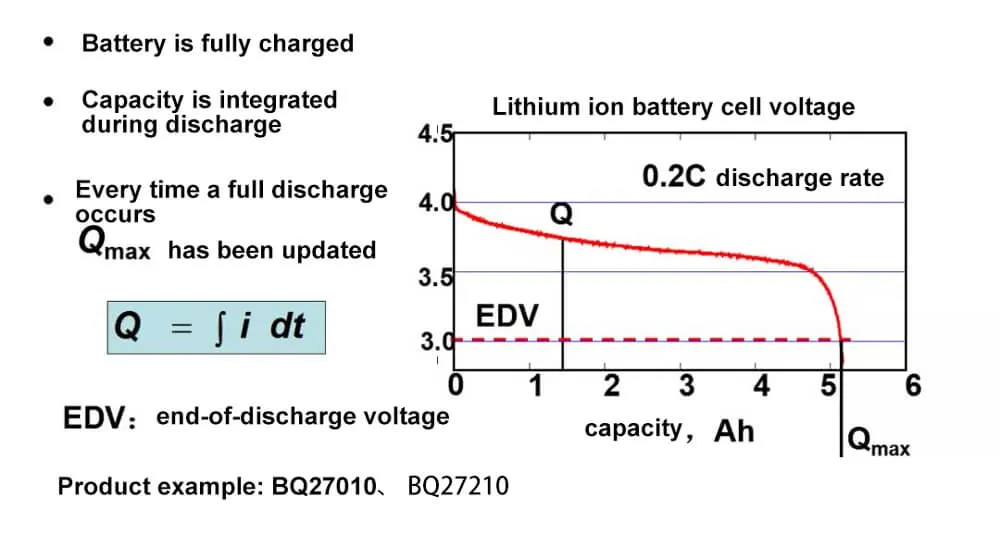
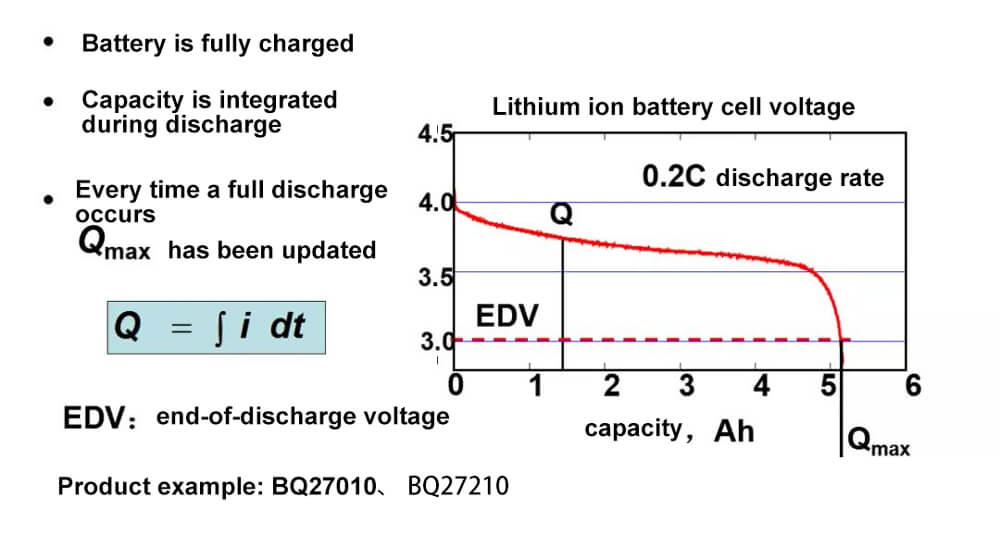
In addition to voltage-based fuel gauges, another fuel gauge is the coulomb-counting fuel gauge technology. The idea of this fuel gauge is to first charge a battery to full capacity, and then you can know the current capacity of the battery during the charging process, which is the full charge capacity of the battery.
Then during the discharge process, the discharge capacity of the battery is deducted from the existing capacity to get how much capacity is left in the battery. Its idea is actually an integral of the current over time to get how much capacity is released, so as to get how much capacity is left in the battery.
With this technology, there will be a record of the discharge capacity at the end of each discharge, and the recorded capacity will be used as the full charge capacity of the battery, so Qmax will be updated each time the discharge ends, that is, the chemical capacity and maximum capacity of the battery. capacity will be updated.
Learning before full discharge
This is the case in theory, but in practice, when updating the full charge capacity or chemical capacity of the battery, it is not necessary to completely empty the battery before updating. Because the update battery voltage is very low at this time, it is possible that the system will be shut down or something happens. At this time, it is too late. The usual update is to update when the battery capacity is about 7% left.
The idea of this update is to say that the capacity reaches 7%, which means that 93% of the capacity is released. If you integrate the capacity just released, the mAh number of the capacity will be released. Divide this mAh number by 93%. Get full capacity, which also achieves the effect of learning, so generally learning will not be put into 0%, but generally at 7%.
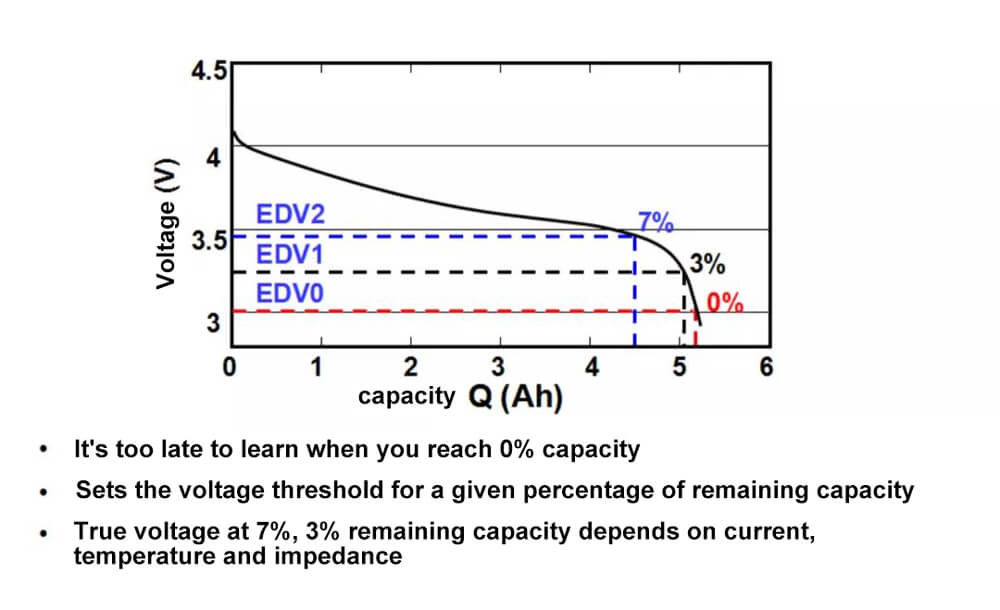
As for learning, what is learned is the full charge capacity of the battery. After the full charge capacity is obtained, the discharge current can be integrated to calculate the remaining capacity. Therefore, the power of the fully charged battery is also more important for the calculation of the power. As for the voltage corresponding to 7% and 3%, it depends on the current, temperature and impedance at that time.
Generally, when the current at room temperature is constant and the impedance difference of the same batch of batteries is not too large, this voltage can also be considered to be basically constant, because at 7%, the voltage deviation at this time will not cause the capacity deviation to be too large, so it can be used in Corrected at 7%.
Compensated end of discharge voltage
The point of 7% just mentioned is actually a given temperature, current or the same batch of batteries, the voltage of this point is basically fixed, but in fact its current cannot be a fixed current, in the process of use The medium current will always change constantly, so the voltage corresponding to 7% is also different, that is, the 7% corresponding to different currents is different.
In this curve, the discharge current is I1, and the voltage corresponding to I1 in this curve is represented by CEDV2, which is a function of I1. If the current changes, it is also corrected by 7% of the voltage. This The error is big. It can be seen from the CEDV curve that the voltage corresponding to 7% actually has 30% remaining capacity. If you synchronize or learn according to 7%, and correct the full charge capacity, there will be 23% capacity lost,
Therefore, a large error is caused at this time, so this algorithm needs to correct the voltage of 7% according to the current. The voltage of 7% is called CEDV2, and the function of the voltage at this point is found with the current. , different voltages are obtained at different currents. So in the case of current I2, we get CEDV2, in fact, its voltage ratio is a little lower,
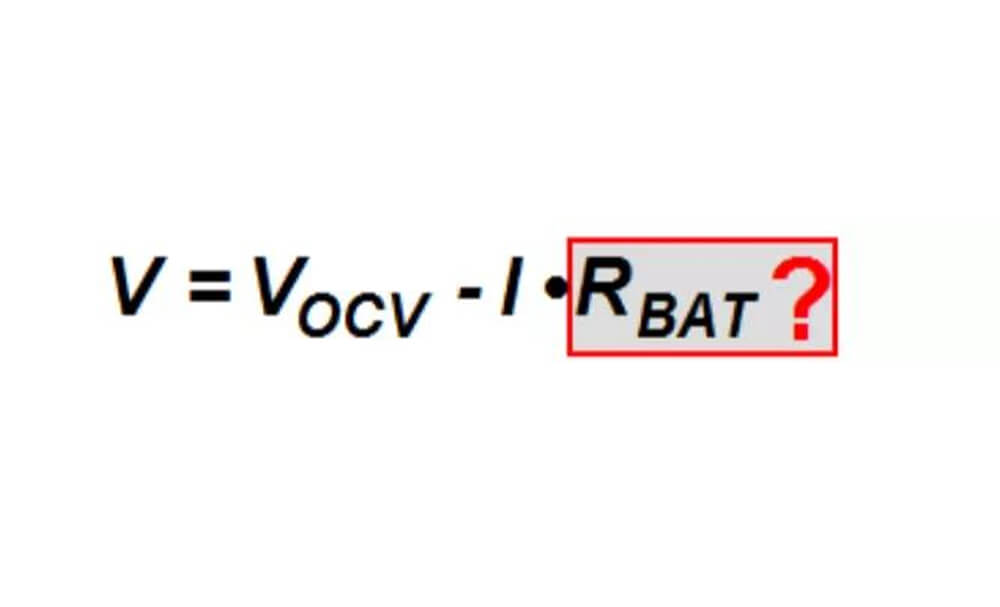
CEDV2(I2) is actually obtained based on complex calculations. Its formula is roughly as follows: CEDV=OCV(T,SOC)-I*R(T,SOC), C of CEDV is compensated, and EDV is terminated The discharge voltage, that is, the compensated termination discharge voltage is actually equal to the open circuit voltage of the battery minus the voltage drop due to the internal resistance.
The key is that in this formula, OCV(T, SOC) can find a function that matches the curve better, and this curve does not change much, but the latter curve is a function of T and SOC, and this curve is difficult to find. matching function, so the formula is quite complicated.
Due to the existence of differences in internal resistance, the accuracy of this formula is limited in the process of using it. It does not mean that this formula is universal in the entire discharge process. Usually when we use this formula to calculate, it is below 7%. Calculated with this formula, that is, a functional relationship such as R(T, SOC), which can be found in our datasheet, and the applicable range is only the range after 7% or 12%.
This is actually enough, because the correction finger needs to be corrected at about 7%, so it is not a big problem that its applicable range is small, so before 12%, Coulomb calculation is still used for integration, and the error caused by Coulomb calculation integration can be found in After 12%, it is compensated by voltage correction, which is the simple idea of CEDV algorithm.
This formula reflects the relationship between impedance, temperature and SOC. This relationship reflects the impedance of the battery. After the general parameters in this formula are determined, the relationship between impedance, temperature and capacity percentage is determined. In fact, As the battery life increases, the internal resistance will definitely change, but this formula does not actually reflect the difference between the battery’s internal resistance and the service life. This formula cannot reflect this difference.
Of course, our subsequent algorithms have been improved, and some linear compensation has been added. This can be done in our chips with CEDV, such as TI’s BQ3060, earlier BQ2084, and BQ2085, which are made by CEDV algorithm.
Electricity monitoring based on coulomb count
Advantages
– Not affected by voltage measurement distortion
– Accuracy is determined by current integration hardware
– Monitoring error: 3-10% (depending on working conditions and usage)
Disadvantages
– A learning cycle is required to update Qmax
– Battery capacity decreases with age
– Qmax less range: 3-5% (100 charges)
– Without learning, the monitoring error will increase by 1% for every 10 charges
– Self-discharge must be modeled: inaccurate
Main parameter related to aging is impedance
What are the advantages of coulomb counting-based electricity monitoring?
Because it mainly calculates the power based on the current integration, the distortion of the voltage measurement has less influence on it, and the accuracy of the current is determined by the hardware of the circuit integration. If you control the parameters of the CEDV algorithm relatively Well, the error can be controlled at 3% or even lower. If the parameters match the actual battery model, it may be larger, and the overall error may be around 3~10%, depending on the working conditions and usage.
Its disadvantage is what I just said, because it uses coulomb counting, that is to say, how much electricity is charged and how much electricity is released for capacity calculation. The premise is that it needs to know the full charge capacity of the battery before it can calculate the remaining capacity in the battery. how much capacity.
This full charge capacity generally needs to be updated before leaving the factory, because the deviation between the full charge capacity and the remaining capacity of the battery is still relatively large, and the remaining capacity of the battery cannot be directly used as the full charge capacity, so the battery must be made before leaving the factory. The full charge capacity of the battery is obtained through the cycle of charge and discharge cycles, and the full charge capacity is obtained according to the cycle by the fuel gauge itself, but the cycle needs to be equipped with special tools on the production line, so this is time-consuming.
In addition, the capacity of the battery will also decrease with the increase of the service life. Of course, the decrease is not as significant as the impedance, but there will be a 3~5% decrease after 100 charges and discharges. This decrease must be compensated for. ,why? Because in the case of actual use, not every discharge can be learned, because our electrical equipment is taken out (mobile phone or laptop) to discharge,
It may not always be empty from full charge, or below 7% to allow you to update the full charge capacity. Generally, it may be discharged to half, or the adapter will be plugged in immediately after a little discharge. In this case, the discharge is very shallow, and it does not necessarily have the opportunity to update the full charge capacity. If there is no update, the error of every 10 times of charging will increase by 1%. In this way, the error of Qmax will become more and more if it is not updated.
Therefore, in the actual use process, if you use an old-fashioned electricity meter, if you have such experience, you may have to fully charge and fully discharge the laptop once a month, and let it constantly update the Qmax parameters inside. relatively accurate.
Another is to estimate the self-discharge of the battery, which is inaccurate, because like the voltage-based power monitoring technology just mentioned, how much power the battery has, it judges the voltage and then checks how much is left. As for the battery It doesn’t care how much electricity is put inside.
If it is a coulomb counter, it mainly judges the capacity not according to the voltage, it judges the capacity according to the charge and discharge of the current, the charge and discharge inside the battery, the monitoring chip of the coulomb counter cannot monitor this current, because the coulomb counter The meter is connected to the outside of the battery, and it can only monitor the current flowing in and out of the battery, but it cannot measure the current consumed inside the battery.
Therefore, it can only be estimated by a simple model, so the result is not very accurate. After the service life is delayed, the error will also increase, so there is a relatively large factor in the battery. Aging, the coulomb counter is more limited in dealing with aging, and it is affected by aging. One is that the capacity will decrease with the increase of aging.
Another battery impedance will increase after aging. As mentioned earlier, when the impedance of the battery increases, the CEDV calculation error of the battery will also increase, because in this formula, the impedance is only related to the temperature and the capacity percentage, and the estimation of the capacity is added, which is actually a linear estimate.
there is still a certain difference with the actual battery, so the error will become larger and larger in terms of the contribution of the impedance to the capacity caused by the increase of the battery age.
Therefore, the CEDV algorithm considers the correction of the battery impedance to the voltage, but it does not consider the factor of the battery impedance changing with time, or it is relatively simple to consider. Therefore, the traditional power monitoring method can use the voltage monitoring method to obtain a more accurate capacity when there is no load, and can obtain the capacity by coulomb counting when there is a load, so these two methods are complementary. In fact, the chips available in the market basically use the combination of these two methods.
Advantages over a typical fuel gauge

Battery management product power monitoring
The chip BQ3060 combines the two technologies of voltage monitoring and coulomb counting.
Question check
Therefore, whether it is a voltage-based fuel gauge or a current-integration-based fuel gauge, the impedance that has a greater impact on the capacity calculation is the impedance, and the impact on aging in this impedance is based on a simple linear model. , or in other words, there is no aging effect of this part in the early stage, so because the model it is based on is relatively simple.
Therefore, the matching success with the battery is actually relatively poor, that is to say, the error caused will become more and more obvious with the extension of time and years. Therefore, one of the factors that has the greatest impact on the calculation of battery power is actually the impedance of the battery. Get the impedance of the battery, then the capacity of our battery can be calculated more accurately.