Skip to content
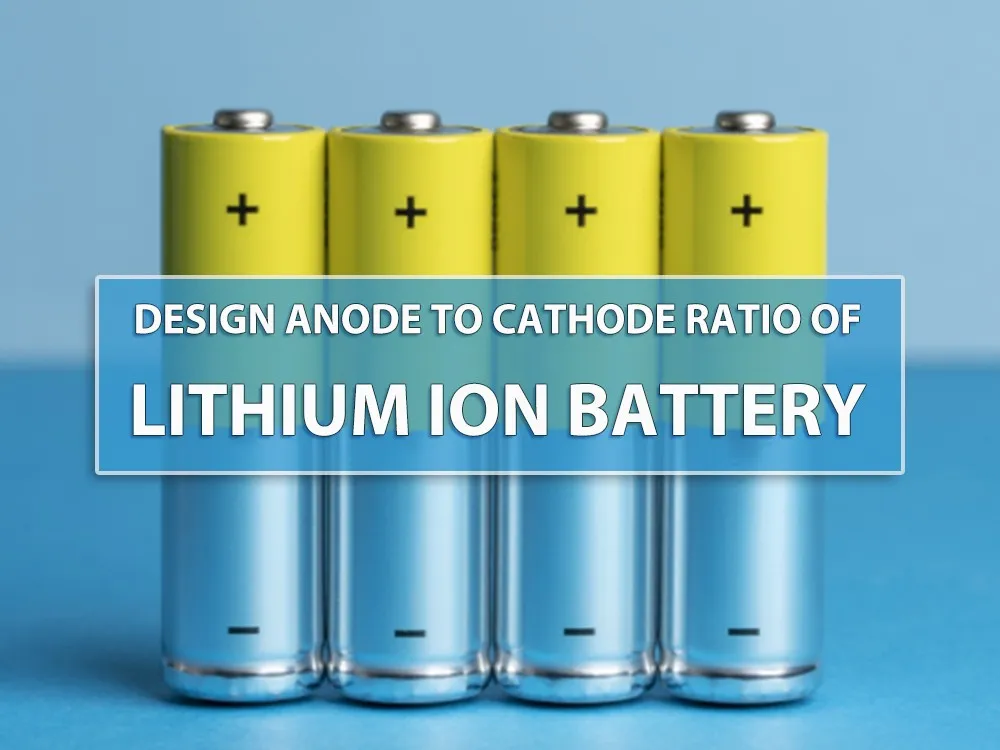


The design table is probably composed of three major equations: capacity equation, volume equation, and anode to cathode ratio (N/P ratio) equation. Where capacity and volume are defined by the customer or defined by the process.
Definition of anode to cathode ratio
N/P ratio is the margin that the capacity of the anode on the opposite side exceeds the capacity of the cathode at the same stage and under the same conditions. In fact, there is another way of saying it is called CB (cell Balance).
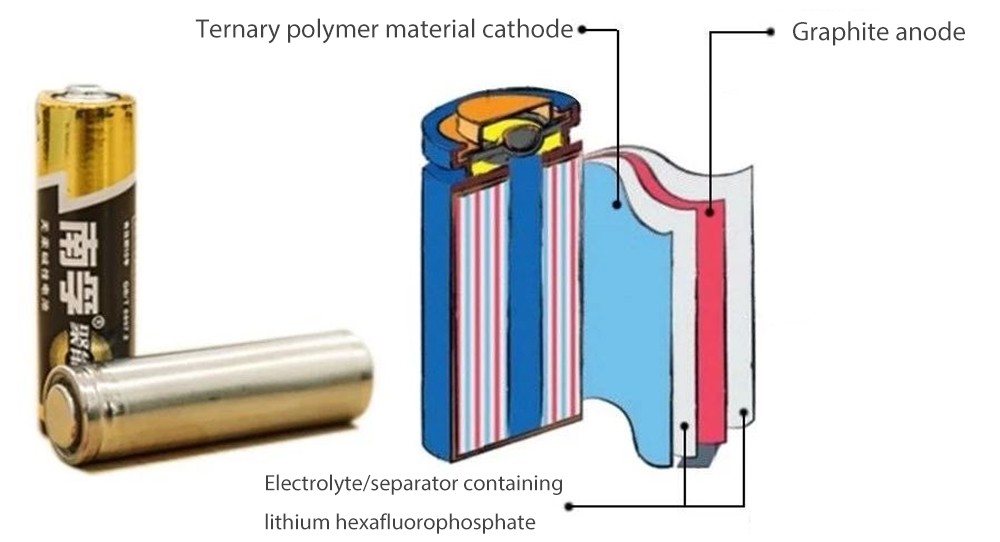
N/P calculation formula:
Anode to cathode ratio =gram capacity of anode active material*anode surface density*anode active material content ratio/(cathode active material gram capacity*cathode surface density*cathode active material content ratio).
The same stage: There are two stages of charging and discharging of lithium batteries, corresponding to different gram capacities, one is the first charging stage, and the other is the discharging stage, corresponding to (first) charging anode to cathode ratio and discharging anode to cathode ratio respectively.
Lithium battery materials have the first effect, which is the first (coulomb) efficiency, that is, the ratio of the first charge and discharge capacity. During the first charging process, an SEI film is formed on the surface of the material, the defect position of the material is reacted, and the impurities in the material are also reacted, etc., resulting in the first charge capacity > first discharge capacity > discharge capacity after aging.
Although after aging and subsequent charge and discharge cycles, the discharge capacity still decays, but a large number of reactions have been completed in the early stage. There is a difference in the gram capacity of the two stages, one is the gram capacity of the first charge, and the other is the gram capacity multiplied by the first effect. If they are mixed, the design will fail.
Same condition: The same condition is also related to the calculation of gram capacity. This condition refers to the same test conditions, such as temperature, rate, voltage range, etc. If the conditions of positive and anode gram capacity tests are different, using the same formula will also lead to design failure.
Directly facing: We need to use the area density calculation, which is the meaning of facing directly. But what if there is a curved deformation in the shape of the pole piece? That is, when the outer ring shrinks and the inner ring stretches, the curvature must be used to correct the value of the surface density, which is why the cylindrical battery has a positive and negative surface during the coating process.
Design anode to cathode ratio considerations
Design factors
● The first effect: it is necessary to consider all reactive substances, including conductive agents, adhesives, current collectors, separators, and electrolytes. However, the gram capacity data obtained from material suppliers often only examines the half-electric gram capacity of the active material, which is why there is a difference between the actual full battery gram capacity and the design gram capacity. For related electrolyte material information, please refer to top 10 lithium ion battery electrolyte company.
● Assembly process: There are differences in the anode to cathode ratio design of cylindrical batteries and square batteries, mainly caused by the tightness of the contact between the positive and anodes. The combination of powder and current collector is also considered as assembly, the direct contact between powder and current collector, and the contact between powders are also one of the factors that affect the gram capacity, thereby affecting the anode to cathode ratio.
● Formation process: Different formation processes also have an impact on the anode to cathode ratio. The formation process also affects the first effect, and then affects the gram capacity. Therefore, when designing the anode to cathode ratio, the formation process should also be discussed. The impact of the specific formation process will be explained in subsequent articles.
Performance factor
● Cycle: cycle life is one of the most important indicators to measure battery performance.
If the cathode decays quickly, then the anode to cathode ratio is lower than the design, so that the cathode is in a shallow charge and discharge state. On the contrary, if the anode decays quickly, then the anode to cathode ratio is higher, so that the anode is in a shallow charge and discharge state.
● Security: Security is a more important indicator than circulation. Not only does it have an impact on the safety performance of the finished product, but some pre-charged batteries have lithium-degrading and heating cells. We need to review whether there are design problems.

Effect of anode to cathode ratio on lithium batteries
Usually, if the anode to cathode ratio is too large, it means that the anode is excessively large, which will cause shallow charge and discharge of the anode and deep charge and discharge of the cathode (and vice versa, of course, this is only a very general statement).
The fully charged anode is not easy to decompose lithium (some materials, such as soft and hard carbon, and LTO materials will not decompose lithium), which is safer, but the increase in the oxidation state of the cathode increases the safety hazard.
Since the first effect of the anode remains unchanged, more parts need to be reacted. At the same time, due to the influence of kinetics, the gram capacity of the cathode will be lower. However, when the N/P is insufficient to a certain extent, the cathode cannot be fully utilized, which will also affect the performance of the gram capacity. In summary, it is very important to find an appropriate anode to cathode ratio.
The N/P of graphite anode batteries should be greater than 1.0, generally 1.04~1.20. This is mainly for safety design, mainly to prevent lithium deposition at the anode, and process capabilities, such as coating deviation, should be considered during design. However, when the N/P is too large, the irreversible capacity loss of the battery will result in a low battery capacity and a decrease in battery energy density.

For the lithium titanate anode, an excess cathode design is adopted, and the battery capacity is determined by the capacity of the lithium titanate anode. Excessive cathode design is conducive to improving the high-temperature performance of the battery: the high-temperature gas mainly comes from the anode. When the cathode is excessively designed, the potential of the anode is lower, and it is easier to form an SEI film on the surface of lithium titanate.
How to determine the anode to cathode ratio when designing the battery for the first time? After calculating the theoretical value, a gradient experiment is carried out, followed by low-temperature discharge, gram capacity development, cycle life, safety tests, etc. for evaluation.
Effect of anode to cathode ratio on cathode
If the anode to cathode ratio is too high, the oxidation state of the cathode material will increase. In addition to causing safety problems, what hidden dangers will the oxidation state increase? Here only ternary/graphite material is taken as an example. For batteries with excessive anode to cathode ratio, conduct hot box (130°C/150°C) or high-temperature storage experiments in a fully charged state, disassemble the batteries, it is common to find that the cathode powder has detached from the foil and the separator is yellowed.

First clarify two concepts:
Concept 1: First of all, it is necessary to clarify the different positions of the pole piece, even if the response of different positions of the particles is uneven, which involves a problem of potential difference in the direction of the thickness of the pole piece.
Concept 2: Ni3+/4+ and Co3+/4+ have energy band overlap with O, and O will escape from the lattice in the form of free radicals, which is extremely oxidizing.
The yellowing of the diaphragm is caused by oxidation, and the mechanism is very clear. It has been reported in the literature that adding PS and other easily oxidizable protective additives to the electrolyte can alleviate the oxidation of the diaphragm.
According to relevant literature reports, in the anode MCMB material, since the interface potential between the anode powder and the current collector is the most negative, lithium salt deposition first occurs at the contact position between the anode powder and the current collector.
In the cross-sectional SEM image of the MCMB material, it is clearly observed that there is lithium salt deposition at the contact interface between the anode material and the current collector, but graphite-based materials are not observed. However, there are few literatures on the cathode SEI film. Since the contact position between the cathode powder and the current collector is at a high potential and has high oxidation,
It is assumed here that a layer of lithium salt deposits on the cathode will be formed (the reaction is accelerated at high temperature), which hinders the contact between the cathode powder and the current collector, resulting in the peeling between the cathode powder and the current collector.
Specific characterization experiments were not carried out, which is also the point of controversy in this paper. The cathode peeling increases the internal resistance and directly leads to the failure of cycling under high temperature service conditions.
Effect of anode to cathode ratio on anode
The excess Li released will provide a Li source for the deposition of lithium salt on the surface of the anode, and the continuous deposition of lithium salt leads to the failure of the cycle. Therefore, the anode to cathode ratio is too low will cause the increase of this risk.
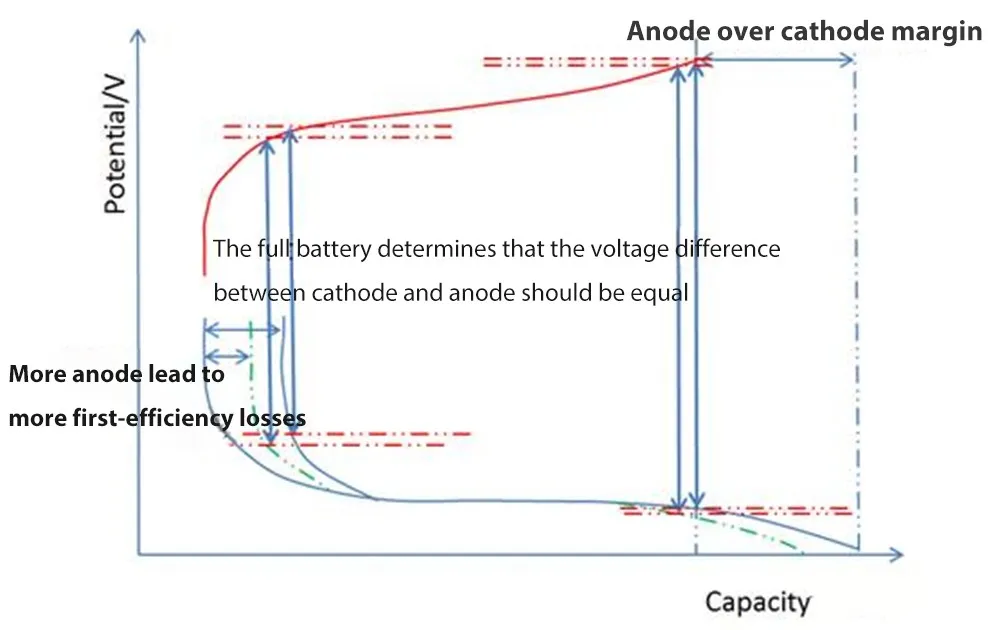
But what happens if the anode to cathode ratio is too high? The same cathode is used here, and the anode to cathode ratio is different by adjusting the amount of anode. At the end of the discharge, the voltage of the positive and anodes with a low anode to cathode ratio is low, the cathode is deeply discharged, and the anode is shallowly discharged. At the end of charging, the positive and negative voltages of the same low anode to cathode ratio are low, the negative pole is deeply charged, and the positive pole is shallowly charged.

It should be noted:
1. A potential curve in the figure represents the two processes of charging and discharging, which can be considered as the potential of the equilibrium state.
2. The capacity attenuation caused by the first effect of the cathode is ignored here. Even after the first effect loss, the anodes with different anode to cathode ratios correspond to the same cathode curve. It is considered here that the loss of the first effect of the cathode is only caused at the beginning of charging, and the film formation caused by oxidation at the end of charging is ignored here. The actual situation is that only as the cycle progresses, the oxidation and film formation will affect the capacity.
3. The ratio of the first effect of the anode is considered to have nothing to do with the anode to cathode ratio, and it is a constant. If there are many anodes, the capacity lost through the first effect is also large. The stage where this reaction occurs is also at the beginning of charging.
4. Positive and negative potentials are free, the only limitation is the voltage of the full battery, that is, the blue vertical double arrows. The two double arrows at the discharge end and the charge end are of equal length, respectively.
5. The two red dotted lines are potential differences, which respectively show the depth of charge and discharge of the corresponding electrodes. Since the proportion of the anode in the first effect reaction is the same, and the total amount of the anode is different, the charge-discharge curve of the anode with more anodes and the anode with very few anodes corresponds to the same cathode charge-discharge curve, resulting in a phase difference.
Since the potential of the cathode gradually decreases with the increase of lithium intercalation (discharge process), during the process of anode de-Li/anode voltage rise, the use position of the positive discharge curve corresponding to the end of the negative discharge curve with more anodes and the anode with less anode is different, and the cathode voltage corresponding to the anode discharge end with less anode is lower.
In order to achieve the same full battery voltage, the voltage of the anode with few negative poles rises lower, which avoids the excessive de-litting of the anode. Excessive removal of Li from the anode will cause damage to and reform of the SEI film, which will lead to cycle failure. This analysis method can also be applied to the end of charging, and it can be concluded that when the cathode is excessive, the cathode is in shallow charge and the anode is in deep charge.
Final thought:
A battery with a small anode to cathode ratio, that is to say, for batteries with too much negative electrode and insufficient negative electrode, the positive electrode can reach the state of shallow charge and deep discharge during the cycle, and the state of the negative electrode is deep charge and shallow discharge, and vice versa.