Skip to content


Anode material subdivision product structure
According to product structure, anode materials can be mainly divided into natural graphite, artificial graphite and new anode materials represented by silicon-based anodes. Although natural graphite has advantages such as cost and specific capacity, artificial graphite has better performance in cycle performance, safety performance, and charge-discharge rate. Therefore, the current anode material market is mainly dominated by artificial graphite anode materials.

Subdivision product structure of anode materials
Anode material shipments and forecasts
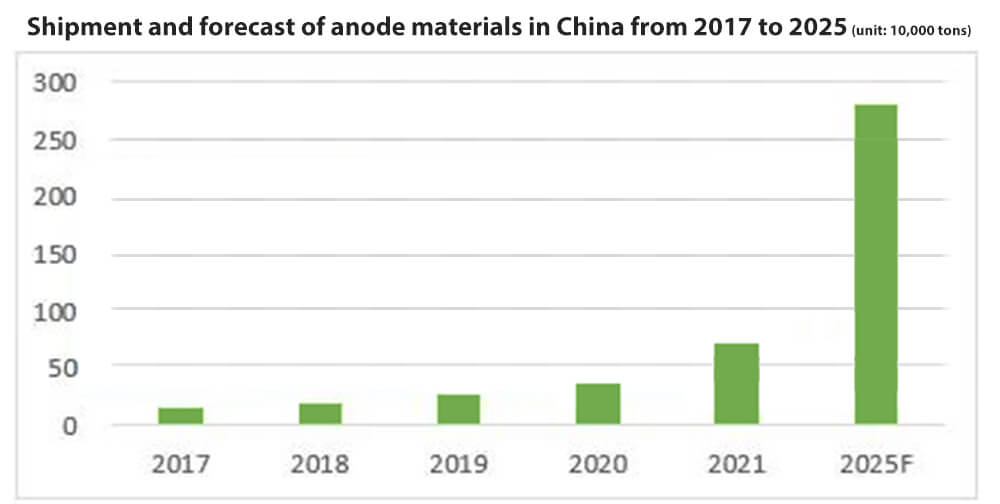
China’s anode material market as a whole is growing rapidly, driven by the strong demand for power batteries and the heating up of segmented application scenarios such as energy storage powerwall battery and small power motorcycle battery. In 2021, China’s anode material market shipments will be 720,000 tons, nearly doubling year-on-year. It is predicted that by 2025, the shipment of anode materials in China will reach 2.8 million tons, and the market growth space is huge.
Regional distribution of anode material production capacity
From the perspective of regional distribution of production capacity, the existing production capacity of anode materials is mainly concentrated in East China, South China, North China and Southwest China. Among them, East China occupies more than 1/3 of China’s anode material production capacity, mainly from the contribution of Fujian Province and Jiangxi Province. The existing production capacity of both places is above 100,000 tons;
Followed by Zhejiang Province and Jiangsu Province, the existing production capacity is more than 50,000 tons. The existing production capacity of anode materials in South China is mainly the production capacity layout of companies such as top 10 anode material manufacturers BTR and Kaijin Energy in Guangdong Province, with a total production capacity of over 200,000 tons.
The production capacity in North China is mainly distributed in Inner Mongolia Autonomous Region and Shanxi Province. Thanks to the advantages of electricity prices and upstream raw materials, North China will be one of the main areas for anode material companies to expand production in the future.
Although the existing production capacity in the southwest region is not high, thanks to the development of the power battery industry and the advantages of green electricity, when the planned production capacity of the existing enterprises is fully realized, it is expected to rise to the first place in the region. The existing production capacity in Central China, Northeast China and Northwest China is relatively low. Benefiting from the advantages of electricity prices in Northwest China, the production capacity of anode materials in the region is expected to be improved to a certain extent in the future.
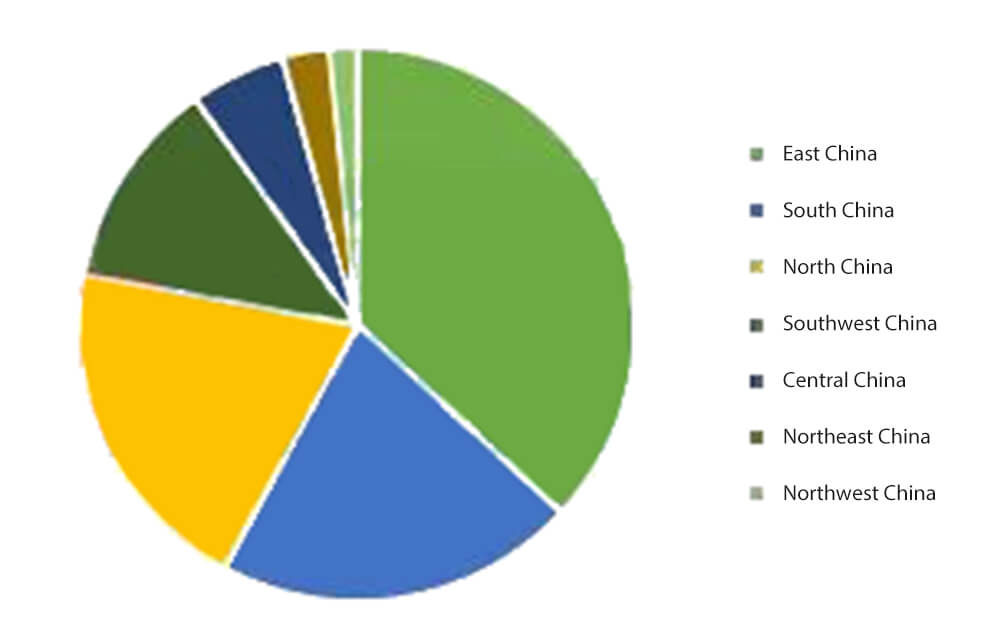
Regional distribution of existing production capacity of anode materials
Note: East China does not include Taiwan Province, the same below
The specific province distribution of anode material production capacity
From the perspective of the specific provincial distribution of anode material production capacity, the largest province at present is Guangdong Province in South China. Guangdong Province is one of the earliest regions in China to develop lithium-ion batteries, where a number of material companies gather and develop. The existing anode material production capacity in Guangdong Province mainly comes from Betray, Kaijin Energy, Xiangfenghua, Shenzhen Xinmao, etc.
Followed by Fujian Province and Jiangxi Province in East China. Thanks to the scale of power battery production capacity in East China, there are a number of power battery supporting enterprises in the region. Among them, the current production capacity of anode materials in Fujian Province is about 139,000 tons, mainly from the production capacity layout of Shanshan, Xiangfenghua, Shenzhen Snow and other enterprises. The current production capacity of anode materials in Jiangxi Province is 120,000 tons, mainly from the production capacity contribution of Jiangxi Zichen, Jiangxi Zhengtuo and other enterprises.
Inner Mongolia Autonomous Region and Shanxi Province in North China are also one of the most important investment/expansion areas for anode material companies. From the perspective of the preparation process of artificial graphite, the process can be roughly divided into four steps: pretreatment, granulation, graphitization, and screening and packaging. Among them, graphitization is the key core link in the preparation of artificial graphite, and it is also a high energy consumption link.
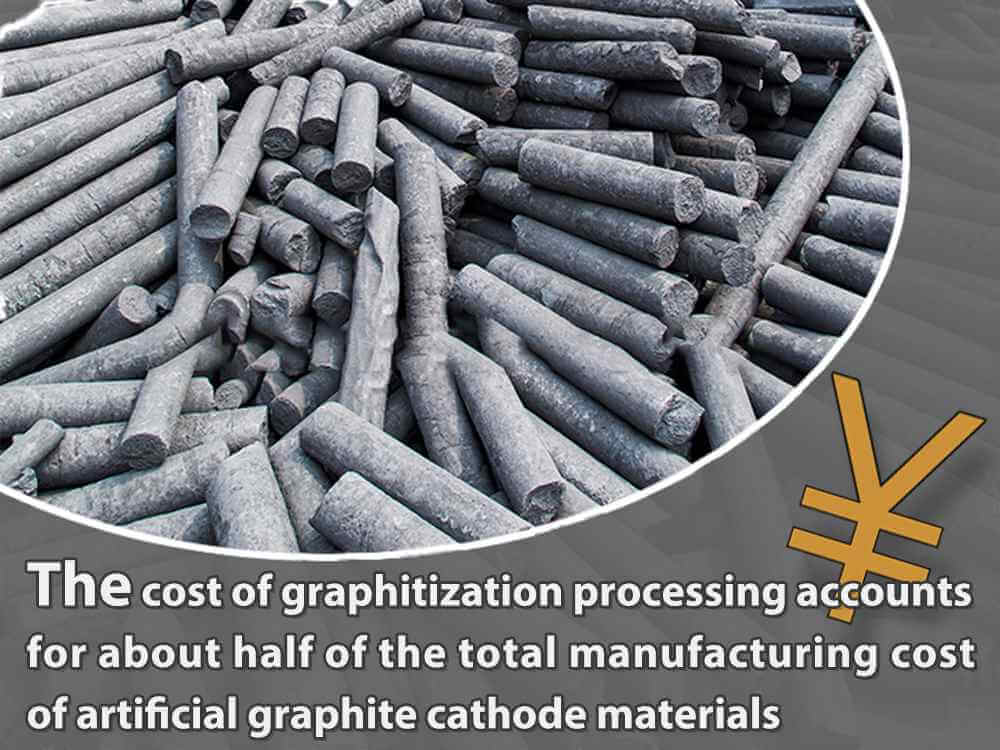
The graphitization processing cost accounts for about half of the total manufacturing cost of artificial graphite anode materials, and the electricity price accounts for more than 60% of the graphitization cost. Therefore, Inner Mongolia Autonomous Region and Shanxi Province in North China have become important gathering places for graphitization production capacity in China by virtue of relatively low electricity price, labor cost, land location, raw materials and other factors.
The existing production capacity of graphitization in the two places accounts for more than half of China’s total production capacity, attracting a large number of enterprises to land one after another, including Shanshan, Jiangxi Zichen, Shenzhen Snow, Xinyuan Graphite, Shangtai Technology, Hengke New Materials, etc.
Conclusion
In the future, the southwest region with advantages in green power resources is expected to become the main agglomeration area for anode material production capacity. The existing production capacity of anode materials in the southwest region is about 135,000 tons, mainly from the production capacity of enterprises such as Zhongke Xingcheng, Beterui, and Sichuan Jintai.
Benefiting from the development of the power battery industry and the advantages of hydropower in the southwest, various enterprises have deployed in the southwest. Among them, the planned production capacity of anode materials in Sichuan, Yunnan and Guizhou will reach 1.5 million tons, 1.1 million tons and 900,000 tons respectively. The total amount far exceeds that of other regions, and it has become a place for investment/expansion of anode material enterprises.
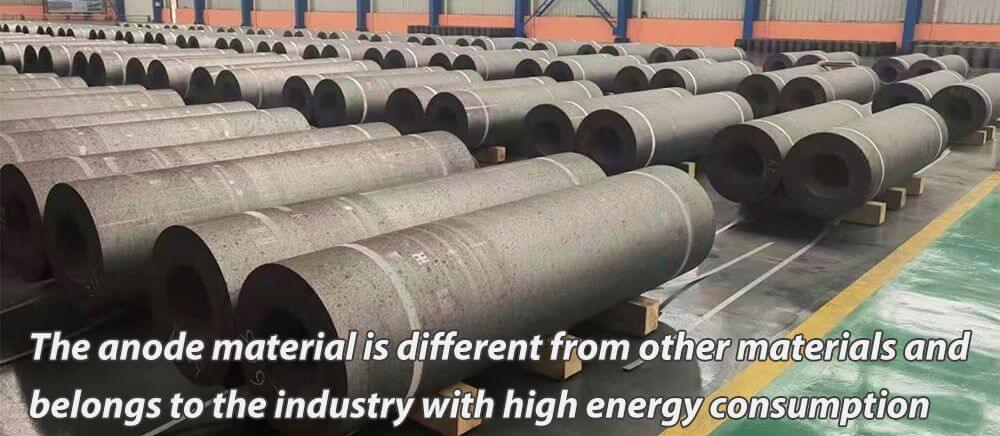
Anode materials are different from other materials in that they belong to high energy consumption industries. Due to the influence of the “double limit” policy, all parts of China have strict restrictions on projects with high energy consumption. Large companies have entered the market one after another.
Including upstream raw materials or related enterprises of anode materials, photovoltaic, construction machinery, ceramics and other fields, the existing planned production capacity is large enough, and the trend of structural excess capacity will become increasingly prominent in the future.