Skip to content
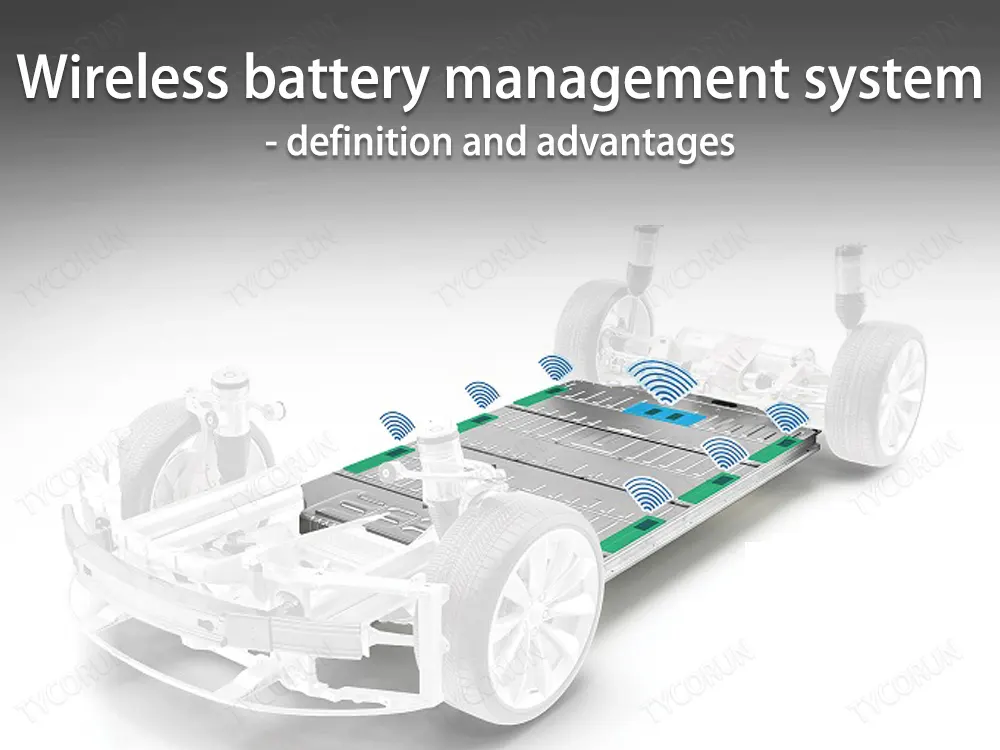

This technology is especially useful in applications where batteries are difficult to access or located in hazardous environments. With a WBMS, batteries can be monitored and managed more effectively, resulting in longer battery life, lower maintenance costs, and improved safety.
Wireless battery management system vs traditional BMS
Compared with traditional wired BMS, wireless BMS can monitor each cell in the battery pack. Traditional wired BMS cannot monitor each battery cell, and can only infer the health status of the battery by checking the overall state of charge of the battery. There is also no way to accurately locate a detected low or dead battery.
In a wireless BMS, by contrast, an array of battery cells transmits a wireless signal that sends secure data to the cloud where it is safely stored.
Using a laptop, a technician or local mechanic can drill down to view a wealth of information, including the state of charge and state of health of each paralleled cell in the battery pack.
OEM lithium battery manufacturers can easily and quickly upgrade battery software from the headquarters. A wBMS provides engineers with flexibility and cloud-grade cybersecurity without adding complexity.
Advantages of wireless battery management system
The advantages of a wireless BMS are many. The following is a detailed introduction:
● Economical and practical
A wireless BMS reduces the overall cost of the system because there is no need for complex wiring and connectors, which can also be a source of failure. As a result, maintenance and repair costs are also significantly reduced.
● Flexibility
Wireless BMS has flexibility in terms of installation and placement. No complicated wiring, easy to install and maintain.
In addition, wireless BMS is more scalable and available in various form factors, and can adopt different numbers of battery modules to meet different electric vehicle needs, all of which can be realized with the same BMS solution.
● Real time monitoring
Wireless BMS can monitor the status and performance of the battery in real time, providing more accurate and reliable data. This is because the wireless chip can also integrate MCU functions.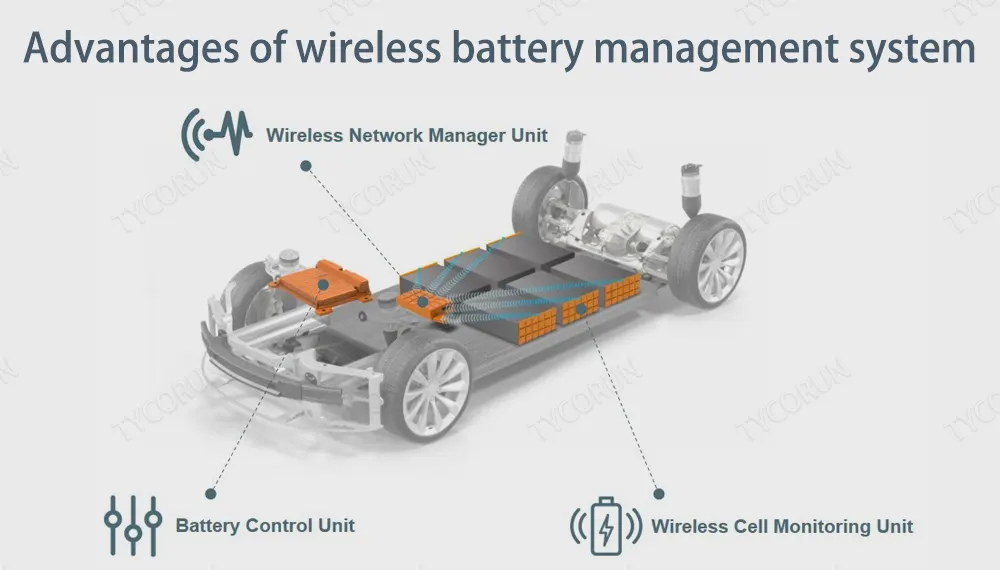
As a result, much of the data processing can be “offloaded to the edge,” offloading the central processor and reducing latency.
● Improve security
Wireless BMS increase safety by reducing the risk of wiring problems such as short circuits and ground faults. Reduced latency in data processing and diagnostics also contributes to improved security.
● Longer range
Elimination of wiring and connectors significantly reduces the size and weight of the BMS. The reduced weight will extend the range of the battery. The smaller size frees up more space for other items in the car, or allows for the addition of more battery modules, which also help extend battery life.
Ultium wireless battery management system
The Ultium wireless BMS is a prime example.
The Ultium wireless battery management system, specially designed for the module design of BEV3, cuts 90% of the wiring harness in the battery pack, reduces the weight of the battery pack, improves energy density, and reduces system complexity.
This wireless BMS embeds radio frequency chips inside each module monitor and BMS controller to form a wireless network called SmartMesh to connect and transmit data between each module monitor and BMS controller.
Ultium wireless BMS adopts 2.4GHz wireless transmission frequency band, applies SmartMesh network architecture, and adopts adaptive random frequency hopping technology.
When the system recognizes that there is interference in the current communication frequency band, the wireless master node chip in the wireless BMS will judge the communication frequency band in the next time window, and notify the slave node chip after the judgment is completed, and the slave node chip can automatically switch to the undisturbed frequency band at the same time to avoid interference.
The SmartMesh network architecture uses a time-synchronized channel hopping link layer for communication, and has redundant paths to overcome communication interruptions caused by interference, physical occlusion, or multipath fading. When an exception occurs, it communicates with the module next to it.
With the increasing popularity of electric vehicles, wireless BMS will play a key role in ensuring the performance and safety of electric vehicle batteries. The wireless battery management system is an important direction for the research and development of top 10 battery management system suppliers in the future.
Future wireless battery management system
Many new technologies for wireless battery management systems are under development.
The RF communication module will be developed using high-precision, high-density, multi-layer board technology. This would allow four-layer boards to have dozens of wireless communication components densely integrated on board.
The result will be an efficient and effective system capable of providing real-time monitoring and management of batteries without the need for physical connections.
One of the key features of a future wireless battery management system is its compatibility with all types of communication chips.
This will enable wireless BMS to be easily applied to all electric vehicles produced. This compatibility will become critical as the industry continues to grow and evolve and new technologies emerge.
Another important future development for wireless battery management systems is the use of adaptive random frequency hopping.
The technology will allow the system to automatically switch to an undisturbed frequency band when it recognizes interference in the current communication frequency band. This will help avoid interference and ensure the system remains reliable and efficient.
Overall, these systems will become more efficient, reliable and effective with the further development of new technologies such as radio frequency communication modules and adaptive random frequency hopping technology.