Skip to content
20v Lithium Ion Battery vs 18v Explained: Voltage, Applications, and Buying Guide
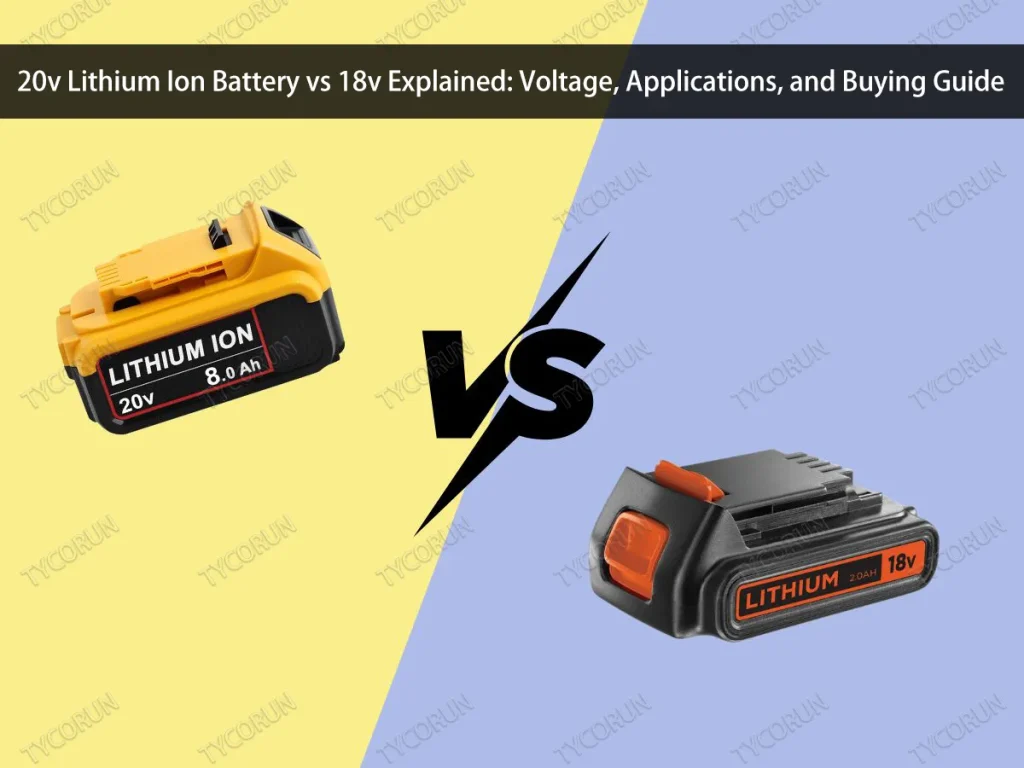
20V lithium ion battery VS 18V battery is a topic that has come up if you use power tools often. Although the two appear to be comparable at first glance, many people are still perplexed. Is it merely a question of statistics, or is there a true difference?
The problem is that battery voltage significantly affects the tool’s performance, including its power, longevity, and compatibility with particular brands. We’ll take a more casual look at the definitions of 20V and 18V lithium-ion batteries in this article, along with their differences and how to pick the one that best fits your needs.


What Are 20V Lithium Ion Battery and 18V Lithium Ion Battery
The 18V and 20V numbers on power tool batteries might seem corresponding to two totally different kinds. The difference isn’t as significant as it seems in practice. Let’s examine what each one truly signifies in order to gain a better understanding of them.
20V lithium ion battery
The more powerful choice is often promoted as a 20V lithium ion battery. The battery’s highest voltage immediately upon full charge is what gives it the “20V” name. As you continue using the device, that voltage will inevitably decrease. Since “20V” sounds more powerful and enticing to consumers, several brands use this quantity as a selling factor.
18V lithium ion battery
Whereas, the nominal voltage of an 18V lithium ion battery-which is the average voltage while in use-is usually used to determine its label. A lower number does not necessarily indicate a poorer battery. Actually, the cells in an 18V and 20V battery are often the same; the key distinction is in the way the voltage is promoted and measured.
20V Lithium Ion Battery vs 18V lithium ion battery: Key Differences Explained
When comparing a 20V lithium ion battery vs an 18V battery, the first presumption is that the 20V version must be significantly more powerful. It’s a little more complicated in reality. Although they both use the same lithium-ion battery technology, they seem to be different in how manufacturers measure and promote the voltage. Here are the main differences to be informed of:
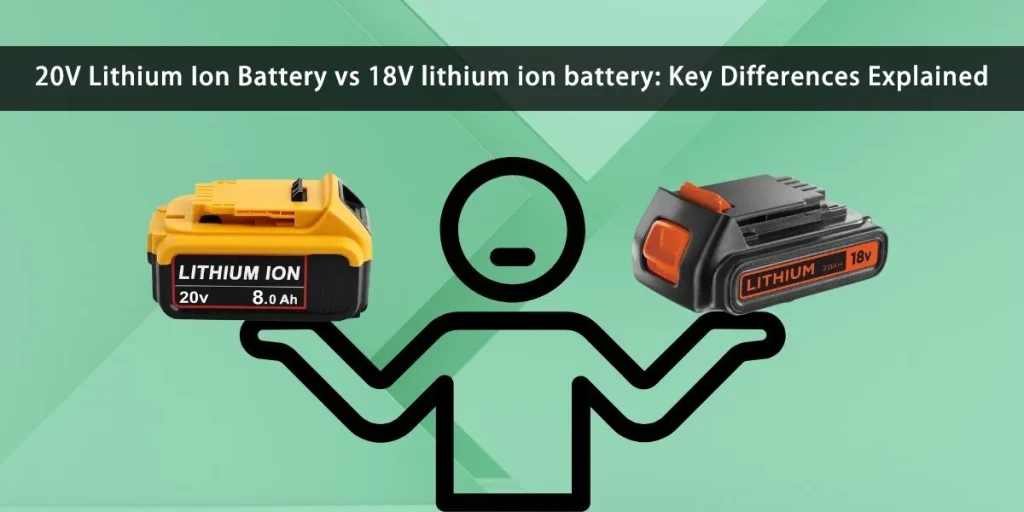
- Voltage measurement
The highest voltage that a 20V lithium ion battery may reach when completely charged determines its label. On the other hand, the nominal voltage, or average power while in use, is used to rate an 18V lithium-ion battery. - Marketing strategy
Even though the real performance is relatively close to 18V, brands often use “20V” because it sounds more powerful. - Tool compatibility
Whichever is the model, some power tool companies only accept one kind of battery, while others let you change between 18V and 20V batteries. - Performance in the real life
The majority of users report that there is little to no difference between 18V and 20V batteries when performing daily duties.
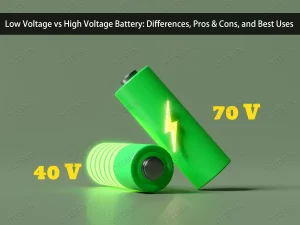
You can also read this article for more insight: 20 volt battery vs 40 volt
How Do 20V and 18V Lithium-Ion Batteries Work?
People often assume that a 20V lithium ion battery vs an 18V battery must operate in entirely different ways when comparing the two. In actuality, both are constructed with remarkably identical parts and operate on the same lithium-ion technology. The main difference is in the method used to measure the voltage.
- Cell structure
Lithium-ion cells compose each battery pack. Nominally, a single cell generates about 3.6 volts; when completely charged, it produces roughly 4 volts. Manufacturers may choose a pack that is either 18V (nominal) or 20V (maximum) by assembling five cells in a row. - Discharge process
Voltage naturally reduces as the device runs. Because of this, once a battery with the number “20V” becomes used to its routine, it will eventually operate within the same operating range as an 18V battery. - Power delivery
Both 18V and 20V batteries give the motor of a drill, saw, or impact driver a consistent power output. Users won’t notice much differences between them for the majority of daily tasks.
In summary, the 20V lithium ion battery vs 18V battery debate is more about labells and how manufacturers choose to display the data than it is about two completely different systems.
Voltage Ratings Explained
Voltage ratings are one of the main points of contention in the 20V lithium ion battery vs 18V debate. Understanding how manufacturers measure numbers is helpful because they don’t always mean what people believe.
- Maximum voltage (20V)
This is the voltage immediately following a full battery charge. That is the origin of the “20V” marking. Although it sounds more powerful, the number only represents the highest value and not the battery’s everyday usage. - Nominal voltage (18V)
The average voltage while the battery is being used is known as the nominal voltage. This more accurate measurement serves as the basis for an 18V battery rating, which is why some brands prefer the 18V label. - Why the numbers overlap
In actuality, once the tool is in operation, a fully charged 20V battery will quickly fall into the 18V operating range. Because of this, a lot of analysts claim that there isn’t a significant performance difference and that the voltage’s marketing is mainly to blame.
You can also read these articlesfor more insight:
36V lithium ion battery
24V lithium ion battery
12 V lithium batteries
Pros and Cons of 20V Lithium-Ion Battery and 18v Lithium Ion Battery
Looking at a 20V lithium ion battery vs 18V battery, the differences aren’t limited to the numbers on the label, they also manifest in the ways that various tool brands sell, price, and support each alternative. Here are the pros and cons of each to help clarify:
- 20V lithium ion battery
Pros: Because of the higher voltage label, a 20V battery often looks more strong at first glance. It is a good option if you want compatibility with contemporary tools designed around the 20V system because it is usually marketed alongside newer tool lines that might have improved capabilities.
Cons: Since the actual working voltage usually falls around the 18V region, the “20V” rating may be deceptive. Furthermore, although having nearly comparable real-world performance, 20V batteries are often significantly more expensive than 18V alternatives. - 18V lithium ion battery
Pros: When used, an 18V battery performs as expected because it has a more realistic voltage rating. Additionally, it typically costs less and works with a wide variety of current equipment, especially older models.
Cons: Even if it isn’t in reality, the lesser number may at times give the impression that it is less powerful. Additionally, some brands have focused on 20V lines, which may eventually result in less compatibility.
Best Applications for 20V Lithium Ion Battery vs 18V Lithium Ion Battery
Choosing between a 20V lithium ion battery vs 18V battery often comes down to how you intend to use your tools. Even if they operate very similarly, there are some situations in which one choice is more logical than the other.

For 20V lithium ion battery: this is often used for heavy-duty tasks such as building, cutting through dense materials, or long sessions with current, high-performance tools. They work well with more recent tool lines that are made to be more efficient and have longer runtimes.
For 18V Lithium ion Battery: this is excellent for routine tasks like light woodworking, fastening, and drilling. 18V batteries are perfect for home builders, homeowners, and anybody else who doesn’t require maximum power all the time because they are generally more economical and broadly compatible with many older tools.
In summary, the 20V battery wins when you desire modern performance and are investing in the newest tool systems, whereas the 18V battery works best if you prioritize compatibility and economy.
How to Choose the Right Battery
Deciding a 20V lithium ion battery vs 18V battery isn’t about which has a higher number, rather, it’s about how well the battery fits your tools and how you use them. Here are some things to consider:
- Check tool compatibility
Always begin by looking at the features that your power tool brand offers. While some brands have completely shifted to 20V, others continue to use 18V systems. - Think about your workload
An 18V battery is more than sufficient if you mainly conduct light to medium duties at your house. With modern tools, a 20V system might provide better support for more demanding, all-day projects. - Think about Extended Use
For compatibility, it is sensible to stay on 18V if you already have a set of 18V tools. However, using a 20V connection could help you future-proof your investment if you’re creating a new toolkit.
Conclusion
It can be concluded, the argument over 20V lithium ion battery vs 18V battery is largely about how data are presented than about actual power. Both have similar cell architectures, use the same lithium ion technology, and function almost identically in the majority of situations.
The sensible and economical option is to continue using your existing 18V tools. But a 20V battery system can provide superior compatibility and future-proofing if you’re just starting off or intend to invest in newer tool lines.
FAQS
Can a 20V battery on an 18V tool?
No, you cannot use a 20V battery directly in an 18V tool because the increased voltage can damage the tool's motor and electronics.
Can I use a 20V lithium battery in an 18V drill?
Yes, you can use a 20V battery on an 18V drill if you can figure out a way to connect it.
What is the maximum voltage of a 18V battery?
A maximum fully charged voltage of around 21V. This is because "18V" is the typical operating voltage, not the maximum charge voltage.