Skip to content

With the continuous development of Internet technology and the increasing popularity of computers, the general high-tech products and equipment put forward more and more strict requirements on the quality of power supply.
For example, industrial automation process control system, data communication processing system, aviation management system and precision measurement system all require AC power grid to provide voltage stability, frequency stability, no surge and no spike AC power.
This is because when the power supply is suddenly interrupted or the quality of power supply seriously exceeds the standard requirements of the equipment (system), data loss, abnormal system operation and unqualified products will be caused in light cases, and the system will break down or cause inestimable losses.
However, the AC power supplied by ordinary utility grid cannot fully meet the load requirements due to the influence of wind, rain, lightning and other natural disasters as well as the influence of some user loads, human factors and other accidents.
In order to ensure the continuity of power supply for loads, provide high quality power supply that meets the requirements of loads and meet the strict requirements of some important loads on power supply.
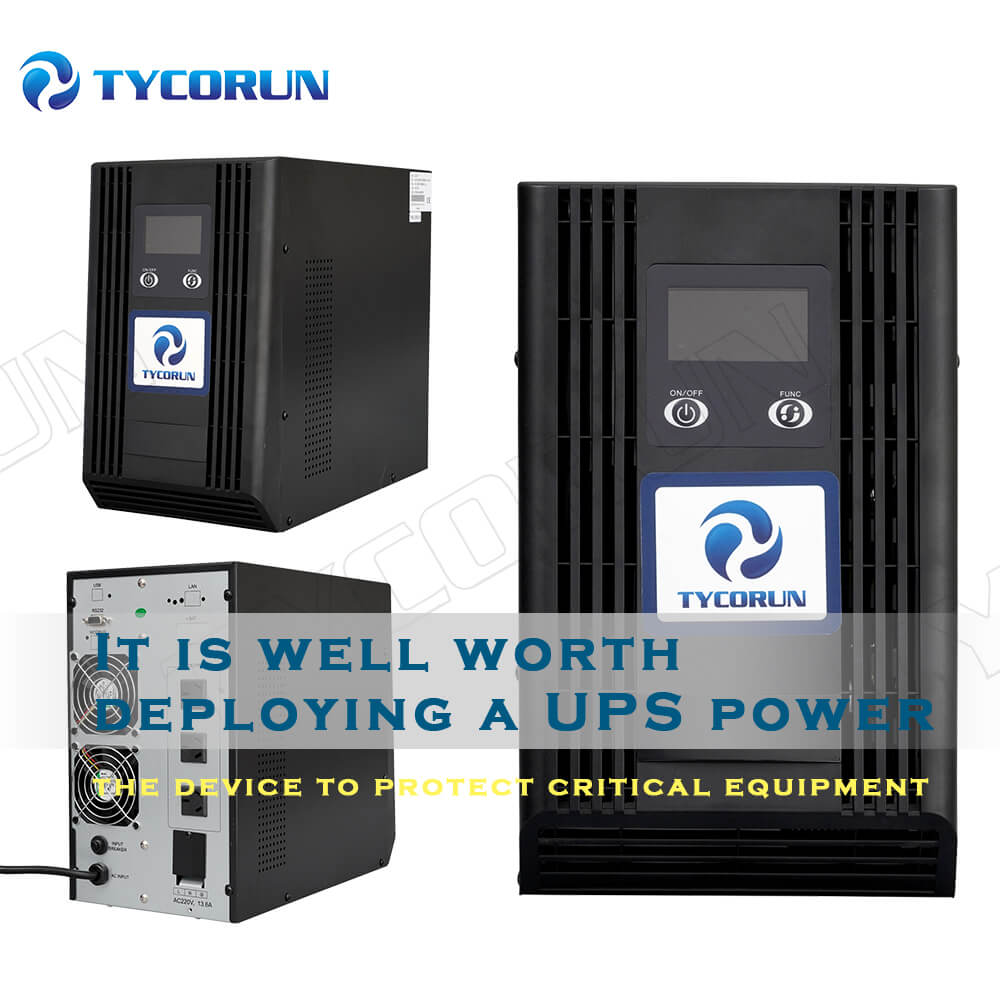
Since the 1960s, a new type of AC uninterruptible power system (UPS) has emerged that is relatively inexpensive to configure compared to expensive equipment. It is well worth deploying a UPS power the device to protect critical equipment.
In recent years, UPS power supply has developed rapidly and has become an essential power supply equipment in the fields of electricity, military industry, aviation, aerospace and modern office.
The battery plays a very important role in UPS power supply. Lead-acid batteries have mature technology and currently occupy a higher proportion share. With the popularization of lithium-ion battery, lithium-ion battery has gradually become a member of the UPS system.
The development of new energy has been rapidly developed in the 21st century, and UPS lithium battery will subvert the UPS industry in early future.
1.Definition and functions of UPS power supply
1.1The definition of UPS
The so-called uninterruptible power supply /system(UPS) refers to the power supply device that can continue to supply power to the load without affecting the quality of power supply when the input of the AC power grid is abnormal.
There are two types of UPS in general ,according to whether it provides AC or DC to the load, that is, AC uninterruptible power supply system and DC uninterruptible power supply system, but people always used to refer to the AC uninterruptible power supply system as UPS.
1.2The functions of UPS
The ideal AC power supply output voltage is pure sine wave, that is, there is no harmonic superimposed on the sine wave, and no instantaneous disturbance.
However, due to many internal reasons and external interference, the waveform of the actual power grid is not the standard sine wave, and its voltage is also unstable due to the limitation of circuit impedance.
There are many reasons for the interference, such as the ac power output of the power plant itself is not pure sine wave, the start of the large motor in the utility grid, the application of switching power supply, the operation of all kinds of switches, lightning, wind and rain, etc., may have adverse effects on the grid.
As a kind of AC uninterruptible power supply equipment, UPS power to large systems has two main functions :
First, it can continue to provide ac power for the load when the mains supply is interrupted; Second, when the mains power supply is not interrupted but the power supply quality cannot meet the load requirements, it should have the purification effect of ac power such as voltage and frequency Purification.
Purification function refers to that when the ac power provided to users by the mains grid is not the ideal sine wave, but is abnormal in frequency, voltage, and waveform.
The UPS power supply can process the electrical energy that does not meet the load requirements into the AC power that fully meets the load requirements. The mains supply is abnormal in the following aspects (as shown in the Figure ).
① Voltage spike: The Voltage spike is which the peak voltage reaches 6000V and the duration is 0.01-10ms.The reasons for it are generally electrostatic discharges, lightning strikes,arc discharges,and switching operations of large electrical equipment.
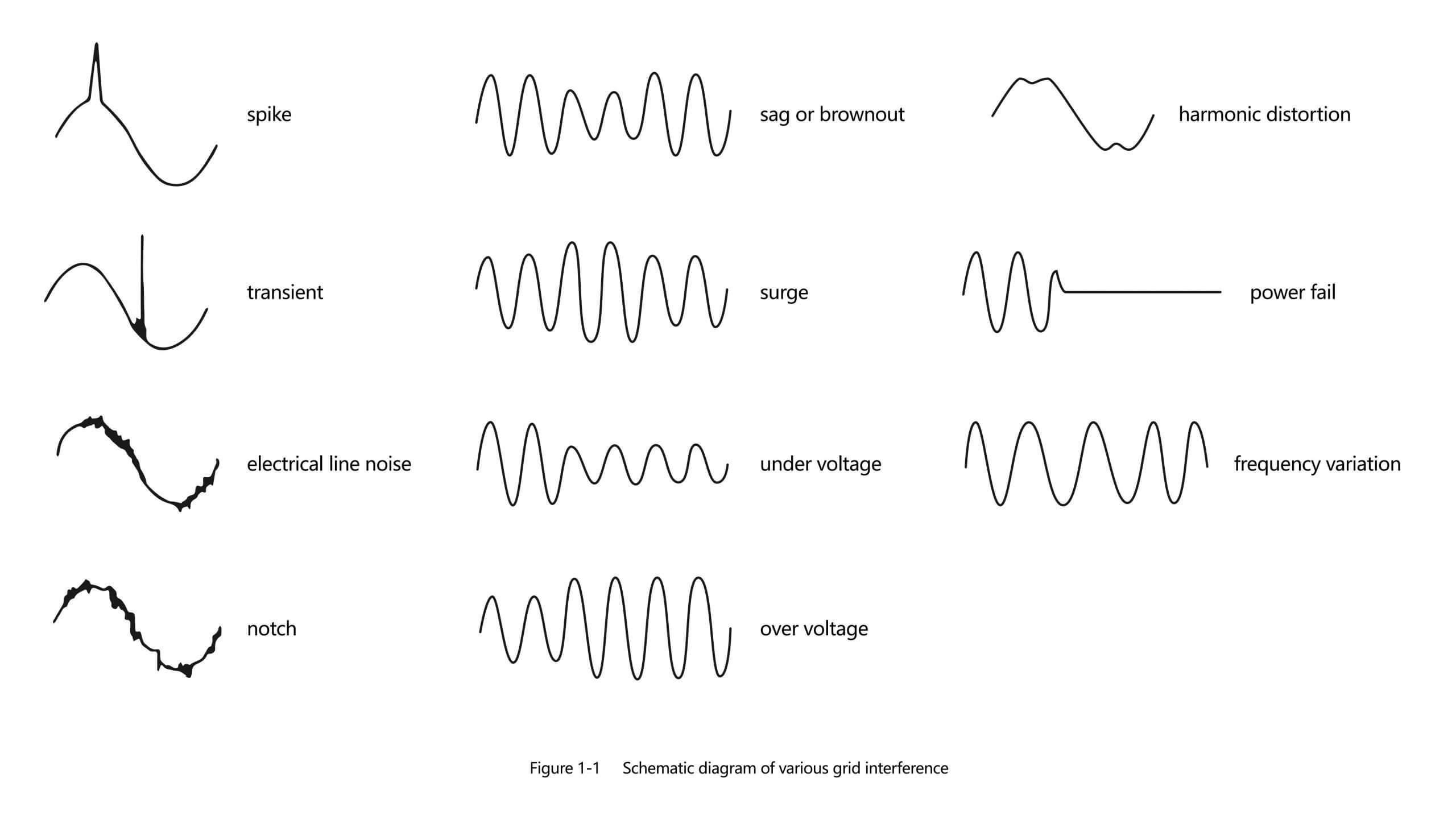
② Voltage transient: pulse voltage with peak voltage up to 20kV and duration of 1~100ps. The main causes and possible damage are alike to voltage spikes, but differ in quantity.
③ Electrical line noise: refers toelectromagnetic interference (EMI), radio frequency interference (RFI) and other high-frequency interference.
When the motor operation, relay action and broadcast will cause wire noise interference. Power grid wire noise will affect the load control circuit.
④ Notch: refers to switching interference (or other interference) on the normal voltage waveform, lasting less than half a cycle, contrary to the normal polarity, and also includes complete voltage loss within half a cycle.
⑤ Sag or brownout: refers to the effective value of the mains voltage between 80% and 85% of the rated value, and the duration of more than one to several cycles.
Starting up of large equipment, starting up of large electric motors and connecting of large power transformers to the grid will cause voltage sag.
⑥ Voltage surge: refers to the effective value of mains voltage that exceeds 110% of the rated value and lasts for more than one to several cycles. The voltage surge is mainly caused by the sudden offloading of the grid when several large electrical equipment are shut down.
⑦ Under voltage: refers to the stable low voltage which is a certain percentage lower than the rated voltage. The causes include large equipment startup and application, main power line switch, large motor startup and line overload, etc.
⑧ Over voltage: refers to the stable high voltage that exceeds the rated voltage by a certain percentage. It is usually caused by wiring errors, mistake on adjustment of power plants or power stations, and shutdown of nearby heavy equipment.
For single-phase power, it may be caused by unbalanced three-phase load or poor grounding of the middle line.
⑨ Harmonic Distortion: Indicates the deviation of the mains voltage relative to the linear sine wave voltage. It is usually expressed by total harmonic Distortion (THD).
On the one hand, the power output of power generation equipment is not pure sine wave, on the other hand, the influence of nonlinear load on the power grid.
⑩ Power fail: The power grid stops supplying electricity for at least two cycles to several hours. It is caused by tripping of circuit breakers on main wires, interruption of mains supply and failure of power grid.
⑪ Frequency variation: deviation of mains frequency exceeding 2Hz (<48Hz or >52Hz),this is mainly due to the unstable operation of emergency generators or power supply with unstable frequency.
The above pollution or interference to the computer and other sensitive equipment caused by the harm is not the same. Power supply interruption may cause hardware damage.

Voltage sag may cause hardware aging in advance and file data loss. Over-voltages, under-voltages, and voltage surges may damage drivers, memory, logic circuits, and may cause unpredictable software failures. Wire noise and transient voltages can damage logic circuits and file data.
2. The types of UPS power supply
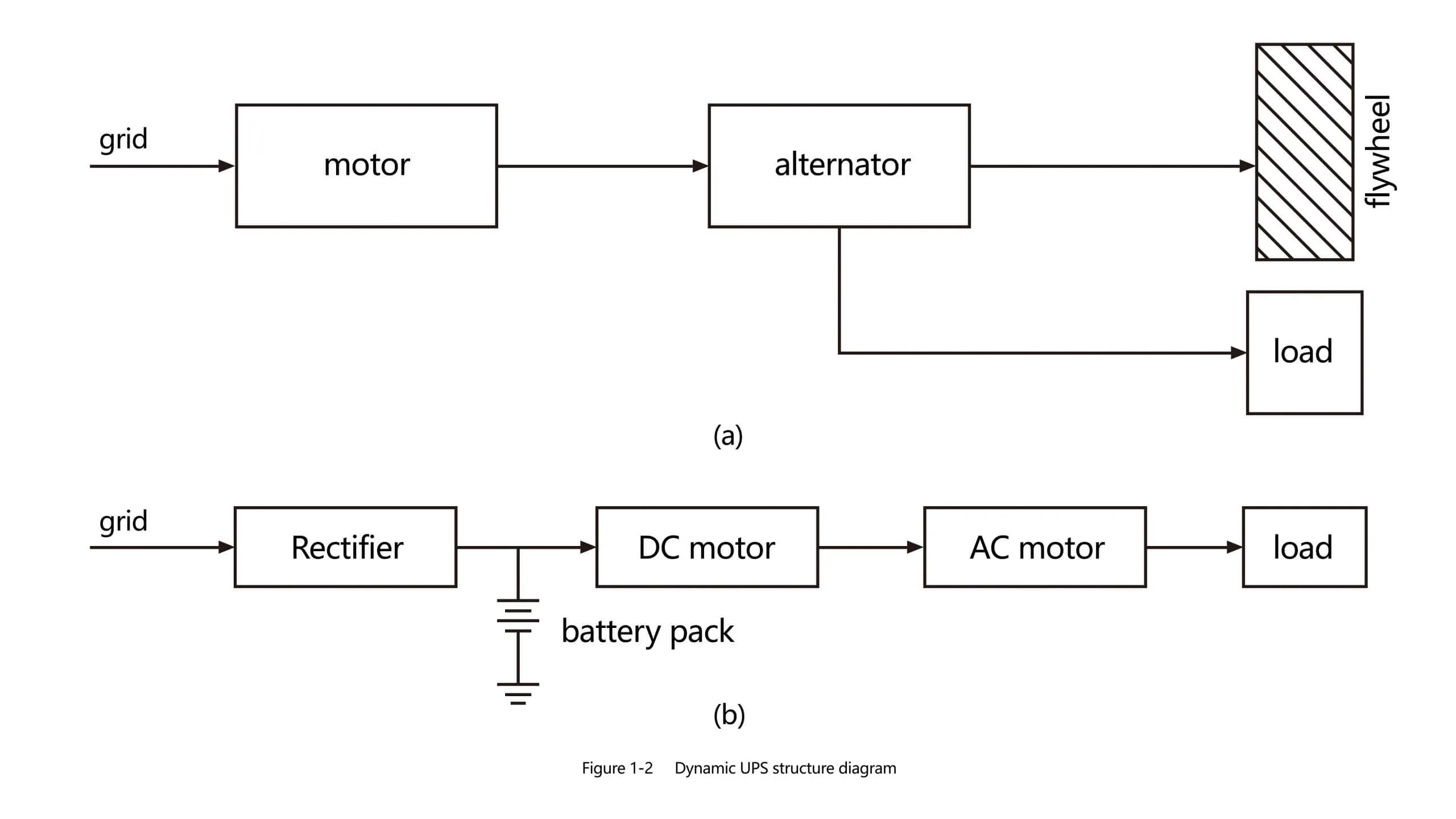
UPS has grown very quickly since its inception. The early UPS power as a dynamic uninterruptible supply. When the mains is normal, the mains drive the motor, which drives the generator to produce alternating current.
This alternating current supplies power to the load and spins the huge flywheel at high speed. When the grid changes, the flywheel’s huge inertia does not respond to the instantaneous change in voltage, so the stability of the output voltage is guaranteed.
In the case of grid power failure, the inertia of the flywheel drives the generator to continue to supply power to the load, while starting the backup generator set connected to the flywheel.
The backup generator set rotates the flywheel and thus drives the alternator to supply power to the load.
However, in the above scheme, it is bound to be limited to extend the power supply time when the power supply is cut off by the flywheel with kinetic energy storage. In order to further extend the power supply time, the structure shown in Figure is adopted later.
After the rectifier, the battery is charged all the way, and the other way is powered by the DC motor. The DC motor drives the AC generator output voltage and frequency stability.
When the mains is interrupted, the ac generator continues to operate by relying on the energy stored in the battery pack, so as to achieve the purpose of uninterruptible load power supply.
When this kind of dynamic UPS power the equipment, it has loud noise and with the other disadvantages like low efficiency, long switching time and heavy, and has not been widely used.
With the rapid development of semiconductor technology, static UPS using a variety of electric appliances quickly replaced the early dynamic UPS, battery storage in the system store energy and supply the static UPS power, through the static inverter to maintain the continuity of load power supply.
Compared with dynamic UPS, static UPS power the load with lower noise and higher efficiency, and they are also smaller in size, light in weight, convenient in operation, and long in backup time. The UPS power supply described in this article are static UPS.
According to the output capacity, types of UPS can be divided into small capacity (below 10kV·A) UPS, medium capacity (10-100kV ·A) UPS and large capacity (above 100kV·A) UPS.
According to the input and output voltage phase number, it can be divided into single input single output UPS, three input three output UPS and three input single output UPS; According to the different output waveform, the types of UPS are: square wave UPS, trapezoidal wave UPS and sine wave UPS;
But people used to classify according to the UPS circuit structure form, can be divided into Passive stand-by UPS, line interactive UPS and online UPS.
2.1Passive stand-by UPS
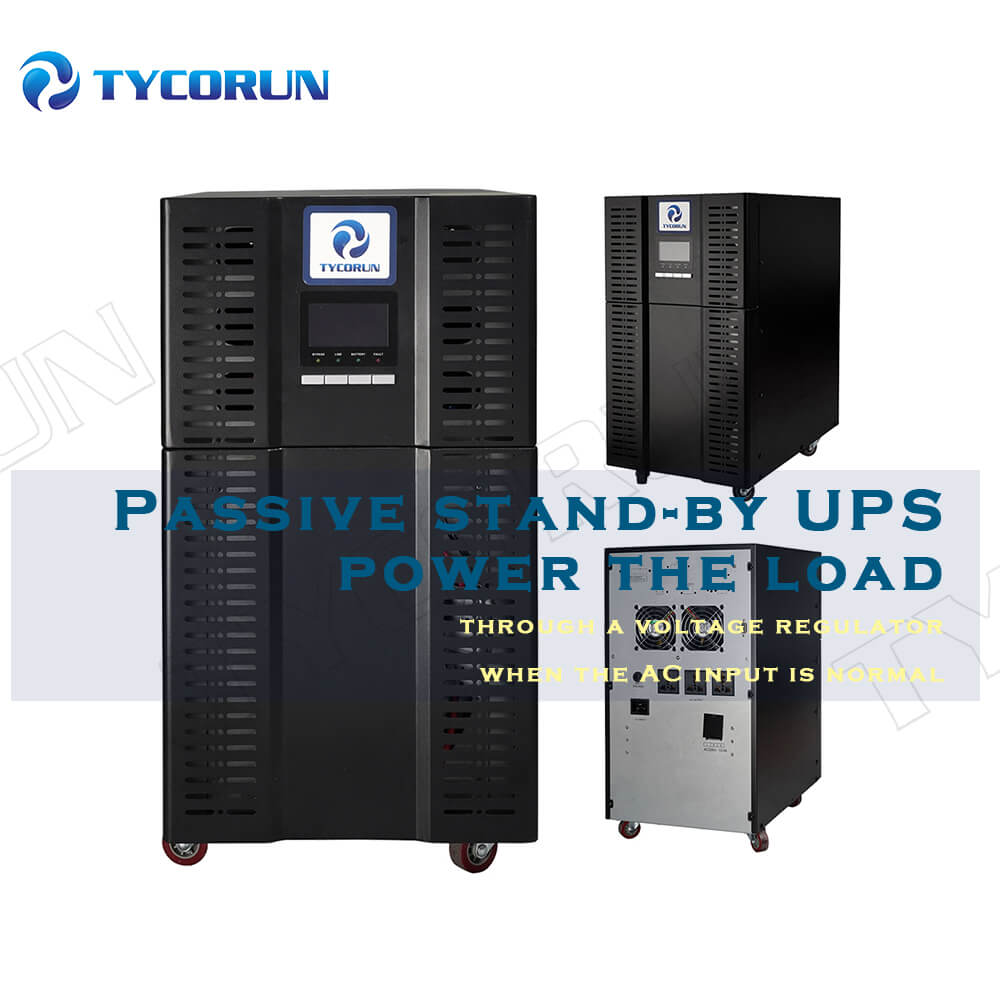
Passive stand-by UPS power to the load through a voltage regulator when the AC input is normal. When the AC input is abnormal, the battery of the UPS power to the load through the inverter.
The Passive stand-by UPS is the original static UPS. It provides mains power and consists of a charger, battery, inverter, and transformer tap voltage regulator. Figure below shows the working principle of the backup UPS.

(1) Normal mode of operation
When the input AC voltage and frequency are within the allowable range, the low-pass filter is used to properly attenuate the high-frequency interference from the power grid, and then the circuit is divided into two channels to control the normal operation of the subsequent stage.
① Charge the battery through the charger to support the normal operation of the UPS power the load in case of mains interruption.
② Through the “transformer tap regulating voltage regulator power supply” located in the AC bypass channel, the voltage of the mains which fluctuates greatly is stabilized.
Then, under the action of UPS logic control circuit, the stabilized mains supply supplies power to the load through the transfer switch.
At this point, the inverter is only in no-load operation state, does not output energy, strictly speaking, the inverter does not work.
(2) Stored energy mode of operation
When the input AC voltage or frequency is abnormal, under the function of UPS logic control circuit, the process of the UPS power the load as follows.
① The charger stops working.
② When cutting off the AC bypass power supply channel, the transfer switch connects the load to the output end of the inverter, so as to realize the conversion from the mains power supply to the inverter power supply.
③ The inverter absorbs the dc stored in the battery and transforms it into a stable alternating current (such as 50Hz/220V) to maintain the power supply to the load. Depending on the load, the inverter output voltage can be either sine wave or square wave.
According to the working principle of the Passive stand-by UPS, its performance characteristics are as follows:
① Simple circuit, low cost, high reliability
② When the grid is normal, the inverter is only in no-load operation state, and the efficiency of the whole machine can reach 98%.
③ Because most of the time it power supplies to the grid, UPS output capacity is strong, the load current crest coefficient, surge coefficient output power factor, overload and other no strict requirements.
④ The output voltage stability accuracy is poor, but can meet the load requirements.
⑤ The output has a conversion switch, the output power has a short period of discontinuity when the mains power supply is interrupted, and is limited by the switching current ability and action time, it is difficult to increase the output capacity.
Therefore, the backup sine wave output UPS capacity is usually less than 3kV·A, while the backup square wave output UFS capacity is usually less than 1kV·A.
2.2Online UPS
When the AC input is normal, the battery of the UPS power the load through the rectifier and inverter. When the AC input is abnormal, the battery of the UPS power the load through the inverter.
The on-line UPS is also called the double transform on-line UPS or series adjusting UPS. At present, most large-capacity UPS adopt this structure.
The UPS power supply is usually composed of a rectifier, a charger, a battery, an inverter and so on. It is a power supply that mainly inverter supply the UPS power. Figure shows the working principle.

(1) Normal mode of operation
When the input AC voltage and frequency are within the allowable range, the EMI/RFI filter is used to properly attenuate the conducted electromagnetic interference and radio frequency interference from the power grid, and then the circuit is divided into three channels to control the normal operation of the subsequent stage.
① Directly connect the AC bypass power supply channel as a backup power supply when the inverter channel is faulty.
② Float charge the battery pack in the UPS through the charger, so that when the mains is interrupted, the battery of the UPS power the normal operation with enough energy.
③ After the rectifier and large capacitance filter into a relatively stable DC, and then the inverter will be converted into voltage and frequency stable AC, through the transfer switch to the load.
(2) Stored energy mode of operation
When the input AC voltage or frequency is abnormal, the UPS power all the load in the following mode under the action of the logic control circuit.
① Turn off the charger and stop charging the battery.
② The battery in the UPS power the inverter, and the dc stored in the battery is converted into the AC power required by the load, which is used to maintain the continuity of the power supply of the load.
(3) Bypass mode of operation
Under normal conditions of mains power supply, one of the following situations occurs:
Output overload or short circuit fault occurs at the UPS output terminal;The temperature of the power switch tube in the inverter or rectifier exceeds the safety limit due to the high ambient temperature and the failure of the cooling fan;
If the inverter in the UPS power supply is faulty, the UPS power the loads by directly switching to mains bypass under the control of the logic control circuit.

(4) ECO Mode of operation
Ac input Normally, the UPS power the loads through static bypass mode. When the AC input is abnormal, the UPS switches the power supply mode of the inverter.
Based on the working principle of the online UPS power supply, the performance characteristics are as follows:
① Whether the mains is normal or not, all the power of the load is given by the inverter. Therefore, at the moment of mains failure, the UPS output will not have any interruption.
② The output power quality is high. The UPS inverter adopts high-frequency sinusoidal pulse width modulation and output waveform feedback control to provide high quality power with high voltage stability, low waveform distortion, stable frequency and fast dynamic response to the load.
③ All the load power is provided by the inverter, the capacity margin of UPS is limited, and the output capacity is not ideal.
Therefore, the load of the output current peak coefficient, overload capacity, output power factor and other restrictions are put forward, the output active power is less than the calibrated kV·A number, the ability to deal with the impact load is poor.
④ The rectifier and inverter bear all the load power, the efficiency of the machine is low.
2.3Line Interactive UPS
Line interactive UPS refers to when the ac input is normal, through the voltage regulator to the load power supply, converter only to charge the battery;
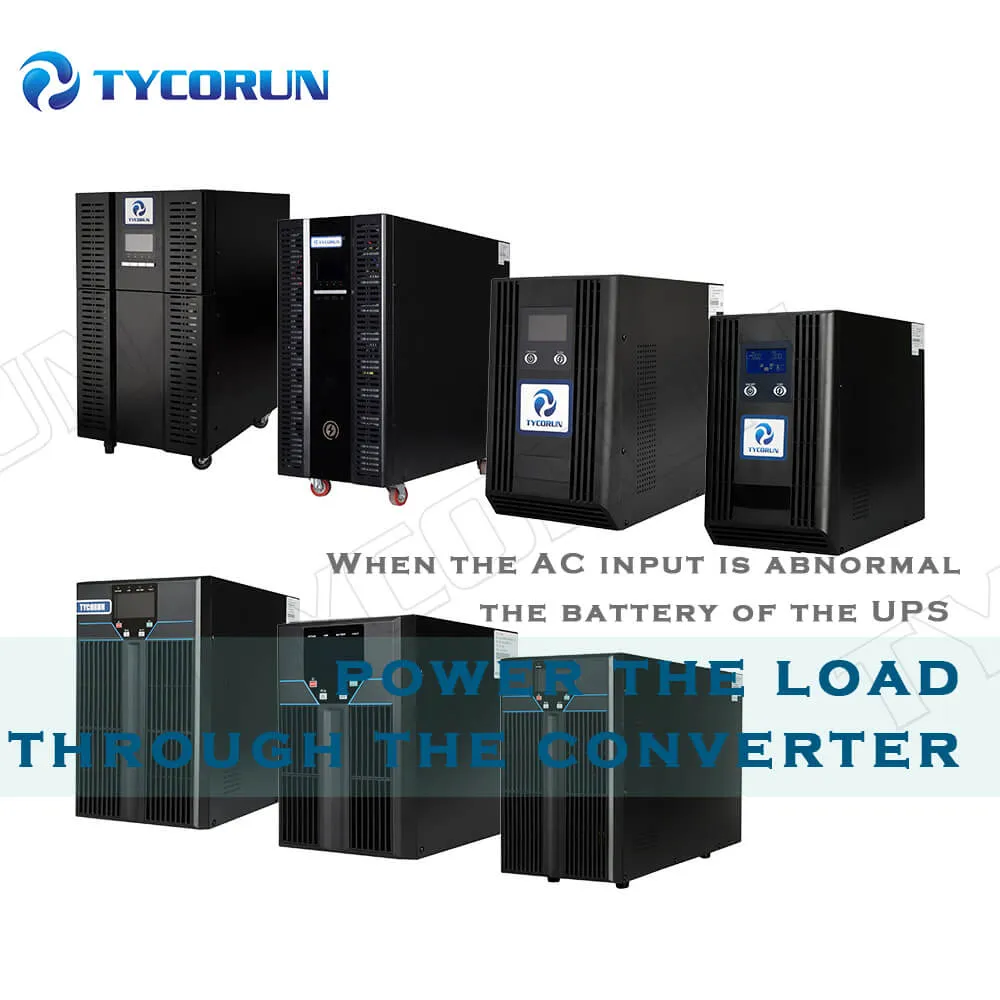
When the AC input is abnormal, the battery of the UPS power the load through the converter. Interactive UPS power supply are also called online interactive UPS or parallel compensation UPS.
Compared with the on-line UPS, this UPS power supply eliminates the rectifier and charger, and consists of a bi-directional converter that can operate in the rectifier and inverter states and a battery.
When the mains input is normal, the bi-directional converter works in reverse (i.e. rectification working state) to charge the battery pack;
When the mains is abnormal, the bi-directional converter immediately converts to the inverter operating state, converting the battery electric energy into AC output. Figure below shows the working principle.

(1) Normal mode of operation
When the input ac voltage and frequency are within the allowed range (for example, the mains voltage ranges from 150 v to 276V), the mains power supply attenuates the rf interference and conducted electromagnetic interference from the mains grid through a low-pass filter, and controls the normal operation of the UPS through the following control channels.
When the mains voltage is between 176 v and 264V, under the action of the UPS logic control circuit, turn on the switch S0 and the switch on the mains output channel of the UPS power supply. Thus, an unregulated mains supply is sent directly to the load.
When the mains voltage is between 150 ~ 176 v, in view of the mains input voltage on the low side, in the role of UPS logic control circuit, the switch S0 under the breaker status at the same time.
The closed booster winding switch S1 at the input, the low amplitude of the mains supply after booster treatment, will be a higher amplitude of voltage by the switch to the load.
When the mains voltage is between 264 ~ 276 v, to prevent damage to the load, the output voltage is too high in the role of UPS logic control circuit, the switch S0 under the breaker status at the same time.
The closed step-down winding at the input switch S2, make the amplitude on the high side of the mains supply via the switch to load again after voltage reduction treatment, achieve the goal of the safe operation of the user load.
After processing, the mains power supply not only supplies the load electric energy, but also serves as the AC input power of the bi-directional inverter.
The bi-directional inverter operates in a rectifying state, absorbing energy from the grid and storing it in a battery bank to provide sufficient DC energy when the mains is abnormal.
(2) Stored energy mode of operation
When the input ac voltage or frequency is abnormal (for example, the mains input voltage is lower than 150V or higher than 276V), the internal logic control circuit performs the following operations on key components of the UPS power supply.
The bidirectional converter is transformed from the original rectification mode to inverter mode.
In other words, at this time, the system no longer charges the battery, but absorbs the dc energy stored by the battery, which is converted into voltage stable and frequency stable AC power output to the load by sine wave inverter.
Based on the working principle of the interactive UPS, the performance characteristics are as follows:
① High efficiency, up to 98%;
② Simple circuit structure, low cost, high reliability.
③ Input power factor and output current harmonic components depend on the load current, UPS itself does not produce additional input power factor and harmonic current distortion.
④ Strong output capacity, the load current peak coefficient, surge coefficient, overload and other no strict restrictions.
⑤ The converter is directly connected to the output end, and in a hot backup state, the output voltage peak interference has a filtering effect.
⑥ Most of the time for the mains power supply, only on the grid voltage slightly stabilized processing, the output power quality is poor.
⑦When the grid is interrupted, because the AC bypass switch has a disconnect time, the UPS output has a certain time of power interruption, but the conversion time is shorter than the Passive stand-by UPS.