Skip to content



What is called voltage-the chemistry behind voltage
Voltage is the potential or potential difference in volts. The chemistry behind the working voltage is: the free charge moves directionally in the circuit to form current, and the potential difference in the current forms voltage.
The term working voltage can refer to either the electrical force that would drive an electric current through a conductor, or the difference in electric potential between two points in a circuit. The common symbol for electrical potential difference is V.
Introduction of voltage-related terms
Working voltage is measured in volts. The higher the voltage level, the greater potential difference there is between two points on an electrical circuit. In technical terms, it’s called electromotive force (EMF).
What is MV and HV
MV and HV are used to describe working voltage in high-energy applications. The higher the potential difference (voltage), the greater risk of damage if something isn’t done to protect against it.
MV stands for medium working voltage, whose range is between 1000 V and 45 kV. Generally, the safe voltage that the human body can withstand is 36V, and the safe current is 10mA. HV stands for high voltage, and this high voltage ranges between 45 kV and 230 kV.
What is drop voltage
The correct term is voltage drop but not drop voltage. Voltage drop is the working voltage difference between the terminal voltage and the resting voltage. It is a measure of how much current can flow through an electrical device without causing damage to it.
Voltage drop, also known as voltage or potential difference, is expressed as U, and the unit is volt (V). It is a physical quantity that describes the power of electric field force to move charges.
In short, the potential difference between the two ends of the load (potential difference) can be considered as the voltage drop. Voltage drop is the driving force of current flow. If there is no voltage drop, there is no current flow.

What is resting voltage
The resting voltage of a battery is the voltage at which it will no longer accept charge. Resting voltage is static electricity. It refers to that the object is charged with some conditions, and the amount of charge and voltage have not changed, that is, there is no discharge current generated, and the original voltage has been maintained for a long time.
What is HT and LT voltage
HT and LT are synonymous with high voltage and low voltage respectively. LT refers to any voltage below 1000V, and HT refers to voltage above 1000V. HT power distribution system is simply a high-voltage power distribution system, while LT is a low-voltage or tension power distribution system.
The term HT is used to describe high-tension working voltage. It’s higher than LT, which stands for low-tension working voltage. You can think of an HT line as being like an AC power line—it has a direct current flowing through it with all the working voltage above ground level (72 volts).
LT stands for low tension—this means that there’s no direct current through this wire but instead just a small amount of alternating current flowing back and forth across the device.
Because this type of “loading” doesn’t create much energy loss during transmission over long distances like an HT wire does when transmitting power over longer distances at higher frequencies (100Hz vs 50Hz), some people refer to LT as “high frequency” versus “low frequency.”
What affects the voltage of a battery
Working voltage is a measure of the electric potential difference between two points in an electric field. The word “potential” means “voltage” and voltage refers to how much energy can be stored per unit charge at those two points.
In other words, it’s like saying “working voltage is a measure of how much force you need to push electrons through a circuit.” When we talk about electricity flowing through wires or cables (or indeed anything else), we are talking about electrons being pushed from one end of something to another.
The battery voltage is related to many factors:
● Temperature
The temperature affect the reduction ability of the battery. If the temperature is too high or too low, the voltage is lower;
● Power
The greater the power, the higher the working voltage;
● Load
The size of the load. If the load is high (the smaller resistance, the larger power supply), the battery working voltage will be low, and excessive load may cause damage to the battery. Using a battery load tester can check the interior conditions of the battery.

How do you calculate working voltage
When the working voltage is measured on the battery, it is actually measuring how much work it can do or how fast it charges up. How do we calculate working voltage:
Working Voltage = Current x Resistance
Working Voltage = I * R
The expression above means that if a current flows through an object, such as a wire or circuit board, then its resistance affects how much power comes out of that device—or vice versa if we reverse things around by turning off current flow through one object and measuring resistance instead.
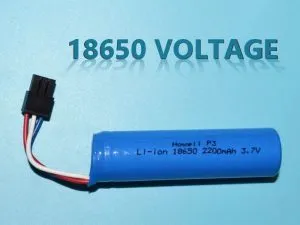
Furthermore, the li-ion cells have a working voltage rating of 3.2-3.7V each and can be connected together according to different requirements. This can be determined by measuring the working voltage at the internal battery terminals labeled V+ and V-.
Is battery voltage DC or AC
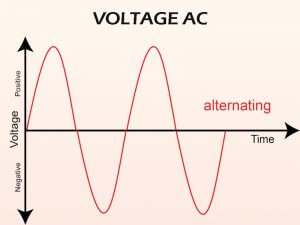
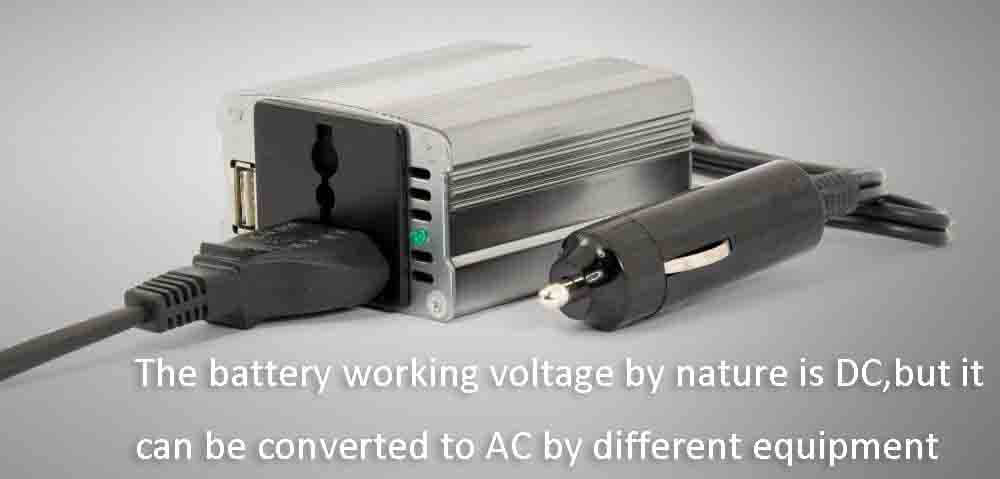
The battery working voltage by nature is DC, but it can be converted to AC by different equipment. As DC stands for direct current so the direction of DC is unidirectional. Moreover, all batteries including Lithium Ion batteries can be used for DC current and working voltage.
How do you convert AC to DC
The most common way to convert AC to DC is use a rectifier or an inverter. A rectifier is an electronic device which converts alternating current (AC) into direct current (DC). The most common type of rectifiers is bridge-based, and they take advantage of the fact that capacitors store energy in their internal resistance.
Bridge-based rectifiers consist of two diodes connected together in series: one diode conducts while the other blocks current flow between them. If there are more than one capacitor in series with your transformer, then it can be used by each capacitor as its own independent battery for charging during one half cycle before switching over to charge another capacitor’s batteries during the other half cycle—and then this process is repeated again!
What is the lowest voltage for a LiFepo4 battery
The lowest voltage for a LiFepo4 battery is 2V. The nominal voltage of the ternary lithium battery is 3.7V, which is the minimum standard working voltage, or factory set voltage.
The battery may have zero voltage, which may be caused by external short circuit, excessive discharge and reverse charge, or sustained overcharge due to high rate and large current, leading to expansion of the battery core and direct contact with the internal positive and negative electrodes for short circuit.
What is maximum voltage of battery
The maximum voltage of different batteries is different because of different materials and structural characteristics. The working voltage for a 12v lifepo4 battery is 3.65V so its maximum charging working voltage is 14.6V. For a 12v ternary lithium battery, the working voltage is 4.2V and its maximum charging working voltage is 16.8V.
FAQs
At what voltage does a 1.5 V battery stop working
Going below the working voltage of 1.2v, the battery appears to be dead. It is recommended not to let the battery get down from this voltage.This is also related to the size of the battery and the current of the electrical appliance.
If the battery is large, the power consumption current is small, and the voltage is low, it can still be used. However, in general, it is not recommended to continue to use the battery when the battery voltage drops to the discharge cut-off voltage.
What should my lithium battery voltage be
The voltage of a lithium battery cell is generally 3.2v-3.7v. For example, the rated voltage of lithium iron phosphate battery is 3.2v, and the working voltage can reach 3.65v when fully charged.
What is the voltage of a fully charged 48V lithium battery
To fully charge 48v lifepo4 battery, the working voltage should be 54.75v. Voltage higher than it can damage the battery. For a 48V ternary lithium battery, the working voltage should be 58.8V.