Skip to content
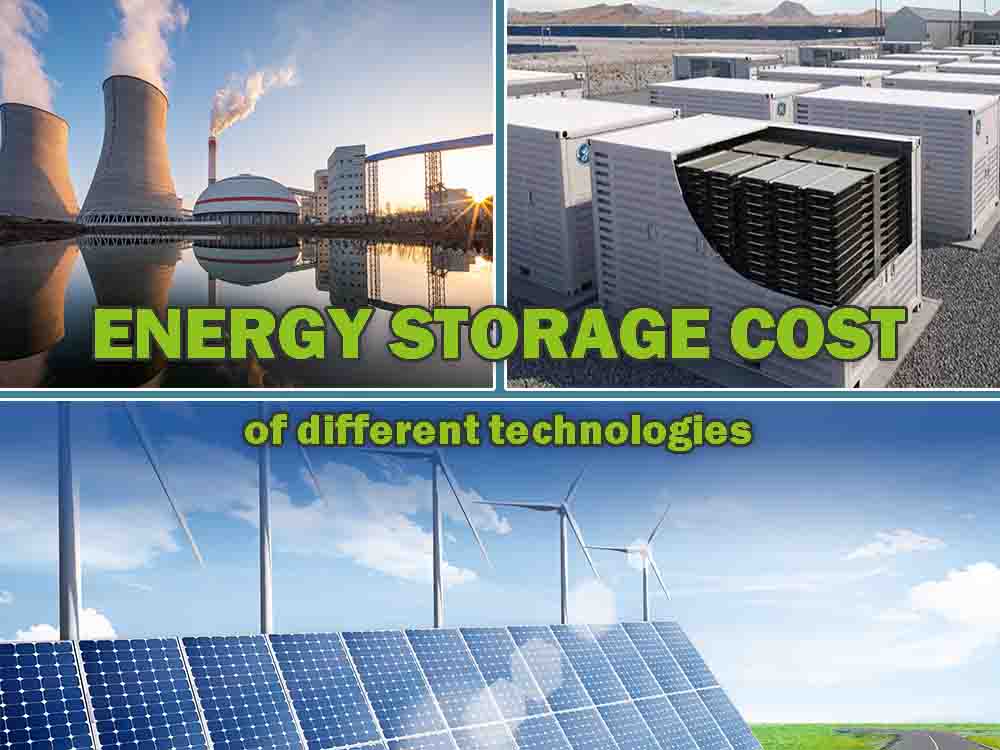


Relevant data shows that the proportion of wind power and photovoltaic installed capacity in the total installed capacity of the global power system has risen from 6.7% in 2012 to 20.9% in 2021, and the proportion of wind power and photovoltaic installed capacity in China reached 26.7% in 2021.However, due to the volatility of wind power and photovoltaic, the proportion of wind power and photovoltaic power generation in China’s total power generation is only 12.1%, 14.6% lower than the installed capacity. Therefore, China has large-scale wind power and photovoltaic abandonment.
Energy storage is the key to improve the flexibility of the power system. The configuration of energy storage can promote the consumption of new energy and reduce the loss of wind power and photovoltaic. In China, there are top 10 Energy storage battery companies.
However, in the face of many energy storage technologies, which technology is most competitive in cost has become one of the most concerned issues, which is closely related to the cost of energy storage. This article will analyze the problems related to the energy storage cost of various technologies.
How to calculate energy storage cost
At the current stage, people focus on the energy storage cost mainly to check the final installation cost from the bidding project, but there is a problem because the so-called energy storage cost does not include the operation and maintenance cost, future loss and other issues.
Therefore, we need to introduce a concept to calculate the ratio between the present value of the total cost and the total storage/power generation in the project life cycle to determine the energy storage cost.
LCOE (levelized kilowatt hour cost) is used to calculate the generation cost of traditional energy. A similar calculation method of energy storage cost is LCOS (levelized energy storage cost). The total cost of LCOS includes the initial installation cost, annual operating cost, and power loss cost. The ratio of the total cost to the number of life-cycle cycles is LCOS.

Cost calculation of various energy storage technologies
Assume that the service life of lithium ion battery and sodium ion battery energy storage system is 12 years, the service life of liquid flow battery is 20 years, the service life of compressed air energy storage is 30 years, and the service life of pumped storage is 50 years. The cost per kilowatt hour of each energy storage technology is calculated as follows:
It can be seen that the cost of energy storage technology is sorted from high to low as sodium ion battery, lithium ion battery, compressed air energy storage, all vanadium liquid flow battery, pumped storage and new liquid flow battery.
Among them, the new liquid flow battery still has a lot of problems to be solved at present, such as low battery density, narrow working temperature range, etc., which cannot be applied in a large scale. Therefore, the lowest cost is pumped storage.
Comparison of various energy storage cost
According to relevant data, China’s average on grid electricity price in the first half of this year was 0.35 RMB/KWh. From this point of view, it can be seen why the current large-scale energy storage construction still depends on policies.
At present, the largest proportion of new energy storage is lithium ion batteries, whose energy storage cost is up to 0.564 RMB, even higher than the grid price, that is to say, the benefits of abandoning wind power and photovoltaic are greater than the construction of energy storage power stations.
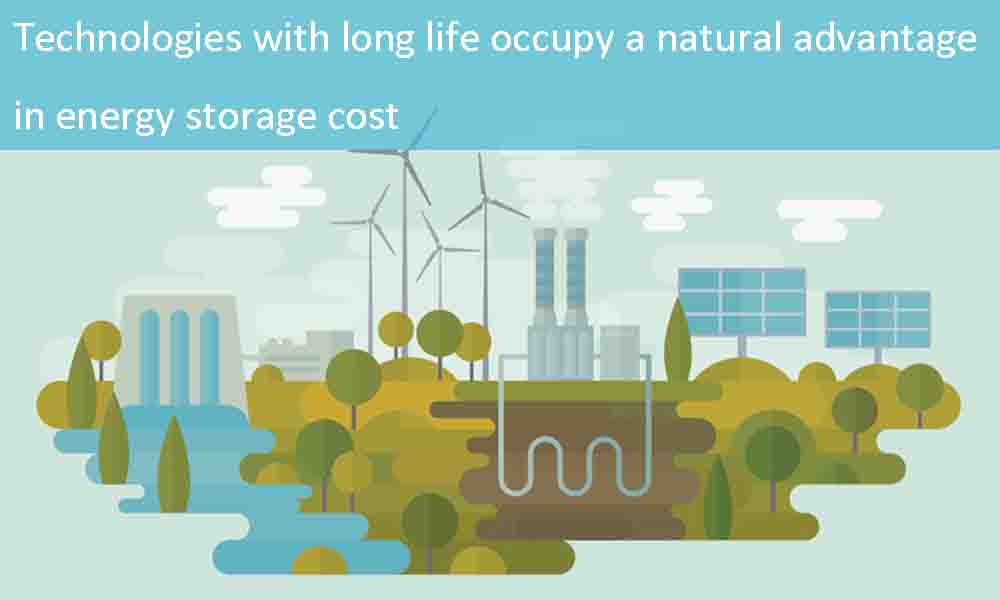
Of course, the above data are lagging behind and cannot represent the latest technology. And the life of each energy storage system is different. Under this calculation method, technologies with long life such as pumped storage occupy a natural advantage in energy storage cost, and there are some flaws. Therefore, the best comparison method is to compare electrochemical energy storage and physical energy storage separately.
In terms of physical energy storage, pumped storage takes the lead in terms of technology maturity and installed capacity. The most widely used energy storage installed capacity in the future will be the most mature pumped storage with the lowest installed cost. Air compression energy storage has started several large projects this year, and has developed to the level of 300 MWh.
 In addition, flywheel energy storage achieved a breakthrough in the middle of this month. For the first time, the flywheel energy storage unit output power of the major science and technology special project of Inner Mongolia Autonomous Region “Research on Key Technologies of MW (MW) Advanced Flywheel Energy Storage” led by CNNP reached 1MW. At present, only CNTY, a listed company, is engaged in R&D and production of gravity energy storage.
In terms of electrochemical energy storage, although it seems to have broad prospects for development, its safety and economy are still in the early stage of commercialization, far from meeting the requirements of market scale.
However, by 2025, the new energy storage will have entered the stage of large-scale development from the initial stage of commercialization, and will be ready for large-scale commercial application. By 2030, new energy storage will be fully developed in the market.
The energy storage cost of lithium ion and sodium ion battery may decrease
Driven by the policy, new types of energy storage based on electrochemical energy storage will usher in a leap forward development in the future. Among them, lithium ion batteries and sodium ion batteries are likely to achieve a significant reduction in energy storage cost.
The vanadium flow battery has good competitiveness in the energy storage field due to its good safety and long life. In the GWh level large-scale energy storage, new liquid flow batteries need to achieve technological breakthroughs before they can be applied.
From the perspective of the past decade, relevant statistical data show that the comprehensive cost per kilowatt hour of electrochemical energy storage was 3.7 RMB in 2010, and by 2020, the electrochemical energy storage cost has dropped to 0.4 RMB, a drop of 89.2%.
However, it cannot be guaranteed that the electrochemical energy storage cost will be reduced to about 0.1 RMB by 2030. In the next ten years, if the energy storage cost can be reduced to about 0.1 RMB, energy storage will usher in a real rapid development.