Skip to content
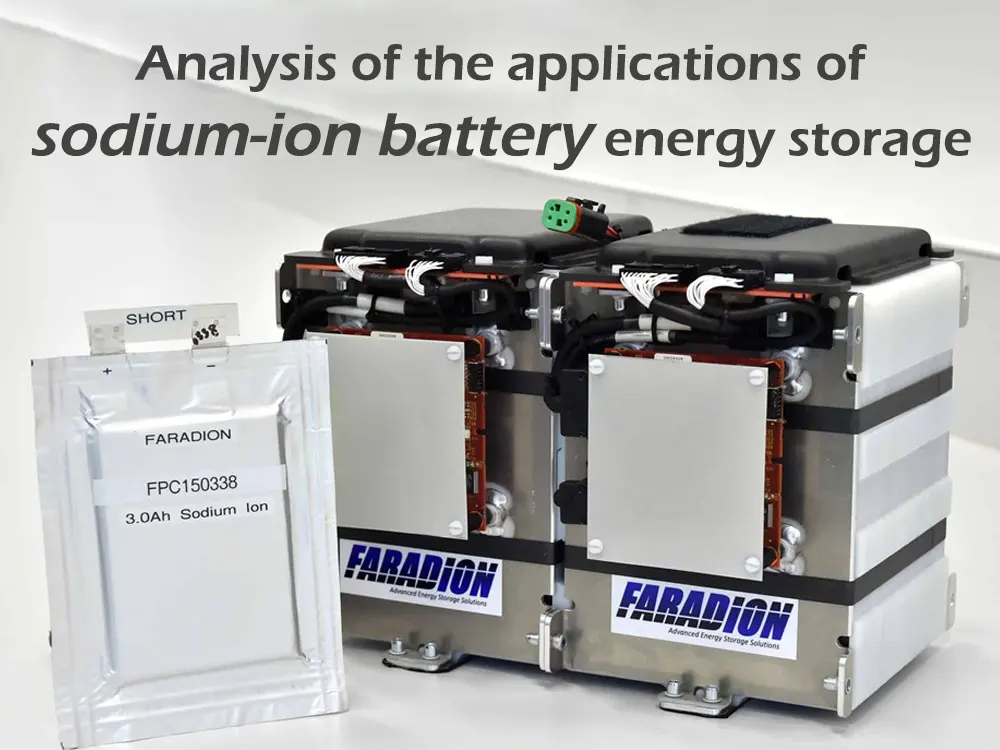


According to forecasts, the new installed capacity of the energy storage market is expected to exceed 300GWh in 2025. The cost of sodium-ion batteries has a lot of room to drop, which is expected to significantly improve the profitability of energy storage and penetrate rapidly in the field of energy storage.
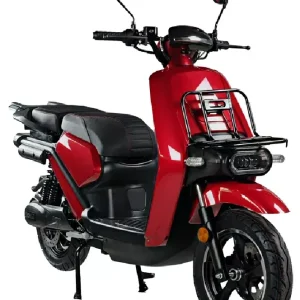
In 2025, under an optimistic scenario, the penetration rate of sodium batteries in the energy storage field is expected to increase to 6%/13%. The penetration rate in the field of two-wheeled electric vehicles as motorcycle battery is expected to increase to 20%/40%, and the total global demand for sodium batteries is expected to exceed 30/70GWh.
The theoretical cost of sodium-ion batteries is lower, the operating temperature is wider, and the performance is more compatible with the energy storage environment. Its capacity retention rate at -20°C is greater than 88%, which means that compared with lithium-ion batteries, sodium-ion batteries can effectively solve the problem of low efficiency of energy storage power stations in alpine regions.
How sodium ion batteries work
A sodium-ion battery is a rocking-chair secondary battery similar to a lithium-ion battery. It mainly includes five parts: cathode, anode, electrolyte, separator, and current collector. The technical difficulties focus on the cathode and anode materials. Its working principle is the intercalation and deintercalation of sodium ions in the cathode and anode materials to achieve energy charging and releasing.
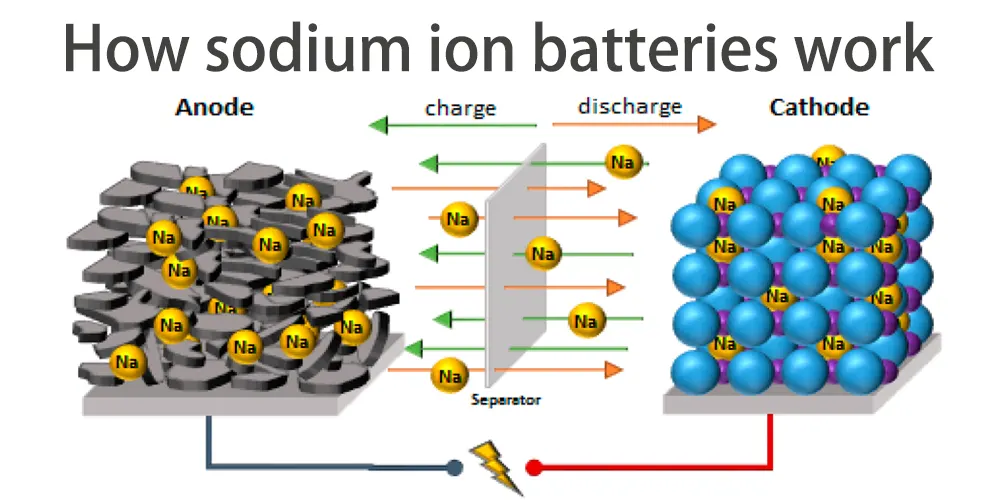
When the battery is charged, sodium ions migrate from the cathode to the anode through the separator, part of the sodium ions in the cathode are deintercalated into the electrolyte, and part of the sodium ions in the electrolyte are embedded in the lattice gaps of graphite or hard carbon materials. On the contrary, during discharge, the anode sodium ions are deintercalated, the cathode sodium ions are intercalated, and the sodium ions migrate from the anode to the cathode.
Energy storage advantages of sodium-ion batteries
Sodium-ion batteries are used for energy storage and have the following advantages:
- It has excellent high and low temperature performance and can work in a wide temperature range. It can discharge more than 70% of its capacity at a low temperature of -40°C, and can be used for cyclic charging and discharging at a high temperature of 80°C.
- High power work. Energy storage equipment needs to meet intermittent large-scale energy storage, and at the same time, it must have the characteristics of high power output.
- Green and sustainable. Aluminum foil is used for the cathode and anode current collectors of sodium batteries, the structure and components of the battery are simpler, and it is easier to recycle and reuse.
Applications of sodium battery energy storage
Energy storage applications focus on cycle life and reliability. Due to the relatively large space and simple operating conditions, the requirements for energy density are relatively low. Among them, large-scale storage has high requirements on cycle life and reliability. Large-scale energy storage uses LCOE (levelized cost of electricity) to judge the cost.
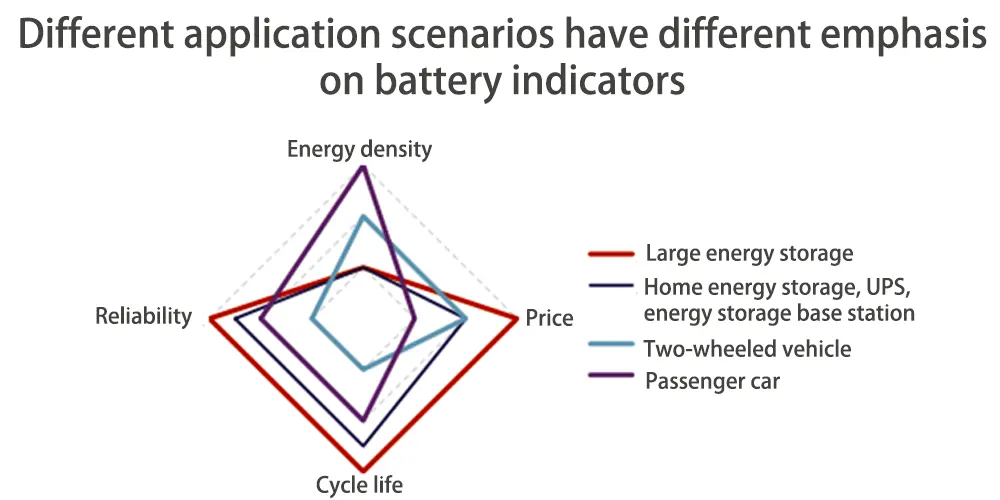
Although sodium-ion batteries are low in cost, they have low cycle performance and have no advantages. Household storage, UPS, and base station energy storage have relatively low requirements for these two indicators, focusing on purchase costs, and relatively low requirements for cycle life.
Cost evaluation elements and core influencing factors of each scenario
| Evaluation elements | Influencing factors | |
| Energy storage | LCOS (large energy storage), lithium iron phosphate battery price (household storage, UPS, base station) | Acquisition cost, replacement cost, cycle life to fame |
| Two-wheeled vehicle | Lead acid battery price | Acquisition costs, production line investment |
| Electric vehicle | Low-end lithium iron phosphate price | Acquisition costs |
Application of sodium battery in home energy storage
Household energy storage has lower requirements on cycle life and performance, the system capacity is not large, and safety control is easier. The household energy storage capacity of the To C attribute is 100kWh level, the capacity is small, and the requirement for the cycle life of the battery is relatively low. The general requirement is about 6000 times. The sodium ion has already approached this requirement in the early stage of industrialization.
At the same time, the number of household energy storage cells is small, often only 20 to 40 cells, with a capacity of about 100Ah, and the overall system power is only equivalent to 1/10 of a BEV, which makes it easier to control consistency and safety.

In the field of household energy storage, the requirements for battery performance and cycle life are low, and the purchase cost is the core evaluation index. The cycle life of sodium-ion batteries can reach 4000-5000 times. In the field of home energy storage, because it is not necessarily full and full, the damage to the battery cycle life is relatively low, and the warranty period is usually 10 years. Calculated by charging and discharging once a day, sodium-ion batteries can meet the requirements of this field.
Home energy storage has low requirements on battery performance
| Home energy storage | |
| Capacity | 50-100Ah |
| System Power | 6.5kWh |
| Cycle life | 6000 cycles |
| Energy density | 150Wh/kg |
| C-rate | 0.5C |
| Warranty period | 10 years |
At the same time, the volume of household energy storage products is small, and the problem of low volumetric energy density of sodium-ion batteries will not have a great impact on cost and floor space. Household energy storage users are more concerned about cost, so the purchase cost of sodium-ion batteries is the core evaluation indicator. With the industrialization of sodium-ion batteries, it is expected to quickly replace lithium iron phosphate battery and ternary lithium battery in this application scenario.
Sodium battery in the application of large energy storage
Large energy storage has high requirements on cycle life and performance, large system capacity, and difficult to control safety and consistency. The large energy storage with To B attribute has a large capacity of a single EPC, which is at the MWh level, and has high requirements on the cycle life and reliability of the battery.
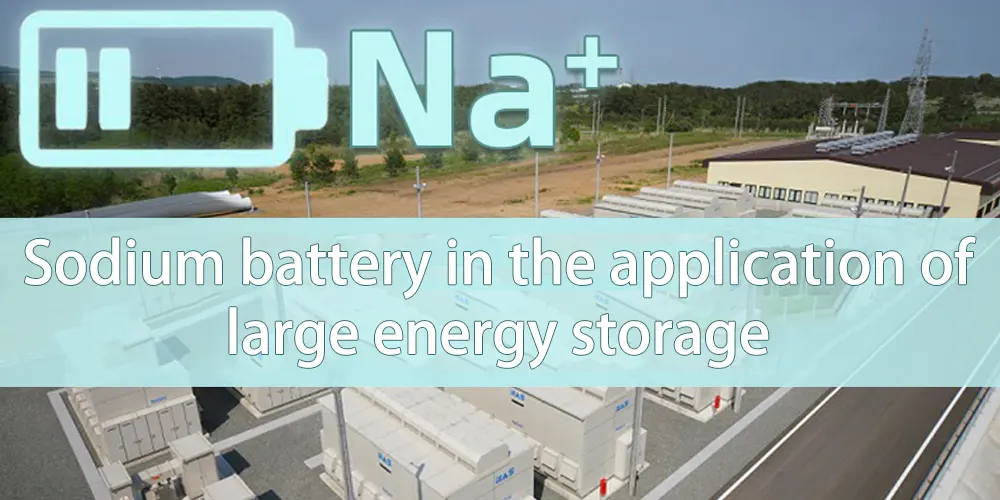
At present, the planned application life of the system is 20 years, and the corresponding cycle life of the battery is required to be more than 10,000 times. The lithium iron phosphate system battery cell can reach this level through lithium supplementation, cathode improvement and other technologies.
However, the cycle life of sodium-ion battery cells is 4,000-5,000 times, which is far lower than that of lithium iron phosphate battery, and often requires multiple replacements in large-scale storage scenarios. At the same time, the large storage system has a large number of batteries, usually 3,000 to 4,000 batteries, and has a large capacity of 280Ah+. Once a safety accident occurs, the overall loss will be large, so it is difficult to control consistency and safety.
Application of sodium batteries in base stations and UPS fields
Base station batteries and UPS are both used as backup power sources, with low requirements on cycle life, but high requirements on anti-floating performance, power decay rate and calendar life. Backup power equipment is often powered by the grid, and only works when a power outage occurs. Due to the emphasis on cost, cascaded lithium iron phosphate batteries were often used as backup power and UPS lithium battery in the past.

With the improvement of performance requirements, CATL has launched 100Ah batteries in the field of 5G base stations. In the UPS scenario, the voltage range varies greatly, and CATL has launched a 20Ah cylindrical battery to adapt to different voltage ranges.
Sodium-ion batteries have a long cycle life and are expected to meet this application scenario. Therefore, similar to the application logic of household energy storage, after large-scale cost reduction is carried out, it is expected to quickly replace in this field.