Skip to content



In its manufacturing process the production of the battery slurry is the basis of the production and manufacturing process of the cell, and is one of the important processes that determine that the electrode can meet the design requirements of the battery cell.
As a large capacity battery is composed of multiple single lithium ion batteries in series or in parallel, the battery life ends prematurely due to the inconsistent performance of a single battery. Before the assembly of the battery pack, ensure the consistency of the single battery of the battery pack as much as possible, so as to reduce the difference of the battery in the recycling process.
The role of battery slurry
Therefore, in order to ensure the consistency of single battery and improve the performance stability of the whole batch of batteries, it is necessary to ensure the uniformity of battery slurry. However, due to the physical characteristics of the electrode slurry, the performance of the battery slurry is difficult to observe directly. Therefore, the following properties are generally measured to indirectly study and ensure the uniformity and stability of the battery slurry.
Properties of lithium battery slurry
The cathode slurry of lithium ion battery is formed by mixing the cathode material, battery binder and conductive agent with stirring and uniformly dispersing them in the solvent. The preparation of battery slurry includes a series of technological processes such as mixing, dissolution, friction and dispersion between liquid and liquid, liquid and solid materials, and solid and solid particles, in this process, temperature, viscosity, particle size, viscosity and other parameters change.
Viscosity of battery slurry
The viscosity of battery slurry is a characteristic quantity reflecting the friction or viscosity (hysteresis) in slurry, which is a feature that fluid blocks its relative flow, and is also one of the key parameters to identify whether slurry is suitable for coating.

There are many factors affecting the viscosity of battery slurry, such as the composition of battery slurry, environmental conditions, solvent ratio, temperature, stirring time, etc.
When the viscosity of battery slurry is too high, although the stability of slurry is good, its fluidity is poor, the leveling performance and wetting effect of copper foil and aluminum foil are not good, which is not conducive to the coating process, and the appearance of the electrode is easy to be abnormal.
When the viscosity of battery slurry is too low, although the fluidity of slurry is good, the storage performance of slurry is poor and it is easy to settle, and the dispersion is also relatively general. At the same time, the low viscosity of battery slurry will also cause problems such as wet flakes formed by coating and drying difficulties, coating cracking, slurry particle agglomeration, poor consistency of surface density, etc.
However, there is no uniform standard for the viscosity of battery slurry, which needs to be adjusted according to the characteristics of the materials and the performance of the coater.
At present, the viscosity of battery slurry is generally controlled at 4000~8000mPa · s. In the future, with the improvement of processing technology, the viscosity of battery slurry should be higher. At present, when measuring viscosity, it is also necessary to ensure the consistency of slurry temperature to compare the stability of slurry viscosity.
Battery slurry temperature
In order to make the battery slurry mix evenly, it needs to go through such processes as mixing, kneading and high-speed dispersion. Under the high-speed rotation and stirring for a long time, the friction between material particles will generate great heat, which will cause the temperature change of slurry inside the slurry.
The influence of temperature on the coating of the next process is the instability of surface density. If the temperature of the slurry entering the coating head is different from the temperature of the coating head lip itself, the coating head lip becomes a heat exchanger. As a result, the temperature of the slurry changes when the coating slurry flows from the inlet of the distribution chamber to the end.
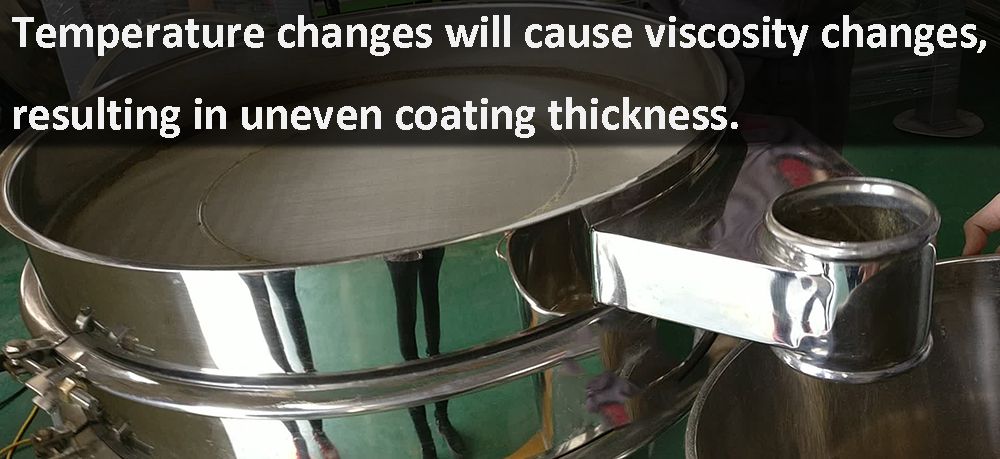
Temperature changes will cause viscosity changes, resulting in uneven coating thickness. Therefore, it is necessary to test the temperature of battery slurry and install a temperature control system during the transportation of battery slurry, to keep the consistency of the temperature of the battery slurry, the temperature of the coating head and the ambient temperature to ensure the consistency of the surface density of the slurry coating.
Particle size distribution of battery slurry
The particle size and particle size distribution of the active substance are important factors in the battery slurry process. The smaller the active substance particles, the greater the viscosity of the continuous phase, the weaker the slurry stratification caused by gravity, and the better the stability of the suspension system.
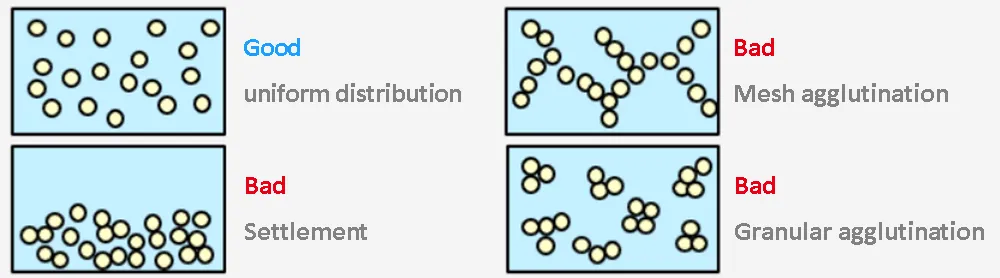
However, when the particle size is reduced to a small size, the binding force between particles becomes the main role, and agglomeration will occur between particles, which is not conducive to the stability of the system.
Therefore, in the dispersion of slurry, the finer the particle size is, the better. Instead, it should be distributed in a narrow size range to achieve the mutual balance between suction and repulsion, so as to ensure the stability of slurry system.
Dispersion degree of slurry
Solid content of battery slurry
The solid content of battery slurry is closely related to the stability of slurry. For the same process and formula, the higher the solid content of slurry, the greater the viscosity, and vice versa. In a certain range, the higher the viscosity is, the higher the stability of battery slurry is.
In the actual production process, it is of other significance to check the solid content of battery slurry, which is to ensure that the weight of various materials put into slurry pulping is accurate. In order to ensure that the solid content is within the required range, the drying method will be used in production, and the instrument used is a moisture tester.
Summary
As a multi-component non-equilibrium system, the biggest problem is that the internal particles are agglomerated due to electrostatic attraction, van der Waals force or hydrogen bonding, or the sedimentation occurs under the action of gravity, which affects the dispersion uniformity and stability of battery slurry.
Therefore, to make a stable battery slurry, it is necessary to comprehensively consider the influence of material properties, formula, mixing process, environment and other factors, and the final answer can be obtained through continuous practice.