Skip to content


The business performance of Hunan Yuneng and Hubei Wanrun lithium iron phosphate products in the first half of 2022 is not disclosed separately, but the comprehensive performance is shown. In 2021, the operating income of Hunan Yuneng lithium iron phosphate products will account for 98.55% of its total revenue, and its operating costs will account for 98.05% of its total operating costs;
The operating income of Hubei Wanrun lithium iron phosphate products accounts for 99.05% of its total revenue, and its operating costs account for 99.03% of its total operating costs. Due to the large proportion of the lithium iron phosphate business of the two companies, their comprehensive gross profit margin in the first half of 2022 can largely be used as a reference for the gross profit margin of lithium iron phosphate products.

The reason for the decline in gross profit margin
The main reason for the decline in the gross profit margin of lithium iron phosphate enterprises is the increase in operating costs, especially the cost of raw materials. From 2021 to the first half of 2022, the price of raw materials for lithium iron phosphate production will rise significantly. The raw materials for the preparation of lithium iron phosphate mainly include lithium source, phosphorus source and iron source. The source of lithium is lithium carbonate, while the sources of phosphorus and iron are more diverse. The mainstream in China is iron phosphate.
From 2021 to the first half of 2022, due to the booming performance of the new energy market, the demand for lithium iron phosphate batteries has increased significantly, and the demand for materials has also increased accordingly. Drive the prices of front-end raw materials lithium carbonate and iron phosphate into the rising channel, increasing the procurement cost of lithium iron phosphate enterprises.
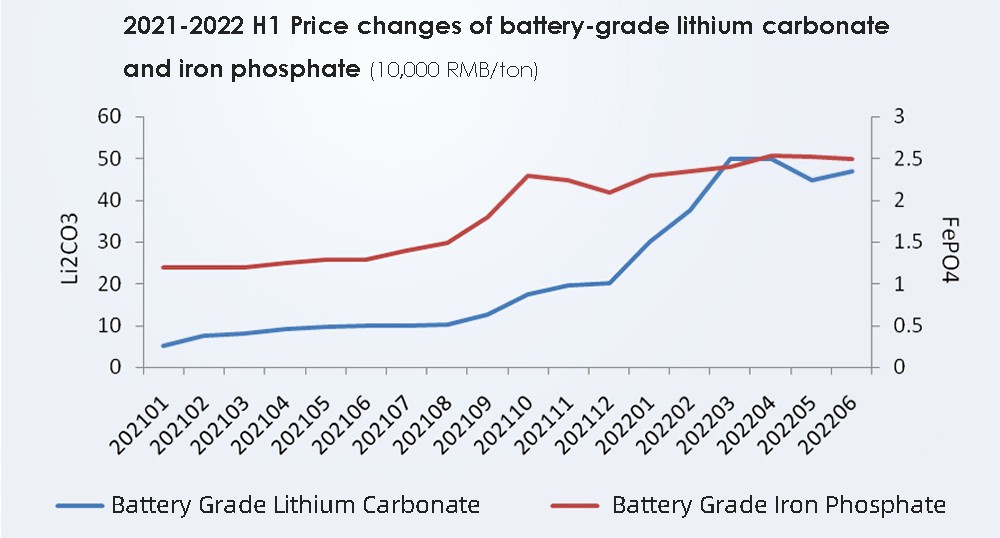
The proportion of raw material costs in operating costs has further increased, from about 80% to over 90%. Judging from the cost structure of four companies including Hunan Yuneng and Hubei Wanrun in 2021, the raw material cost of a single ton of lithium iron phosphate in 2021 will be around RMB 30,000, accounting for about 80% of the total cost.
Due to the strong rise in the prices of raw materials such as lithium carbonate and iron phosphate, in the first half of 2022, the proportion of raw material costs of lithium iron phosphate enterprises to the total cost has increased to more than 90%, and the overall cost of raw materials has risen by more than 150%. The raw material procurement cost of a single ton of products of some enterprises has risen by more than 100,000 RMB, which has brought great pressure on the enterprises in terms of cost.
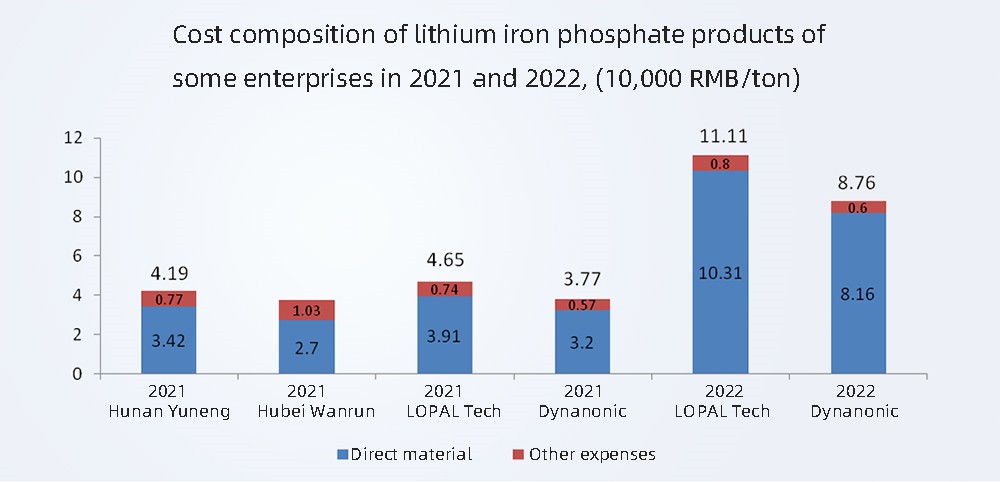
Note: 2022 LOPAL Tech, Dynanonic costs are estimates
Controlling raw material costs has a significant impact on gross profit margins. From the perspective of cost structure, the cost reduction space of raw materials is the largest and most feasible, which is also reflected in the first half of this year. In the first half of 2022, as one of top 10 sodium ion battery manufacturers Dynanonic’s lithium iron phosphate product average selling price is lower than that of LOPAL Tech (The average selling price of Dynanonic is about 120,000 RMB/ton, and LOPAL Tech is about 127,600 RMB/ton).
However, due to its well-controlled raw material cost, the unit raw material cost is 20,000 RMB lower than that of LOPAL Tech, and finally achieved a gross profit margin of 27%, while the gross profit margin of LOPAL Tech is only 13%. The importance of controlling raw material costs cannot be overemphasized.
Lithium iron phosphate enterprises try to strive for raw material cost advantages
Cost reduction will be the key for lithium iron phosphate enterprises to achieve high profitability in the future, and enterprises need to strive for raw material cost advantages as much as possible. Lithium iron phosphate enterprises can consider cooperating with upstream raw material enterprises such as lithium carbonate to build raw material production projects.
Lithium iron phosphate material companies and lithium salt companies jointly establish subsidiaries to jointly build lithium salt projects, which can not only ensure the supply of lithium in the future, but also can usually purchase lithium carbonate raw materials at relatively low prices, which is conducive to reducing the cost of raw materials.
For example, LOPAL Tech’s unit raw material procurement cost has always been high in the industry. In May this year, LOPAL Tech announced that it will jointly develop and construct a lithium hydroxide/lithium carbonate project with an annual output of 30,000 tons with Tangshan Xinfeng Lithium Industry Co., Ltd. In order to ensure the stable supply of raw materials and reduce the adverse impact of raw material price fluctuations on the company.

The introduction of recycled materials has the potential to reduce costs. China’s lithium iron phosphate recycling technology is initially mature and put into the market, providing a new choice for raw material sources.
For example, Guanghua Technology can currently use raw materials to manufacture 8,000 tons/year of lithium iron phosphate. It will put into operation a high-efficiency comprehensive utilization project of waste lithium batteries within this year, and will use recycled battery-grade lithium carbonate and iron phosphate to synthesize lithium iron phosphate.
Guanghua Technology said that the project will further expand the production of lithium-ion battery electrode materials, and also strengthen the efficient and comprehensive utilization of waste lithium batteries, which will help reduce operating costs, improve product profit levels, and lay a solid foundation for subsequent development. In addition, the use of recycled materials can maximize the harmlessness and resource utilization of waste, which is conducive to the realization of battery recycling economy and has good social benefits.