

These problems are inconvenient to core industries, e.g., healthcare, tech businesses, etc., that rely on stable electricity to function effectively. Beyond inconvenience, these problems can damage expensive essential devices, e.g., servers, medical equipment, etc.
Consider an alternative power source, e.g., a high rate battery that can store electric power and deliver the required current when needed. We’ve designed this article to help you understand why a high rate battery benefits you. You’ll also understand the best high rate battery type and how to choose the high rate battery that’ll power your device efficiently.
What is a high rate battery?
A high rate battery is a specially engineered battery that releases large bursts of current over a period of time. A comprehensive understanding of how battery works heavily depends on its charging and discharging rate – commonly referred to as a battery’s C-rate.
A battery’s C-rate is a unit used to measure how fast a battery can be fully charged or discharged. For example, 1C charge rate means the battery can be charged from 0% to 100% in one hour.

High rate discharge battery
A high rate discharge battery means that the high rate battery has a uniquely high power performance. It additionally discharges large bursts of current with exceptional temperature stability, which is essential for this type of battery.
In some cases, high rate battery such as lithium-ion batteries can discharge faster than they can be recharged. This difference is brought by how difficult it is to embed lithium ions to the cathode during current discharge.
High rate charge battery
High rate charge battery means that the high rate battery can fast charge to rejuvenate lost charge during the charging process. However, since lithium ions are inserted into the anode (graphite) during charging, it is difficult to insert lithium ions into the cathode during discharge, so the rate of fast charging is generally lower than the rate of discharge.
What are the types of high rate battery? Which is the best?
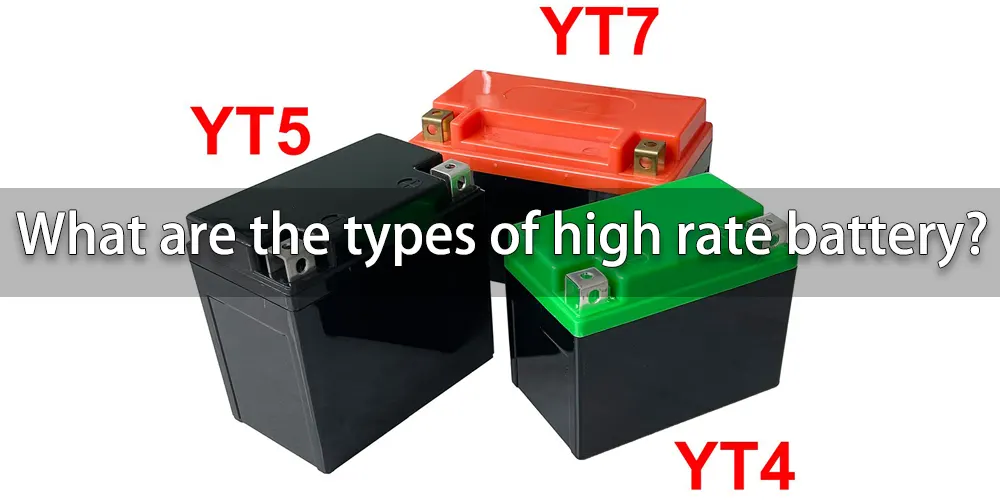
There are three main types of high rate batteries; sealed lead-acid Battery (SLA), high rate lifepo4 battery, and high discharge NMC lithium battery (ternary lithium battery).
Sealed lead-acid high rate battery
A sealed lead-acid (SLA) high rate battery has a slightly different internal structure than a normal lead-acid battery. High rate SLA batteries have more lead plates that are significantly thinner.
The unique design of sealed lead-acid high rate battery enables the battery to release large bursts of current. The key benefit of using an SLA high rate battery is that it does not require active maintenance.
High rate lifepo4 battery
A high rate lifepo4 battery is essentially a rechargeable lithium battery. This battery is highly beneficial because of its thermal stability and long cycle life. The battery further has a low self-discharge rate.
High discharge NMC lithium battery
A high discharge lithium battery is, yet again, a rechargeable lithium battery that discharges large bursts of amps quickly. It has a higher energy density than a high rate lifepo4 battery and is popularly used for heavier applications.
In general, a high discharge lithium battery is better than SLA batteries primarily because of its efficiency. In addition, its ability to comfortably handle heavier applications makes it a better choice.
What are the features of lithium high rate discharge battery?
There are four primary features of a lithium high rate discharge battery:
● A high rate discharge battery has power cells that deliver high current loads.
● Longer life spans if handled properly.
● It can handle heavier applications such as racing devices, jump starters, etc.
● Lightweight compared to other high rate batteries, e.g., SLA high rate battery.
High rate battery vs normal battery – difference and comparison
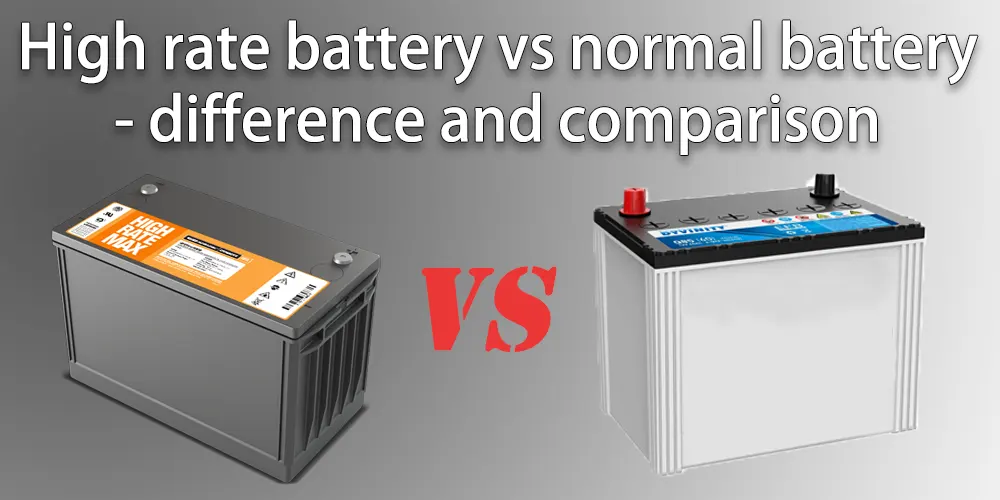
At this point, it’s clear that a high rate lithium battery differs from a normal lithium battery. Here are their differences and similarities:
Differences
| High rate battery | Normal battery |
| Discharges high amounts of amps | Discharges normal amounts of amps – its discharge duration depends on the battery’s Ah rating |
| A high rate battery can fast charge without damaging the battery | Fast charging may cause lithium stripping, therefore, causing irreversible damage |
| Used to power significantly heavy applications, e.g., aerial drones, model airplanes, emergency power supplies, power tools and other products that require rate discharge, etc. | They are primarily used for normal applications, e.g., small energy storage batteries, electric toys, etc. |
| Better temperature handling and tolerance | Lower temperature handling and tolerance compared to a high rate discharge battery |
Similarities
● Similar battery chemistry – both batteries are lithium best rechargeable batteries.
● Lightweight and stable.
● Both batteries have protection circuit boards (or battery management systems) to protect the batteries from overcharging and over-discharging.
Pros and cons of lithium high rate battery
Pros
● Faster charging and discharging times – reduced downtime
● Longer battery life span
● Releases high bursts of amps
● Excellent temperature handling and tolerance
● Lightweight and stable
● Powers heavy applications comfortably
● Environmentally friendly

Cons
● High acquisition costs – lithium high rate batteries’ initial price is quite high.
● Do not overcharge and overdischarge – overcharge and overdischarge will affect the life of lithium-ion batteries
The applications of high rate battery
As you read at the beginning of this article, a high rate battery is primarily used for high-power applications. Some of these applications include:
● Racing devices
● Aerial drones
● Jump starters
● Power tools
● Electric skateboards, bikes, etc.
What affects the high rate discharge battery performance?
A high rate discharge battery performance is primarily affected by internal resistance, mainly at the battery’s electrodes. Batteries generally have two electrodes, an anode and cathode.
The battery’s performance at the anode is affected by following factors: the electrode’s size, structure, thickness, anode surface resistance (also known as internal ohmic resistance), electrode conductivity, and electrode film thickness. The physical aspects of the anode determine the concentration of lithium ions, causing concentration resistance.
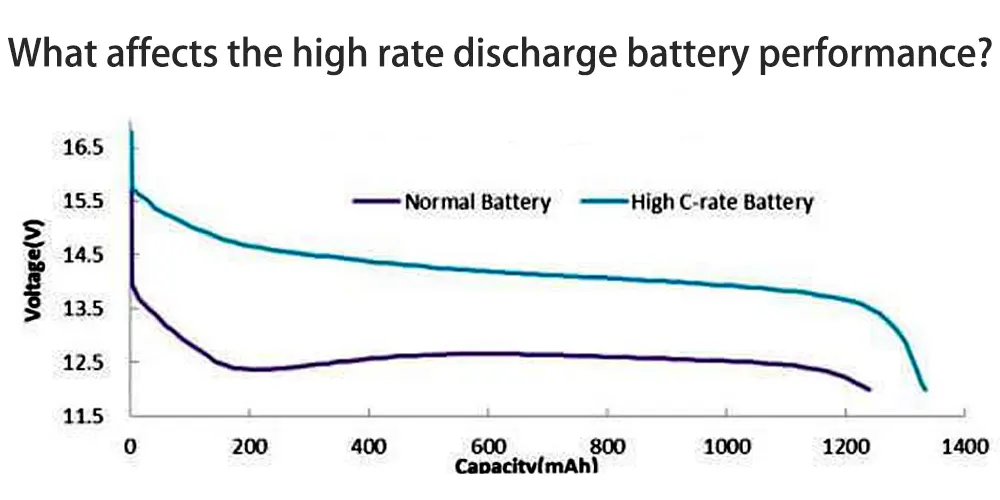
Similarly, Ohmic resistance affects a high rate discharge battery’s performance at the anode – the lesser the Ohmic resistance, the better the performance. Thinner electrode film thickness helps batteries have a better performance. On the other hand, a battery’s cathode is affected by three primary factors; structure of cathode material, electrode conductivity, and electrode film thickness.
The best cathode structure that will guarantee rapid transfer of lithium ions is a three-channel cubic crystal structure popularly used by lithium-ion manganese oxide batteries. This type of cathode is ideal for high rate charge and discharge batteries.
Cathode conductivity also affects a high rate discharge battery’s performance. High rate lithium discharge batteries can improve their cathode conductivity by adding conductive agents, e.g. carbon black. These conductive agents significantly improve the battery performance.
The final factor that affects the performance of a high rate discharge battery at the cathode is electrode film thickness. Thinner electrode films portray better battery performance, especially if the battery is under high currents.
How to choose a high rate battery for your device?
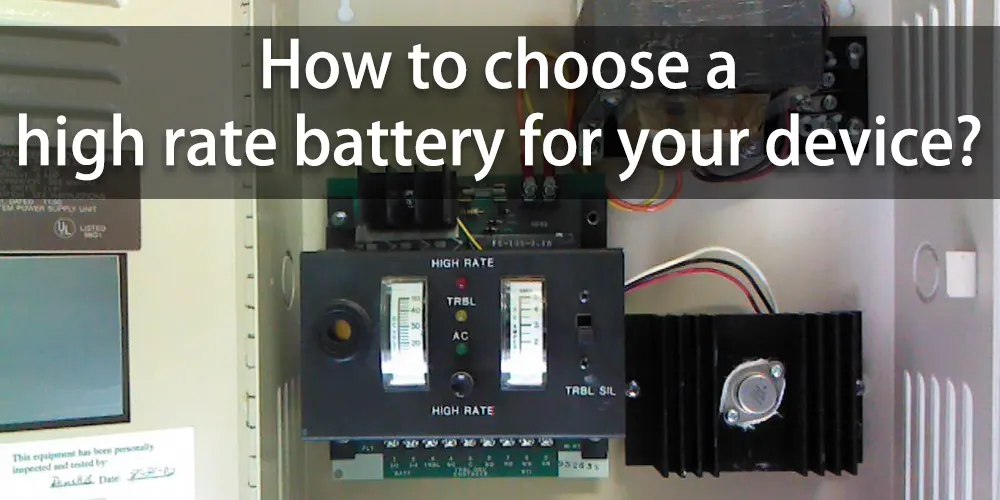
You’ll need to consider several factors when choosing a high rate battery for your device.
The first factor is the battery load requirements. Your high rate discharge battery needs to deliver enough amps without running out of current, depending on what kind of devices and applications you want to use the battery for.
Secondly, consider checking the battery’s environmental temperature. While high rate batteries have exceptional temperature stability, it would be best to avoid hotter temperatures.
Thirdly, consider whether your battery will be mobile or stationary. This consideration will enable you to acquire the ideal battery for your application. It would be best if you’d further consider evaluating your application’s required discharge time.
What do you need to consider to choose high rate discharge 18650 batteries?
It would be best to understand your application’s continuous current – doing so will help to determine the ideal high rate discharge 18650 batteries. Choosing a battery with a lesser current rating than your application will cause the battery to overheat because it will be overworking. If an inverter is used, the power of the inverter should also be considered. The power of the high rate battery should be greater than the power of the inverter
Wrap-up on high rate battery
High rate batteries are versatile – they can power homes, businesses, and critical industries. What’s more important is choosing the right high rate battery to power your applications. You can always contact us for more personalized information on high rate batteries.