Skip to content
Understanding Smart Watch Battery: Battery Life and Safety Analysis
With the rapid development of artificial intelligence technology, high-tech products such as smart watches, smart bracelets, and smart glasses have emerged. Especially in the field of smart watches, the functions are becoming more and more complete, with powerful functions such as positioning, mobile payment, calls, videos, health monitoring, electronic fences, learning, etc., and the next 10 years will usher in a period of rapid growth.
As the energy supply station of the product, the quality of the smart watch battery directly determines the user experience to a large extent. This article will introduce the application of smart watches, the battery life of smart watch battery, the safety performance of batteries, and the time to replace smart watch battery.

Daily use of smart watches
The type of smartwatch to use should be determined based on the mobile phone that the user uses most often. Apple phones can not only use iwatch, but also many Android smartwatches; while Android phones cannot use Apple’s iwatch at all, and can only use other brands.
Although the systems of smartwatches may be different, they all need to be used with mobile phones to work properly, so they must be connected to mobile phones via Bluetooth, and the software for managing the watch must be installed on the mobile phone.
One of the most important functions of smartwatches is to tell time, just like ordinary watches. The advantage of smartwatches is that the dial can be changed at will, whether it is mechanical retro or trendy and alternative, it can be downloaded and installed. In addition, the watch screen can be selected to be always on, just like traditional watches, or you can choose not to light up the screen at ordinary times, and then light up the screen when the hand is raised, the latter is more power-saving.
When you need to record your daily exercise, using a smartwatch is a good choice. A powerful watch will not only record your steps and the number of stairs you climb at any time, but also record heart rate and other values. It can also remind you in time that you have been sitting for too long and need to get up and exercise. So you should turn on the reminder and notification functions of the smartwatch to achieve the best fitness function.
When the user is busy and cannot hold the phone to make calls, then using a smartwatch is a good choice. After connecting the phone and the watch via Bluetooth, the incoming call will be transferred to the watch, and the call can be answered and made directly with the watch, and the user can continue to be busy with the work at hand.
When the user is in a meeting, or in certain occasions where the use of mobile phones is not allowed, you can use a smartwatch to connect to the mobile phone, which can be more convenient to use the watch to check text messages or notification information of some software, so as not to miss important things.

What are the factors that affect the life of smart watch battery?
- Battery capacity:
Battery life depends largely on the battery capacity of smart watches. After the industrial design is completed and the product appearance is designed, organizations and hardware engineers need to find a way to put batteries into the product. Generally speaking, the larger the battery size, the larger the capacity will be, but the battery cannot only look at the capacity, but also the capacity density.
Many smart watch batteries have large capacity and large size. Putting a battery of such a large size on the smart bracelet host, which is originally limited in size, greatly affects the thinness and aesthetics of the bracelet. Therefore, while maintaining the thinness of the bracelet, if you want to increase the battery life, you have to consider the capacity density of the battery.
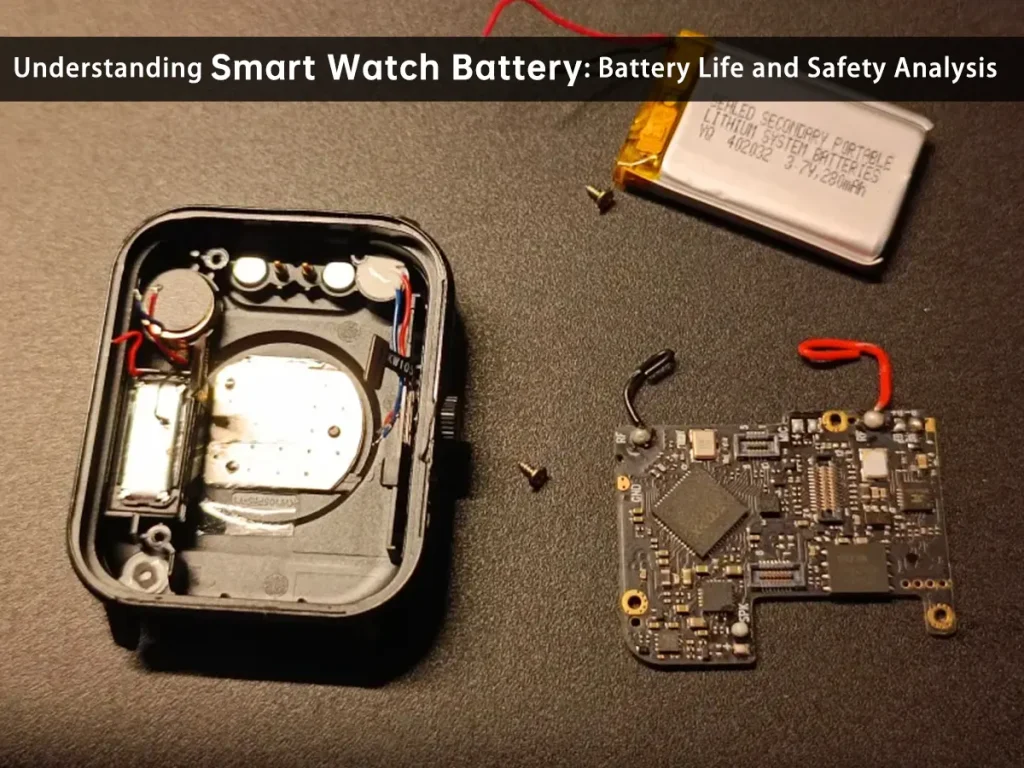
The root cause of the poor battery life of smart watches is mainly limited by the current battery technology. Although lithium batteries have a smaller and lighter volume than earlier nickel batteries, and have a higher energy density, within a limited volume, from a safety perspective, smart watches can only use lithium batteries of about 300-400mAh. Under the consumption of the screen and high-performance processor, the battery life it can provide is really limited.
- System and functions
In addition to the battery capacity and the size and structure of the watch itself, the battery life of the watch is also affected by the watch system and functions.
The battery life of sports watches affects the usage scenarios and scope of the watches. They have real-time monitoring functions such as blood oxygen, heart rate, and sleep, and also have positioning and navigation functions. The more and more complex these calculation programs are, the more hardware support is required, and naturally the power consumption is faster.
- Display
Sports watches are similar to smartphones in that the display consumes a lot of power. If the power consumption of the screen can be controlled, it is the key to improving the battery life of the product.
In fact, increasing the battery life of smart watches is not an absolute problem. The difficulty lies in how to find a balance between battery life and multi-functions.
Challenges in the smart watch industry
- Insufficient battery life and frequent charging
Smart watches are generally charged once every 2-4 days on average. Due to the limitations of appearance and weight, they cannot be equipped with larger capacity batteries. At the same time, smart watches also integrate multiple functions such as heart rate monitoring, sending and receiving text messages/emails, and caller ID, which puts more stringent requirements on power consumption.
- Lack of innovative functions and unclear positioning
Smart watches overlap with smartphones in positioning, lack of innovative functions, screen display area is much smaller than that of mobile phones, touch is not accurate, and network connection depends on mobile phones. These problems have become bottlenecks for the rapid growth of smart watches in the early stages of development.

Safety performance index requirements for smart watch battery
Smart watch batteries are somewhat similar to lithium-ion batteries in smartphones. They both require high energy density, high voltage, and high safety. They must ensure low expansion rate in cycles, excellent fast charging performance, and low self-consumption rate. The market entry threshold is much higher than the current entry threshold of the mobile power market.
Battery safety indicators are the primary condition and are strictly tested in accordance with higher than national standards. They must be charged, discharged, dropped, vibrated, thermally abused, short-circuited, heavily impacted, squeezed, punctured, kept at a constant temperature, horizontally wet, high and low temperatures, and fogged to ensure their safe use.
How to achieve safety indicators for smart watch battery?
The balance between ultra-high energy density, stable and reliable safety and cycle life has become a technical difficulty in the industry. It tests the limit indicators of material and process design, the high precision of manufacturing equipment, the comprehensiveness and effectiveness of process inspection methods, and the quality management capabilities of manufacturers.
The specific implementation is a comprehensive consideration from material research and development to process design, to high-level manufacturing, to reliability testing and inspection shipment. Add anti-overcharge and flame retardant additives to the electrolyte, and increase the safety margin in process design.
In the manufacturing workshop, perform efficient and high-standard demagnetization, dust control, burr control, moisture control, electrostatic protection and other operations. Use X-Ray, β-Ray, CCD and other efficient detection methods to perform long-term high-temperature aging storage, OCV testing, etc. before shipment.
When does a smart watch battery need to be replaced?
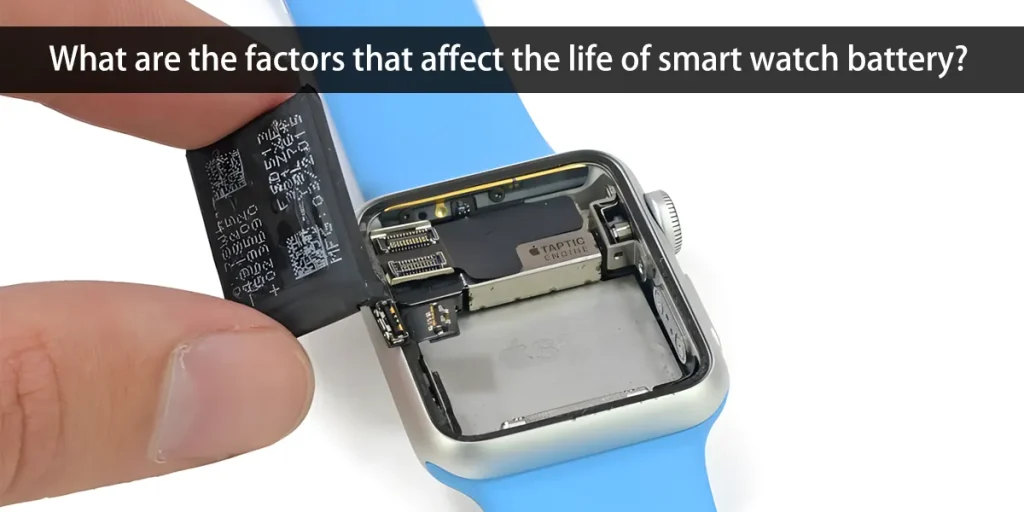
Smart watches play an increasingly important role in people’s daily lives. Unlike traditional mechanical watches, their lifespan is obviously not that long. After all, they rely on batteries for power supply, and batteries will eventually run out. So can smart watch battery be replaced? When should they be replaced?
The lifespan of smart watch battery is related to brand and usage habits. Some better brands have better product quality, so the longer they can be used, another very important factor is personal usage habits. If the frequency of use is high and the number of charges per day is high, then it may need to be replaced in 1-2 years, while the lifespan is longer if the frequency of use is low.
For sports watches, the battery generally needs to be replaced every 12-18 months. However, this is also normal usage, and everyone should determine the time and frequency of battery replacement according to their own different usage.

Conclusion
In addition to paying attention to the replacement time of smart watch battery, it is also important to choose original batteries, which will be more compatible with the original watch. The watch bands is also a vulnerable part. Frequent daily use causes severe friction of the strap and often breaks.
Therefore, users have a great demand for watch bands. The smart watch brands we often see include Apple, Garmin, Samsung, etc. When choosing a strap, choosing a strap of the same brand will be more compatible with the original watch. For example, Garmin watches choose garmin watch bands, and Apple watches choose Apple watch bands. Wearing products of the same brand will give full play to the performance advantages.