Skip to content

At the same time, fast charging has progressively become the default setting for popular models. The focus of the battle between automakers and power batteries has also shifted to how to address the issue of thermal protection of battery packs under high power and high voltage fast charging.
Battery thermal runaway
The battery system of an electric vehicle is composed of hundreds of cells connected in series and parallel. When a cell in a battery module or battery pack experiences thermal runaway.
The battery module releases a large amount of heat, part of which is used to increase its own temperature, and the other part is transferred to adjacent cells by convection, heat conduction, and radiation, and the remaining heat flows out during the smoke injection process.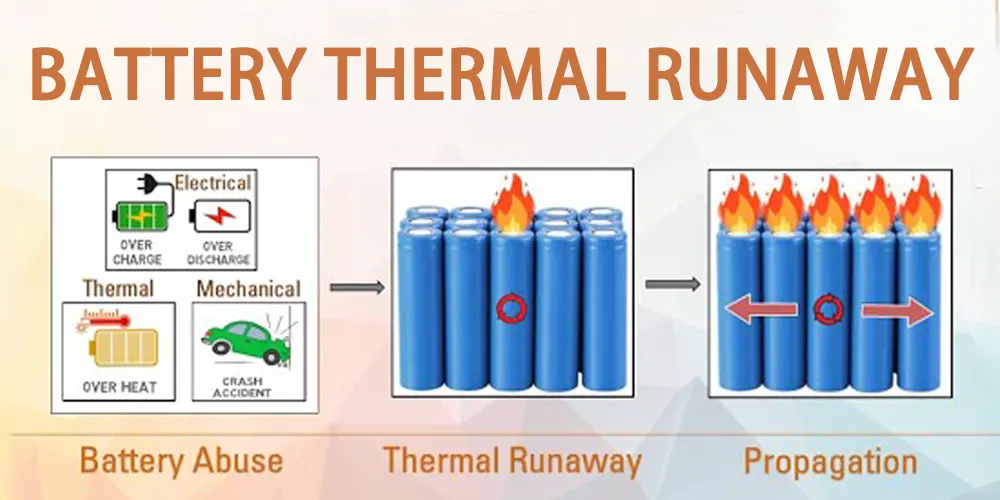
When the temperature of the adjacent cells reaches the trigger temperature of thermal runaway, thermal runaway spread or thermal diffusion occurs.
For a single cell, the energy released by its thermal runaway is very limited, but if hundreds of cells experience thermal runaway at the same time in a short period of time, it will cause great harm.
The necessity of thermoelectric separation
Thermoelectric separation is the only way to the next generation of protection technology. The traditional battery pack safety design focuses on the protection of “heat”, such as increasing the cooling area, using heat-resistant materials with better heat insulation performance, etc.
After all, from the perspective of chemical paths, “heat” does cause the battery to catch fire and explode root cause. The technologies and solutions for heat protection, including the industry, are already very mature. In many cases, the current “heat” protection scheme, blocking heat is no problem.
However, the gas-liquid-solid mixture emitted by the thermal runaway of the battery cell is very easy to cause the “secondary hazard” of thermal runaway.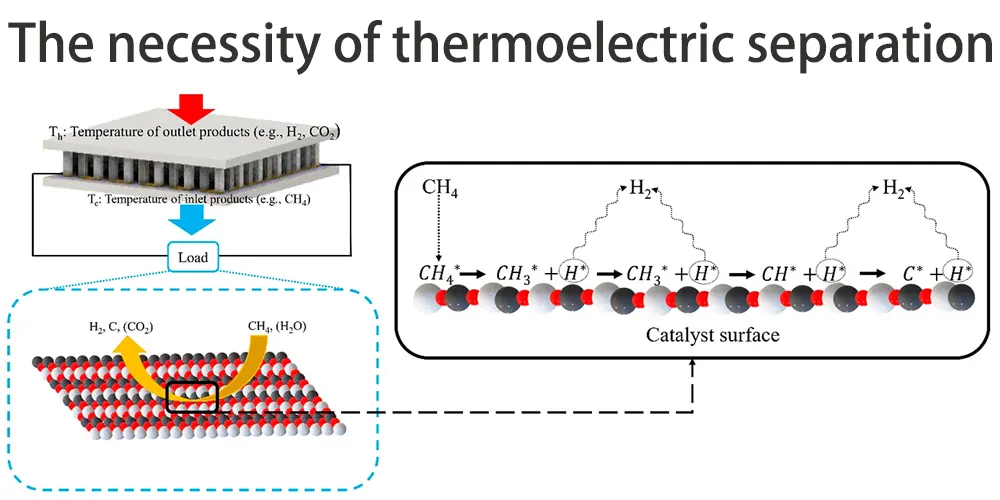
Among them, the secondary hazards caused by “electricity” are the most serious, such as arcs (breaking through metal plates, melting metal plates, etc.), short circuits, and insulation failures. In this case, the thermal runaway that could have been suppressed instantly became uncontrollable.
Therefore, the factor of “electricity” must be considered in order to realize the real “battery pack does not catch fire”. Thermoelectric separation design is a good solution.
The core of thermoelectric separation
With the development of liquid power battery technology to a relatively mature stage, the current power battery industry chain is fiercely competing around cost reduction and efficiency enhancement and large-scale manufacturing.
Compared with the previous two years, the technological dividends brought about by subversive material and structural innovations have weakened.
Under the current background, the technological innovation of power batteries is more reflected in more targeted solutions to subdivided pain points or terminal scenarios.
At the system level, thermal runaway protection and structural simplification have become the focus of power battery companies.
The battery cell has an explosion-proof valve, which can realize directional discharge of thermal runaway, so that thermal runaway protection design can be carried out in a specific direction.
The current mainstream cell protection valve arrangement is:
(1) Cylindrical 18650 battery and 21700 battery explosion-proof valves are located at the positive end;
(2) The square cell (the output pole is at the same end), the explosion-proof valve is located at the end of the output pole, vertically upward;
(3) Square batteries (output poles are distributed at both ends) such as blade batteries, the explosion-proof valve is located at one end and arranged horizontally;
(4) There is no clear direction of explosion venting for pouch batteries, which is one of the main reasons why it is difficult to do thermal runaway of pouch batteries
The explosion-proof valve of the conventional cell is on the same side as the tab, which means that the thermal runaway pressure relief area is in the same direction as the high and low voltage lines, and it is impossible to “separate” in physical space.
In this case, high-temperature eruptions are easy to accumulate in the pressure relief channel, resulting in a high-voltage short circuit, and can easily spread to adjacent cells or electrical units.
Only by changing the position of the explosion-proof valve can the cross-linking of gas and strong electricity not occur. Therefore, the core innovation of thermoelectric separation mainly lies in the bottom or side explosion-proof valve design.
When the explosion-proof valve is transferred to the bottom of the cell, the battery pack can truly achieve “thermoelectric separation”.
However, the transfer of the explosion-proof valve position will also bring a lot of technical difficulties. One is how to stably produce explosion-proof valves on shells with a thickness of millimeters; the other is how to precisely control the valve opening pressure; the third is the anti-shock and calculation of pressure relief after the valve is opened.
In addition, the difficulty in the design of the explosion-proof valve lies in the shell. The wall thickness of the battery case must be different. There are specifications for the thickness of the shell that must be met while welding explosion-proof valves.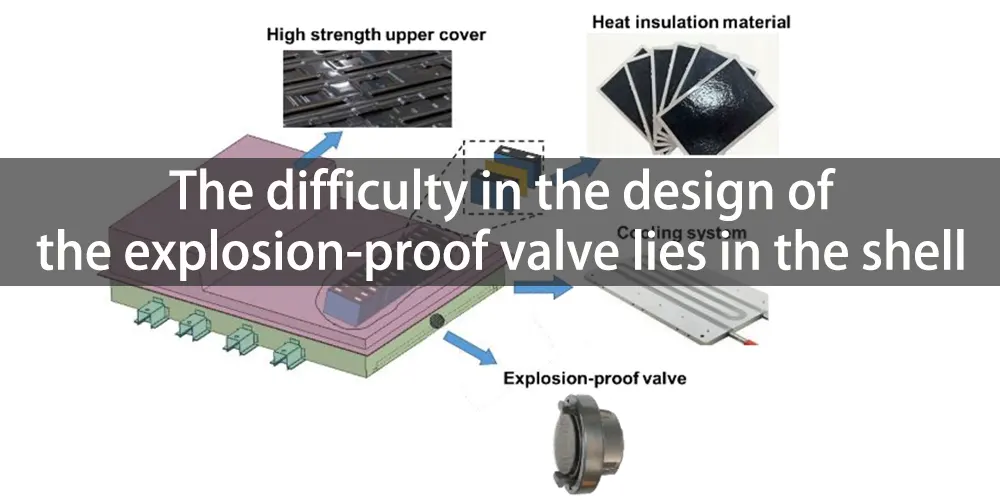
The weight and price of the cell will be too high if the constant wall thickness shell is too thick. The three sides of the shell that do not require welding the explosion-proof valve must be made as thin as possible, while the side that requires welding the explosion-proof valve must be made thicker.
The side of the explosion-proof valve that needs to be welded should be thickened. Shells with unequal wall thickness are mainly extruded, which is affected by yield.
Application of thermoelectric separation
In Tesla’s 4680 CTC solution, the cell explosion-proof valve is designed at the bottom of the cell, that is, the thermoelectricity is separated in the Z direction.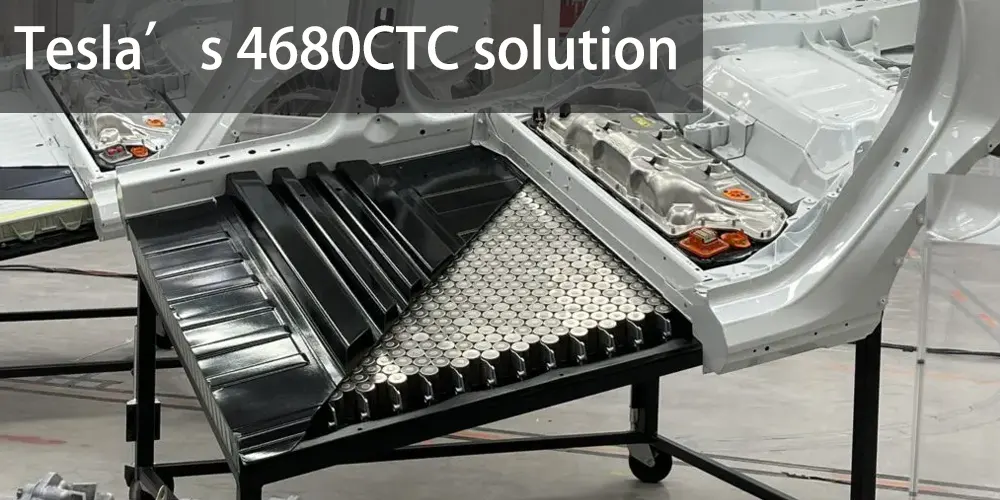
When the battery is integrated, it is only necessary to guide and fix the bottom discharge space, and complete the electrical connection at the positive end of the battery cell.
However, SAIC’s “Rubik’s Cube” battery directly “lays down” the battery cells, so that the direction of the eruption port is no longer upward, but instead erupts sideways.
In addition, CATL NP2.0 technology and CALB TPP2.0 technology also have the characteristics of active isolation of high pressure and smoke, and downward pressure relief.
As the industry’s first battery system that clearly adopts the design of “thermoelectric separation”, one of the highlights of SVOLT’s “dragon armor battery” is that the explosion-proof valve is placed at the bottom of the short blade battery.
The thermal runaway of a single cell can quickly achieve directional pressure relief, and the eruption can be quickly discharged through the optimal channel in the specified direction without spreading to the surrounding cells.
It is reported that SVOLT has innovated the position design of the explosion-proof valve and placed it on the side when designing the first generation of short knife cells. The second-generation short knife battery was changed to the bottom, and 2 pressure relief valve positions were designed.
As a result, the dragon armor battery completely physically isolates the bottom pressure relief valve from the poles on both sides, realizing complete insulation between the high-temperature pressure relief material of the battery core and the electrical connection space.
At the same time, the dragon armor battery can provide a cooling solution on the upper and lower sides, so that the large area of the battery cell is in contact with the cooling plate, and the heat exchange capacity is increased by 70% compared with the general level.
In conclusion, thermoelectric separation is an innovative solution to battery safety and protection issues, and it is likely to become a standard design feature in the near future. As automakers and power battery companies continue to compete in this space, it’s clear that the focus on safety will remain a top priority.