 Skip to content


Therefore, under the trend of rising prices of new materials and scraps and predictable market prospects, the battery recycling industry chain has also spawned some new business models. Enterprises in the new energy industry chain are also making more and more frequent moves in the field of recycling, and their cooperation models are gradually diversified.
Lithium will be priced separately
According to reports, the recycling pricing model of China’s ternary lithium battery and materials was based on the cobalt and nickel prices of Shanghai Nonferrous Metals Network, China, and multiplied by a certain coefficient on this basis. Although lithium does not participate in the pricing during the recycling process, under the background of high lithium prices, the cost of lithium is amortized to nickel-cobalt, resulting in a substantial increase in the nickel-cobalt coefficient.
The data shows that in the past two months, the discount factor of waste lithium iron phosphate black powder has rapidly increased from 30% to nearly 10%, and the price of each lithium point (1% lithium content) has increased from 21,000 RMB to 26,000 RMB. The procurement cost of recycling companies has increased by more than 20%, while the price of lithium carbonate of finished products has increased by only about 15% in the same period.
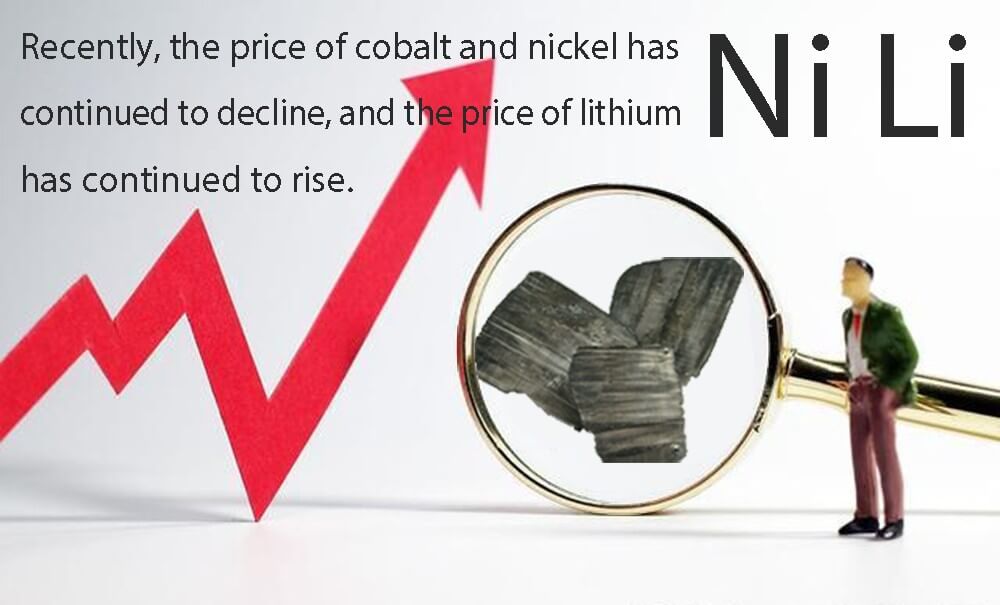
Because the most valuable lithium element does not participate in the pricing of ternary waste, the discount coefficient has already been inverted, and the discount coefficient of the waste powder of the pole piece has risen sharply from 200% to nearly 230%. Therefore, in the recent situation that the price of cobalt and nickel has continued to decline and the price of lithium has continued to rise, the profit margin of recycling companies has been greatly compressed. Therefore, recycling companies began to explore new pricing methods for battery recycling materials, and began to gradually incorporate lithium into the pricing system.
At present, recycling companies are actively promoting this action. It is reported that the relevant person in charge of Tianqi Co., Ltd. said that the company is working with several leading recycling companies to actively promote the direct incorporation of lithium into the pricing system. At present, most of the company’s purchase orders have already gone according to the new pricing system. Specifically, the recycling discount coefficient of cobalt and nickel is 80%~90%, and that of lithium is 65%~80%.
Of course, it is impossible for the market to accept all the new pricing methods for a while, and there are still some differences. Especially in terms of the reference standard of quotation, such as the discount factor of lithium element, some manufacturers are benchmarking against lithium metal, while others are benchmarked against lithium carbonate.
Overall, the new pricing method will play a clear normative role in curbing speculative molecules doping lithium-containing battery materials with lithium-free materials, but whether it is a long-term feasible solution needs to be tested by the market.
Industrial chain enterprises and capital start various strategic cooperation
Since the beginning of this year, the price of lithium has continued to skyrocket. Data shows that the average spot price of battery-grade lithium carbonate rose by 2,500 RMB/ton to 570,000 RMB/ton on the same day, continuing to hit a record high. The highest price in the spot market on that day reached 578,000 RMB/ton.
At the same time, it has entered the traditional peak season in the fourth quarter, and the demand for lithium carbonate is further increasing, but the supply has decreased. In the context of rising prices, some market participants believe that the price of battery-grade lithium carbonate has risen to 600,000 RMB/ton.
In the face of new outlets, strategic cooperation between new energy industry chain enterprises and various capitals emerges one after another, and a new business model of ‘waste for raw materials’ has also emerged.
1. Battery factories and OEMs join hands with material companies or recycling companies:
On September 25, Vine Renewable, a joint venture between Ivy Vine Renewable Resources, which is 100% owned by SVOLT, and Guizhou Zhongwei, was officially launched in Shangrao, Jiangxi.
In May and July, BMW and one of the top 10 power battery companies LG New Energy successively reached in-depth cooperation with Huayou cobalt in the field of waste battery recycling. Among them, BMW will join hands with Huayou Cycle, a subsidiary of Huayou cobalt, to create an innovative cooperation model of closed-loop recycling and cascade utilization of power battery materials to achieve closed-loop management of power battery raw materials; LG New Energy and Huayou cobalt will establish a battery recycling joint venture in China. The source of used batteries is LG New Energy’s Nanjing Battery Plant.
On October 26th, Funeng and Zhenhua E-chem signed a strategic cooperation agreement, and will carry out various cooperation around battery materials. Among them, in terms of waste and used battery recycling, the two parties will jointly strengthen cooperation in the field of recycling waste and used batteries, and a recycling contract has been signed in July 2022 to realize the recycling of ternary cathode material metal through Zhenhua New Material’s shareholding company, and then process it into ternary cathode material for recycling.
Under this cooperation model, a new industry model of ‘waste for raw materials’ has gradually emerged recently, that is, recycling companies collect waste from the production process of battery factories and material factories in a targeted manner by agreement. After the nickel, cobalt, lithium and other metals are extracted, battery-grade nickel, cobalt sulfate and lithium salt are produced, and then returned to the battery factory and material factory.
And this model has already been implemented by leading recycling companies and battery companies in 2021. In August 2021, GEM signed a memorandum of cooperation with EVE on the directional recycling of 10,000 tons of recycled nickel products.
In 2022, GEM will continue to expand the partners of this business model, and successively reached strategic cooperation with Ronbay, Funeng, REPT and other companies, and agreed to return battery-grade finished products to each company by means of directional recycling of waste. In addition, Guanghua technology and LISHEN, Tianqi and Jinghe Shaanxi Coal Research Institute and Phylion Battery also signed similar waste-to-raw material agreements.
2.The raw material enterprises are recycled by themselves:
Tianqi Chuangli, a wholly-owned subsidiary of Tianqi lithium, and Weilan New Energy jointly established Tianqi Weilan solid lithium in August this year. Tianqi Chuangli and Weilan New Energy hold 58.50% and 41.50% respectively.
The company’s business scope includes recycling and secondary utilization of waste power batteries for new energy vehicles. Tianci material issued two production expansion announcements in May and July this year, both of which included a 100,000-ton iron-lithium battery recycling project;
Earlier on August 3, 2021, the Tianci material iron phosphate new energy material project was officially signed, after the project is put into production, it can achieve an annual output of 300,000 tons of iron phosphate and 50,000 tons of lithium iron phosphate recycling, and is expected to become the largest iron phosphate production base in the country.
Ganfen Lithium established Ganfeng Renewable in January this year to expand its presence in the waste battery field. Its subsidiary Recycling Technology has formed a recycling and processing capacity of 34,000 tons/year for dismantling and comprehensive metal recovery of decommissioned lithium batteries. In the future, Ganfeng Lithium will build a large-scale complex that can recycle 100,000 tons of retired lithium batteries per year.
3.Enterprise cross-industry entry recycling field:
On May 26, Sany Heavy Industry, a leading Chinese construction machinery company, reached a strategic cooperation with Batrui Technology. The two parties will carry out long-term cooperation in battery banking, retired power battery recycling and other businesses, and jointly build a power battery recycling network. Overclocking III entered the field of battery recycling and cathode materials through the acquisition of Gejiu San Bihe in January.

Recycling companies frequently receive financing
According to incomplete statistics, since the beginning of 2022, more than 11 battery recycling companies have received financing, including EVERGREEB, Shunhua Lithium, Raynen, Saidemi, etc. The funds raised are mainly used to expand reproduction and the construction of recycling channels.
It is worth mentioning that Shunhua Lithium received three rounds of financing during the year. The latest A+ round of financing on October 31 was led by Minmetals Venture Capital, Jiangsu Guoxin, and SVOLT invested directly. It also received follow-up investment from many other well-known institutions. .
Both Raynen and Jin Sheng received two rounds of financing during the year. Among them, Raynen was also approved as a ‘whitelist for recycling’ in 2020. Its customers have covered battery manufacturers such as BYD, Sunwoda, and SKI, as well as OEMs such as GAC, FAW, and BAIC. At the same time, it has also entered the supply chain of international companies such as Apple.
Jinsheng New Energy has been approved by the Ministry of Industry and Information Technology’s “white list”, and has entered the supply system of China’s leading companies in top 10 lithium ion battery manufacturers such as Huayou cobalt, Zhongwei, LG Chem, CATL, etc.


2 thoughts on “Power battery recycling prices rise – lithium will be priced separately”
I am curious to find out what blog system you’re utilizing?
I’m having some minor security problems with my latest site and I would like
to find something more risk-free. Do you have any suggestions?
just wanted too say, I liked tyis post.
It was funny. Keeep onn posting!
Comments are closed.