Skip to content



However, solar energy has problems such as low energy density, low power generation efficiency, and great influence by environmental factors, which restrict its development. Therefore, improving the efficiency of photovoltaic power generation has become a hot research field.
This paper mainly analyzes the change of heat transfer flow caused by changing the spacing of the solar cell square array structure, which can improve the efficiency of photovoltaic power generation, and other factors that affect the efficiency of solar power generation.
Change the distance of photovoltaic panels to increase photovoltaic efficiency
Some studies have found that when changing the distance of the photovoltaic panel, the change of its operating temperature has a significant impact on the output power of the photovoltaic array.
The change of the square array will not only affect the total irradiance incident on the module surface, increase or decrease the temperature of the module, but also change the path of the heat removal airflow, and change the convective cooling efficiency of the photovoltaic system.
The power temperature coefficient of a single crystal silicon battery is about -0.5%/℃, that is, the battery operating temperature increases by 1℃, and the battery output power decreases by 0.5%.
Therefore, in order to improve the efficiency of photovoltaic power generation, it is essential to control the temperature of photovoltaic modules.
In order to achieve the maximum power of the solar panel in actual use, it is necessary to simulate its real working environment through modeling before design, so as to adjust the parameters or structure of the device.
To this end, some researchers established a general photovoltaic temperature model, taking into account parameters such as row spacing, panel height and tilt angle to complete the spatial arrangement of photovoltaic systems.

In addition, the model also considers the spatial layout of different photovoltaic power plants, and improves the model by adding convective heat transfer coefficients.
The results of the study show that as the row spacing increases, the incident irradiance and convective cooling of the PV modules increase, and so does the output power. Compared to existing conventional thermal modeling of convection, the system predicted a 0.98% increase in power output per year for the same row spacing variation.
However, the researchers did not specify how far apart the solar panels should be, as each photovoltaic system is different and depends on local conditions.
What other factors affect photovoltaic power generation efficiency?
When the conversion efficiency of the solar cell module is constant, the power generation of the photovoltaic system is determined by the radiation intensity of the sun, and the solar radiation amount is positively correlated with the power generation.
Due to the existence of the atmosphere, the amount of solar radiation that actually reaches the earth’s surface is affected by many factors, including the altitude of the sun, the quality of the atmosphere, and the transparency of the atmosphere.
Sun altitude
The altitude at which the sun is above the horizon is called the sun altitude. The altitude of the sun is constantly changing throughout the day. For a certain ground plane, when the altitude of the sun is low, the light travels through the atmosphere longer and its energy decays more.
In addition, the light is projected on the plane at a smaller angle, so less solar energy actually reaches the place, and vice versa.
Atmosphere quality
Atmospheric absorption and scattering attenuate solar energy reaching the ground. The magnitude of its attenuation is related to the length of the solar radiation passing through the atmosphere.
The longer the solar radiation travels through the atmosphere, the greater the energy attenuation; the shorter the distance, the smaller the energy loss.

Atmospheric transparency
On the Earth’s surface, the solar irradiance varies frequently due to differences in atmospheric transparency.
In clear and cloudless weather, the atmospheric transparency is high, and more solar radiation reaches the ground; in cloudy or dusty weather, the atmospheric transparency is low, and less solar radiation reaches the ground.
For photovoltaic power generation, the most important factor affecting its power generation is the amount of solar radiation, followed by the temperature of the components.
Since the radiation intensity and spectral characteristics of the sun change with the meteorological conditions, it has a large randomness and is difficult to control.
Therefore, the researchers turned their attention to adjusting the distance of the components to control the temperature.
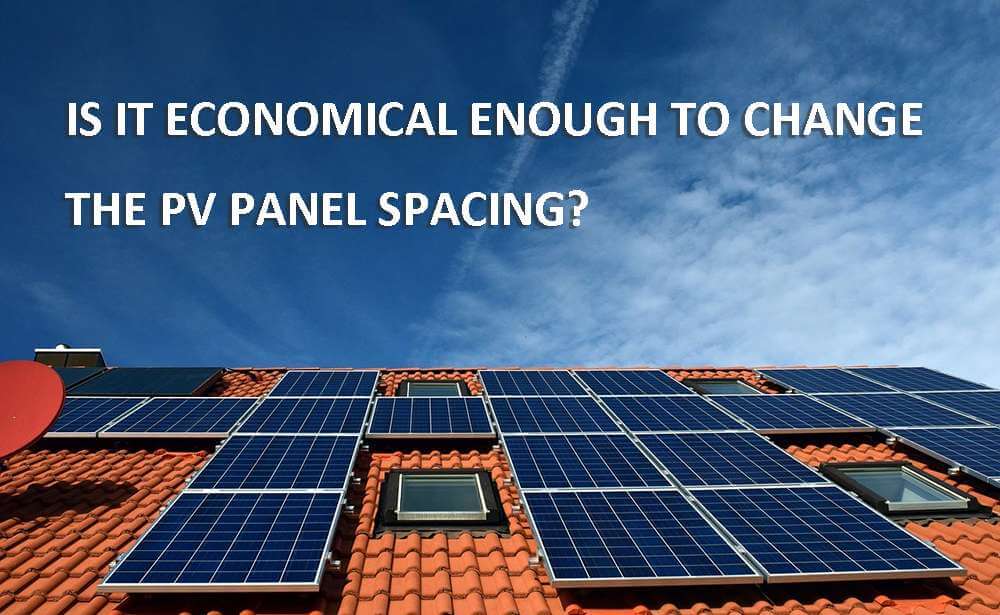
Is it economical enough to change the PV panel spacing?
Increased row spacing or ground coverage results in increased PV system costs and land costs, as well as changes in energy performance.
Therefore, it is necessary to evaluate the impact of PV array configuration changes that change the convective heat flow on the surface of PV modules on the performance of PV system techno-economic analysis.
The researchers evaluated the techno-economic analysis of their model using normalized energy cost output as an indicator. The results show that by adjusting the row spacing of PV modules, the normalized energy cost output of the system can be increased.
In certain climates, the increase in primary energy from increased incident irradiance for single- and double-sided PV systems and the secondary convective cooling effects from increased row spacing outweigh the increased land and wiring costs.
On a related note, the research could be particularly relevant to the field of agricultural photovoltaics, where crops can be grown alongside or below solar panels. Industry experts say that increasing the spacing allows a wider variety of crops and more types of agricultural equipment to be used in agricultural PV systems.
Another advantage of increasing the distance between the solar panels is that it increases the ground reflected irradiance on the solar panels, and the panels do not block each other to reduce the amount of solar radiation.
While greater spacing may come with higher costs due to the need for more land, professionals say the benefits ultimately outweigh the costs.