Skip to content



The price war of new energy vehicle companies
In January 2023, new energy vehicle power batteries will mainly be destocked, and the price of lithium battery materials will decline to varying degrees. In the terminal market, new energy vehicles ushered in a wave of price cuts. Among them, the prices of Tesla’s China-made models Model 3 and Model Y have dropped to record lows, with a price cut ranging from 20,000 RMB to 48,000 RMB.
The price cuts of different models of Xiaopeng Motors are about 20,000 RMB-30,000 RMB. The price reduction range of some models of AITO Wenjie Automobile is between 28,800 RMB and 30,000 RMB. At the same time, car companies including one of the EV battery swapping companies NIO Automobile, GAC Aian, Jikr Auto, SAIC-GM-Wuling, and Feifan Automobile are also reducing consumers’ car purchase costs in various ways.
New energy vehicles are going through a “price war” to stimulate the recovery of sales. Judging from the price cut, it basically returned to the price level before the material price increase last year. The growth of downstream sales has stalled, and car companies are cautious about orders for power batteries.
Negotiations on purchase volume and prices are currently underway. At the same time, the price reduction of upstream materials across the board is further reducing the cost of power batteries. Based on the price linkage method of signing orders, the price reduction of power batteries is already imminent.
It is reported that the current cost of lithium iron phosphate batteries has dropped to 0.53 RMB/Wh, and the cost of ternary lithium battery has dropped to below 0.73 RMB/Wh. The reduction in the cost of battery cells is mainly due to the decline in the price of upstream raw materials.
Taking battery-grade lithium carbonate as an example, from December 2022 to the present, the price has fluctuated green for two consecutive months. As of February 7, 2023, the average price of battery-grade lithium carbonate has fallen to 450,000 RMB/ton, a drop of more than 150,000 RMB/ton from the highest point in early November last year, and the current price has not yet bottomed out.
Some material companies also reported that the current product price drop has been around 10%, orders have been weak since the beginning of the year, and head battery companies have not yet started procurement plans.
On the one hand, the reason is that there is still inventory purchased years ago, and on the other hand, the price is still on the sidelines. This has also become the epitome of the general price drop in the lithium battery material industry chain.
Price trend of the four major lithium battery main materials
In the field of cathode materials, due to the decrease in orders and the drop in the price of lithium salts, the price of battery-grade lithium iron phosphate has dropped by more than 10%, and the price of medium-high nickel ternary materials has dropped by about 3%.

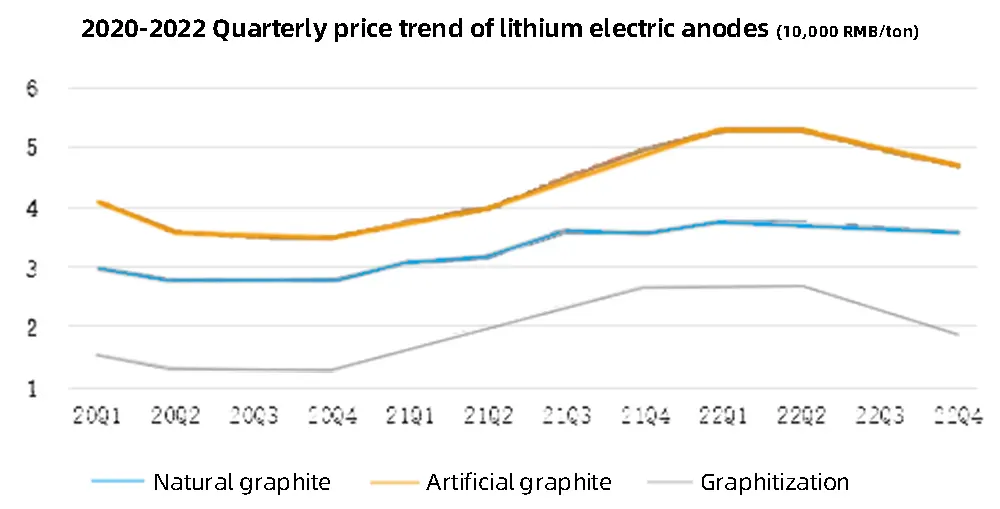
In the field of anode materials, the production capacity of artificial graphite products has been gradually released, and the production capacity of finished products has gradually shifted from balance to excess.
The new graphitization production capacity has been put into concentrated use and the proportion of application of new chamber furnace technology has increased, and the graphitization processing fee has gradually declined under the loosening of supply and demand. Supported by the simultaneous decline in upstream coke prices, some anode materials also saw a 5% price drop.
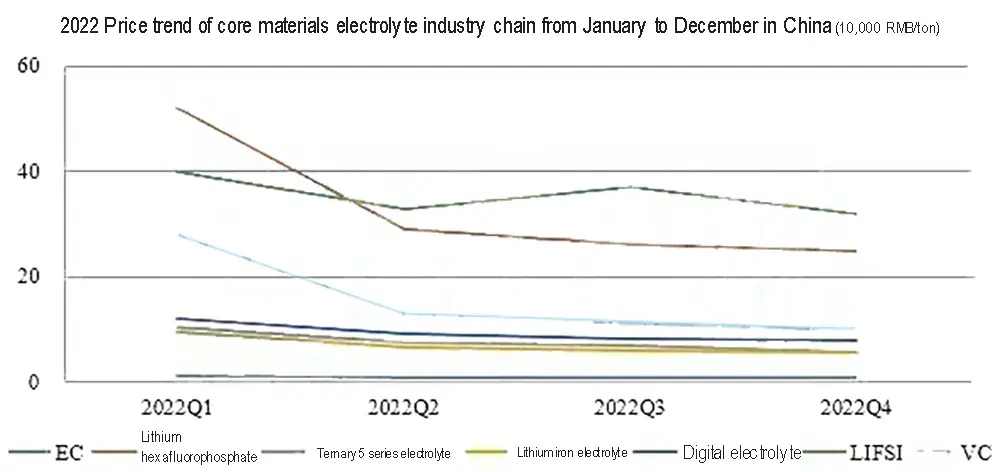
In the electrolyte field, the release of electrolyte and upstream raw material production capacity will be accelerated in 2022, among them, the new production of lithium hexafluorophosphate exceeds 80,000 tons, the new production of VC exceeds 20,000 tons, and the new production capacity of the electrolyte market exceeds 350,000 tons. Recently, the price of lithium hexafluorophosphate has dropped to 200,000/ton, a drop of 20% compared to December, and the drop of electrolyte is around 4%-7%.
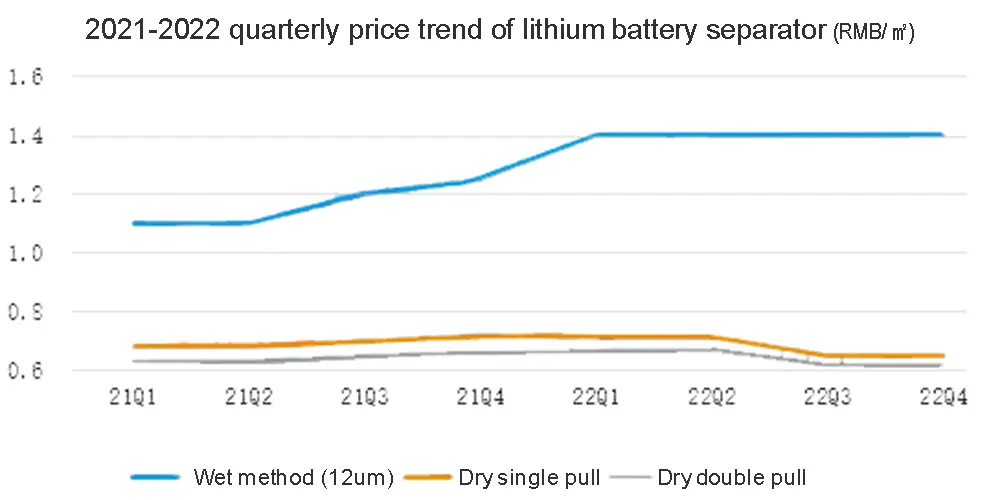
In the field of seperator, with the release of new production capacity after Q2 last year, the relationship between supply and demand in the industry has initially eased, but the price remains firm. At present, some manufacturers have started preliminary price negotiations, and it is expected that there will be a certain downward space.
It is worth noting that, from the perspective of supply and demand, the industrial chain of lithium iron phosphate, the industrial chain of negative electrode materials, and 6F, VC, PVDF, etc. In 2023, the effective capacity utilization rate will further decline, and the situation of oversupply will intensify.
The industry generally believes that with the help of falling prices of lithium battery materials and batteries, China’s new energy car companies may start a trend of exchanging prices for volume. With the launch of new models, sales in the second quarter are expected to improve. The annual sales volume of new energy vehicles in China is still expected to exceed 10 million.
Why is the price of lithium battery materials drop
Why has the price of lithium carbonate, which has been rising, dropped now? Some industry insiders said that the price drop was mainly due to factors such as the decline in subsidies for new energy vehicles and the expected weakening of the new energy vehicle market in 2023.
According to Cui Dongshu, secretary-general of the China Passenger Car Market Information Association, due to factors such as the withdrawal of new energy vehicle subsidies and lower market growth expectations.The price of lithium carbonate has dropped below 400,000 RMB/ton on the futures side, and the cost of batteries will inevitably drop significantly in the next few months.
In the first half of 2023, lithium will still maintain a tight supply and demand situation. In the second half of the year, there may be an oversupply. It is expected that the marginal supply of lithium resources will exceed demand in the second half of 2023.
Dr. Liu Jincheng, chairman of EVE, once pointed out at the industry summit that it is expected that there will be overcapacity in the entire industry chain by 2024 at the latest. Mo Ke is also worried that with the withdrawal of subsidies, the new energy vehicle market may usher in zero growth in 2023.
In the past year, the sales volume of China’s new energy vehicles reached nearly 7 million, a year-on-year increase of 93.4%, and the market share also reached 25.6%. Data show that in 2022, China will newly register 5.35 million new energy vehicles, accounting for 23.05% of the total number of newly registered vehicles.
In his view, the difference between sales and registrations of new energy vehicles is nearly 2 million units, which means that the inventory of electric vehicles accounts for a relatively high proportion, and trams may not be able to sell this year, and the supply is significantly higher than the demand.
Amid concerns about overcapacity, Tesla took the lead at key nodes and cut prices again in early 2023, setting off a storm in the Chinese market. After Tesla’s price cuts, Huawei’s Wenjie took the lead in following up, and the price cuts directly matched the Tesla Model Y, and the new force Xiaopeng Motors even started to cut prices.
Years ago, Xiaopeng Motors lowered the prices of its G3i, P5, and P7 models. The entry price ranged from 148,000 RMB to 209,000 RMB. The overall price reduction this time was 20,000 RMB-36,000 RMB.
Mo Ke believes that from the second half of the year, OEMs will gradually adopt the strategy of exchanging price for volume. If the growth rate of new energy vehicles suddenly slows down and becomes a more competitive Red Sea market, it will not be good news for the entire industry chain.