Skip to content

The European Union has unveiled an green power generation plan called “RepowerEU” that involves up to 210 billion euros ($221 billion) in funding over the next five years.
It mentioned the establishment of a dedicated EU solar strategy to double solar PV capacity by 2025 and install 600GW by 2030.
The need for renewable energy
The “RepowerEU” energy plan includes increasing imports of renewable energy and liquefied natural gas, reducing energy demand, thereby reducing energy dependence on Russia and accelerating the transition to green energy.
Recently, there has been a wave of shocks to the global energy supply. The EU has increased the proportion of renewable energy, including the input of photovoltaic power generation, not only to meet the needs of climate change, but also to meet the needs of many strategic considerations such as energy independence and energy security. New challenges and risk factors impact.
With the rise in the price of fossil energy, not only the EU, but also the global demand for renewable energy has increased, which is also good for the photovoltaic industry, and the overall prosperity of the photovoltaic industry has been further improved.
Since the beginning of this year, there has been an energy crisis in Europe. European countries have paid more attention to energy security and energy independence, and accelerated the transition to renewable energy. Among them, Germany has increased the time to fully use renewable energy to 2035, stimulating the demand for photovoltaic products.
The data shows that in 2021, Europe will add 25.9GW of photovoltaic installed capacity, a year-on-year increase of 34%; in 2022, Europe’s new photovoltaic installed capacity is expected to exceed 40GW, a year-on-year increase of more than 54%.
The prosperity of the photovoltaic industry is further improved
Driven by the European market, CITIC Securities predicts that the global installed photovoltaic capacity is expected to reach 230GW in 2022, a year-on-year increase of more than 30%, and the demand rhythm is expected to improve quarter by quarter.
At the same time as the market demand is strong, China’s photovoltaic industry relies on the large-scale advantages of the strong industrial chain and is very competitive in the world, and China’s intra-industry competition is also trending towards an oligarchic era.

The advantages of large-scale production capacity also enable Chinese photovoltaic enterprises to have certain pricing power, supporting the price of photovoltaic silicon materials and silicon wafer products to maintain a high level. The photovoltaic industry has the characteristics of capital-intensive and technology-intensive.
Industry access requires a certain core competitiveness, and preparations for a long-term race of three to five years or even more than ten years are required. Capital investment is far from enough. The photovoltaic industry has relatively fast process upgrades and technological iterations. It is very important to test the R&D ability of the enterprise and the control of costs, that is, the ability to reduce costs and increase efficiency.
Exports of photovoltaic products will accelerate
China’s photovoltaic industry has a price advantage, so without considering other geopolitical conditions, this energy plan is good news for the overseas export of China’s photovoltaic industry.
According to data, China’s PV module exports in the first quarter of this year were 9.6GW, 14.0GW, and 13.6GW for a total of 37.2GW, a year-on-year increase of 112%; among which, Europe imported 16.7GW of Chinese PV modules in the first quarter, an increase of 145% year-on-year.
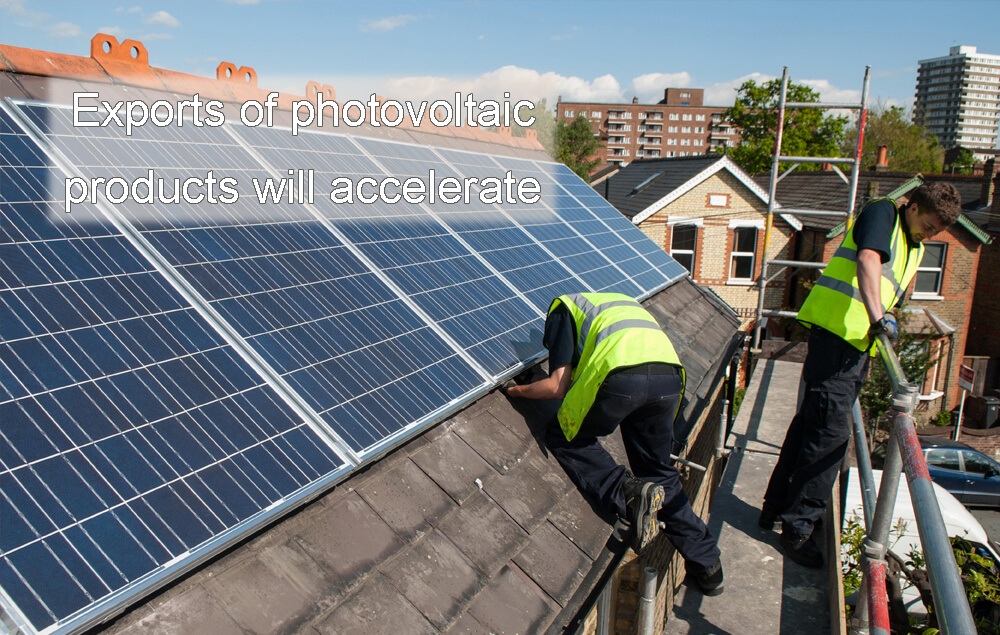
It is estimated that the installed photovoltaic capacity in Europe will be close to 30GW in 2021, accounting for about 18% of the world, including 25.9GW in the EU. “In terms of type, the distributed installed capacity in Europe accounts for about 80%, mainly due to the high degree of overall urbanization, which is suitable for the plain area of ground-based power stations. Relatively few, rooftop distributed photovoltaics have more suitable application scenarios.”
As a global leader in photovoltaic companies, LONGi Green Energy has also paid attention to this plan. “The company’s market share and shipments in the European market are in a leading position. The launch of this plan is good for the company’s layout in the European market.” LONGi The relevant person in charge of Green Energy told the “Securities Daily” reporter.
The financial report shows that the company achieved revenue of 80.932 billion yuan last year, of which the European region achieved revenue of 11.386 billion RMB, accounting for 14.07% of the revenue.
LONGi Green Energy
LONGi Green Energy’s performance in the European market this year is expected to further improve, “In the first quarter of 2022, in order to accelerate the development of the BIPV (Building Integrated Photovoltaic) business, the company and Cente Co., Ltd. conducted integrated operations for this business.

And this is also the direction of European photovoltaic development in the next few years, so the company has great potential for business development in this area in the future. “The European market is usually the core sales place for Chinese photovoltaic module manufacturers, accounting for a higher proportion of total revenue. First of all, the gross profit margin of modules is relatively high, which is expected to be around 20%, which is significantly higher than that of domestic companies.
The PV manufacturing capacity layout in Europe is relatively small, and most of the products will be supplied by Chinese companies, which will further stimulate the demand for Chinese products. It is recommended to pay attention to the overseas layout of the PV industry chain.
For more photovoltaic industry information, we have listed Top 10 solar battery manufacturers and Top 10 powerwall manufacturers for home energy storage.