Skip to content


Under the dual effects of rapid cost reduction and subsidy policies, distributed pv power plants with small-scale decentralized construction on the power consumption side have developed rapidly.
The development trend of distributed pv in China
Since 2021, China’s newly installed distributed pv capacity has surpassed that of centralized photovoltaics for the first time, while household photovoltaic installed capacity has experienced explosive growth, with an additional installed capacity of 21.5 GW, accounting for nearly three-quarters of the newly installed distributed pv capacity.
It is foreseeable that China’s distributed photovoltaic installed capacity will continue to maintain a rapid growth momentum, and distributed photovoltaic will also be deeply integrated with the new power system with the help of technological innovation.
Main application scenarios of distributed pv
The distributed pv power generation system has small installed capacity and flexible forms. In the vast urban and rural areas, it is easy to combine with load centers and idle spaces.
At present, the fields of construction, transportation, facility agriculture, and communication have become the main application scenarios of distributed photovoltaics, and the functional integration of photovoltaic power generation systems with sites and facilities is realized in the form of “photovoltaic +”.
Photovoltaic + Architecture
There are two types of distributed pv systems on buildings: installed photovoltaic power plants (BAPV) and building-integrated photovoltaic power plants (BIPV).
The most widely used rooftop photovoltaic power station belongs to the BAPV system; the BIPV system refers to the use of photovoltaic modules as building materials to become a part of the building itself, such as photovoltaic curtain walls, photovoltaic sunshades, photovoltaic roofs that directly replace color steel tile roofs, etc.
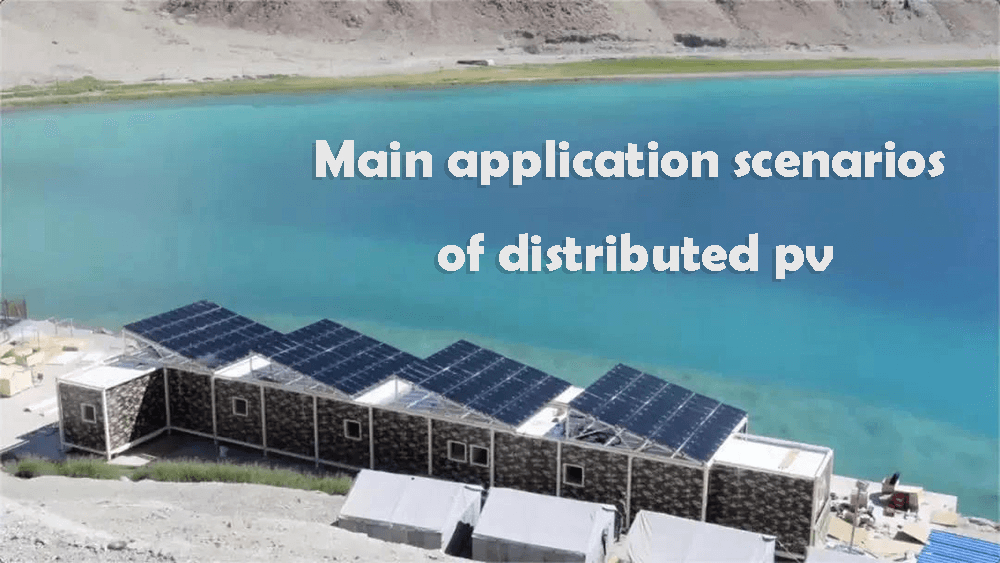 The installation of rooftop photovoltaic power stations and BIPV can protect the building from direct exposure to wind and rain. The smooth surface of photovoltaic modules can reflect part of the sun’s rays and absorb 80% of the light and heat at the same time.
This heat is collected on the photovoltaic panels, transferred partly to the tiles below by thermal conduction, and partly dissipated into the air, making heat conduction to the roof more limited.
Photovoltaic + Transportation
With the popularity of electric vehicles, the light storage and charging integrated carport has become a popular distributed pv application form. The photovoltaic system charges electric vehicles on-site, and the surplus power is connected to the Internet.
The distributed energy storage system can also be used to time-shift the energy, so as to smooth the fluctuations of photovoltaic power generation and load. In the public road system, photovoltaic street lights are the earliest and most widely used distributed pv form.
In recent years, photovoltaic bus stops, photovoltaic gas stations, and road slope protection photovoltaic power stations have also emerged in large numbers, and exploratory applications such as photovoltaic floor tiles and photovoltaic roads have also appeared.
Photovoltaic + Communication
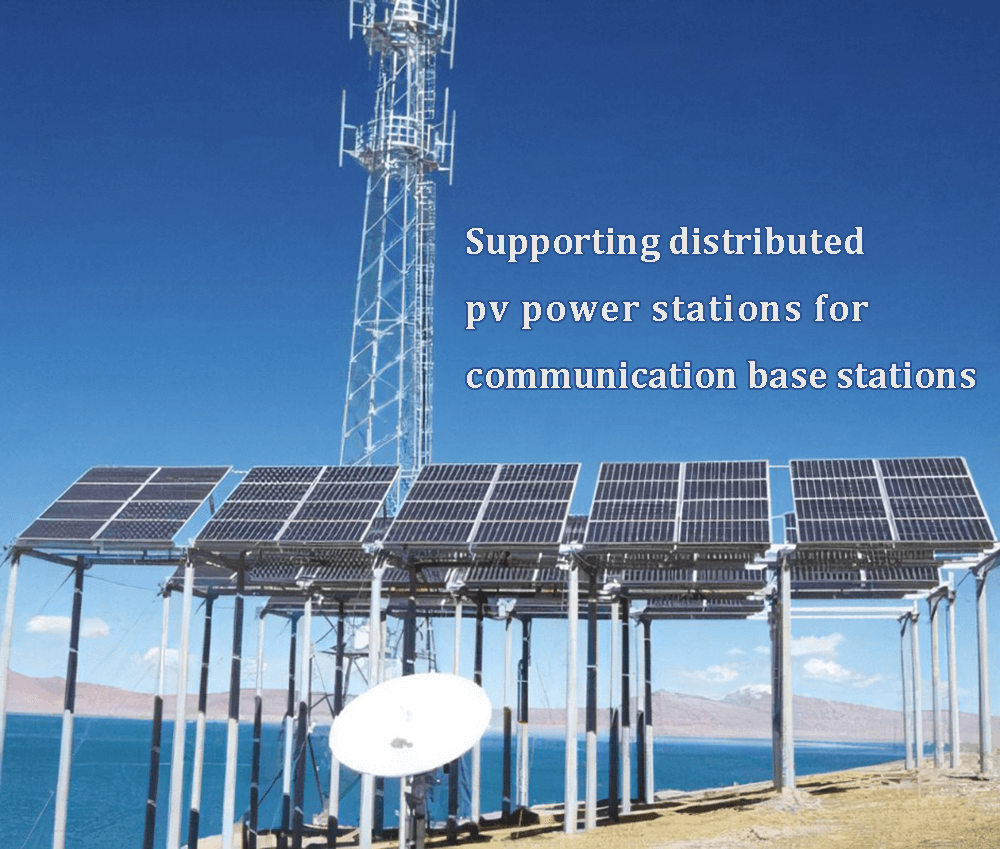
With the expansion of China’s communication service coverage and the upgrading of communication technologies, the inconvenient power supply of communication base stations in remote areas and the sharp increase in power consumption of base station equipment have become more and more prominent.
Therefore, supporting distributed pv power stations for communication base stations and supplying power locally can effectively reduce power supply costs and improve power supply guarantee capabilities.
 Photovoltaic + Facility agriculture
Install distributed pv power generation systems on planting facilities such as solar greenhouses, glass greenhouses, and breeding facilities such as cowsheds and chicken coops, which can supply power for heating, liquid supply, and lighting supplementary light equipment on the spot.
This can not only reduce the cost of electricity consumption, but also bring power generation benefits to rural areas by using the surplus electricity to connect to the grid, and at the same time help to reduce the carbon emissions in the agricultural production process.
Other application scenarios of distributed pv
In recent years, various manufacturers have developed a variety of photovoltaic application products, such as photovoltaic floor lamps, photovoltaic smart waste bins, photovoltaic tents, photovoltaic backpacks, etc., mainly for daily use, display, emergency and other purposes.
Many shared bikes also have photovoltaic modules installed to power smart car locks. The daily application of photovoltaic technology is quite mature and popular, and more application scenarios will be explored and expanded in the future.
Key technology innovation direction of distributed pv
Innovation direction of distributed pv system equipment
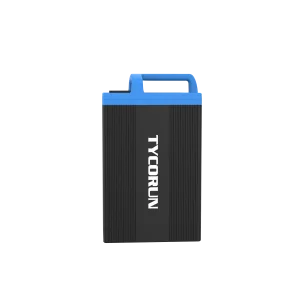
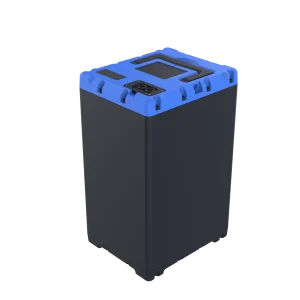
The distributed pv systems are usually installed on buildings or combined with various equipment and facilities, while the lithium ion solar battery is often used in combination. The characteristics of their application scenarios put forward the following requirements for the characteristics of the system:
 ● As small-scale, large-scale, and highly dispersed engineering projecst, the design and construction of distributed pv power stations should be as standardized as possible;
● The distributed pv power plants close to production and living facilities should ensure safety;
● The photovoltaic modules of distributed power plants are often blocked by surrounding buildings and facilities. Shadows can easily lead to hot spots or even damage to the modules, which will also cause large differences in the working current of each module in the string, significantly reducing power generation. Therefore, it is necessary to fully consider the influence of shadow occlusion from both ends of the design and equipment to maximize the power generation.
In order to improve the standardization of the design and construction of distributed pv power plants, especially small household photovoltaic power plants, the plug-and-play system is an effective solution.
The photovoltaic modules, inverters, small energy storage devices and accessories such as cables and fixtures are highly integrated, and the electrical connection method is improved to simplify the installation operation to direct plugging or crimping, which not only can greatly improve construction efficiency, but also improve safety.
The popularization feasibility of the plug-and-play system solution largely determines the applicability of the integrated system to rural houses and small buildings.
- As an electrical system, the distributed pv system has the risk of leakage, fire and other accidents. Therefore, it is necessary to promote the application of the shutdown device at the string level and even the component level. At present, the cost of the circuit breaker is relatively high, and the application scale in China is small; unifying the standard and reducing the cost should be the key research direction.Compared with the conventional rooftop power station, BIPV system is closer to the people and property in the building, and safety is very important; In addition to electrical safety, structural safety and material environmental protection should also be the core focus of further R&D and standardization.
Due to the slight difference in the rated electrical parameters of each module in the string, the shadows and contamination are also different, which makes the output current mismatch, resulting in power loss. Micro-inverters and component-level optimizers enable each component to operate at its maximum power point, minimizing losses.
For microinverters and component optimizers, the current research and development focus includes optimizing the maximum power point tracking algorithm, improving device reliability, reducing its own power loss, and reducing costs. In addition, similar to conventional inverters, microinverters and component optimizers also need to be smarter.
Innovative direction of distributed pv system operation and maintenance technology
The distributed pv power plants are geographically scattered, and owners often do not have photovoltaic expertise.
The operation and maintenance work urgently needs to improve the level of automation, intelligence, and intensification to reduce operation and maintenance costs and improve work efficiency.
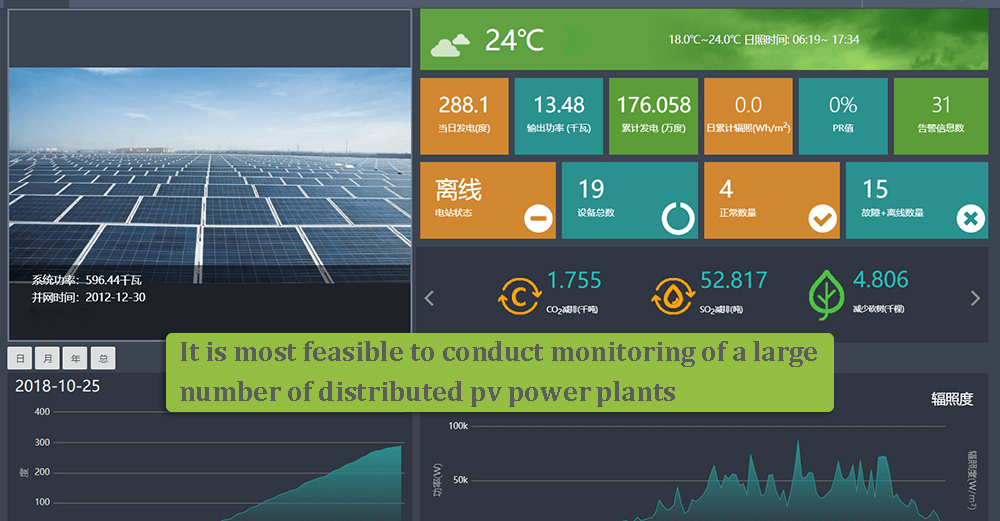
Based on system equipment such as inverters, using the Internet, big data, artificial intelligence, 5G communication and other advanced technologies, it is the most feasible technical route to conduct centralized and unified monitoring of a large number of distributed pv power plants.
The monitoring system not only monitors the operation data of each power station in real time, but also conducts data analysis, counts power generation, calculates revenue, and predicts future power generation trends;
When an abnormal situation is found, the fault point can be located, and the type and degree of the fault can be diagnosed, so as to provide auxiliary decision-making for operation and maintenance work arrangements such as personnel dispatch and maintenance matters.
 Meanwhile, with the large-scale and high-proportion access of distributed pv to the distribution network, in order to ensure the power quality and operation safety of the power grid, it will also become an inevitable trend to participate in the intelligent scheduling of the power grid through the intelligent monitoring system.
In addition, operation and maintenance platform mobile terminals, intelligent cleaning robots, automated inspection tools and other operation and maintenance equipment are also important breakthroughs in the innovation of distributed pv system operation and maintenance technology.
Coupling of distributed pv and multiple energy sources
In building-level and campus-level microgrids, distributed pv are one of the most common and important energy sources, which together with electrochemical energy storage, heating/cooling, heat storage/cooling and other loads are centralized by energy management systems Monitoring, unified scheduling management.
As the main source of clean electric energy in the microgrid, distributed pv are controlled by the energy management system, and their randomness and volatility are controlled by the energy storage system.
The mismatch between the power generation curve and the load curve is also alleviated by the energy storage system. Through this multi-energy coupling method, the efficient use of energy can be achieved and the carbon emission reduction of buildings and parks can be facilitated.
In order to improve the matching of distributed pv with other energy sources and loads in the microgrid, improve power quality and power supply reliability, and reduce electricity costs.
It is necessary to develop a more intelligent energy management system, based on meteorological data and historical operating data such as photovoltaic output and load, to predict photovoltaic power generation and load power, and to carry out multi-time-scale source, load, and energy storage matching optimization scheduling management.
 DC microgrids or AC-DC hybrid microgrids including distributed pv systems are typical forms of building-level and park-level comprehensive utilization of new energy.
For application scenarios with a large number of DC loads, using a DC power distribution system can more conveniently access distributed photovoltaics and energy storage, simplify the conversion process, and reduce power loss.
Based on the improvement of power electronics technology, the expansion of energy storage application scale and the optimization of energy management system, this “photovoltaic storage direct flexible” mode will effectively promote the deep integration of distributed photovoltaics and the power consumption side.
Suggestions for promoting distributed pv technology innovation
The distributed pv have been widely used in China, and the scale of application will continue to expand. In order to effectively solve the following problems in the process of consumption, operation and maintenance, it is necessary to promote technological innovation from various aspects, greatly improve the intelligence level of distributed photovoltaic systems, and effectively improve the efficiency and safety of distributed photovoltaic power generation, so as to ensure that distributed photovoltaics can participate in the balance on a large scale in the new power system and provide strong support for the power consumption side.
As an important part of the photovoltaic industry, solar batteries are also attracting attention. If you want to know more about solar cells, please read the Top 10 solar battery manufacturers on our website. this article will give you a detailed introduction to the relevant layout of the solar battery industry giants and the latest trends in this field.