Skip to content

Changes in the power battery industry
With the increase in sales of new energy vehicles year by year, the installed capacity of power batteries in China is also climbing rapidly. If you stretch the time line, it can be clearly seen that from 2017 to 2021, my country’s power battery industry has indeed undergone many changes.
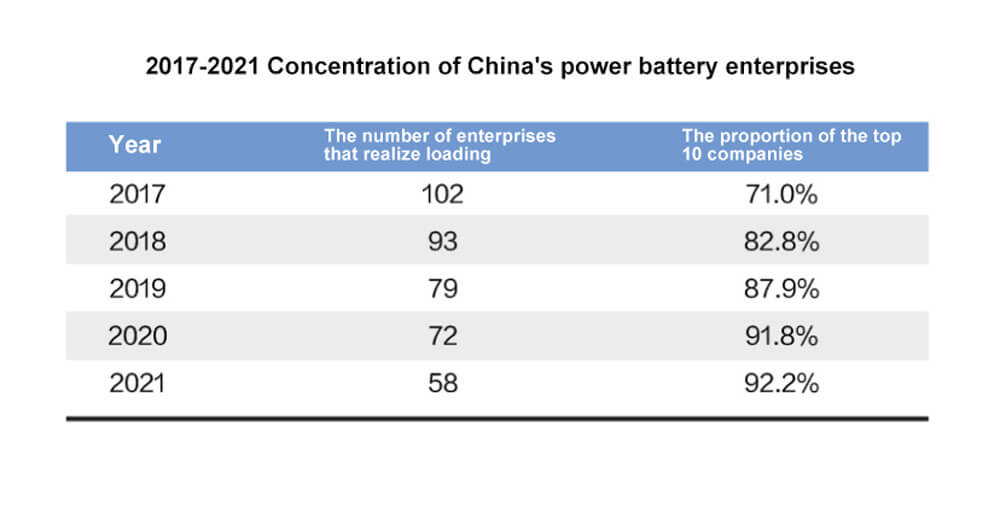
First, the scale of installed capacity climbed to 150 GWh, and the industry concentration was further improved. The installed capacity has increased from 36.4GWh in 2017 to 154.5GWh in 2021, and the number of power battery companies that have achieved vehicle installation has been reduced from 102 in 2017 to 58 in 2021.
Second, the installed capacity of lithium iron phosphate and ternary lithium is changing. Lithium iron phosphate batteries dominated the market in 2017, were overtaken by ternary lithium batteries in 2018, and overtook ternary lithium batteries in 2021.
Third, the industry accelerates the survival of the fittest. Among the top 10 companies in terms of installed capacity, except for CATL and BYD, which occupied the first and second consecutive places, the rankings of the rest of the companies have changed a lot. Some companies have disappeared, and some new stars in the industry are rising.
From 102 to 58 companies
According to data from the China Automotive Power Battery Industry Innovation Alliance (CABIA), in 2021, the installed capacity of power batteries in my country will reach 154.5GWh, a year-on-year increase of 142.8%. Behind this is that the annual sales of new energy vehicles reached 3.521 million in the same year, a year-on-year increase of 157.5%.
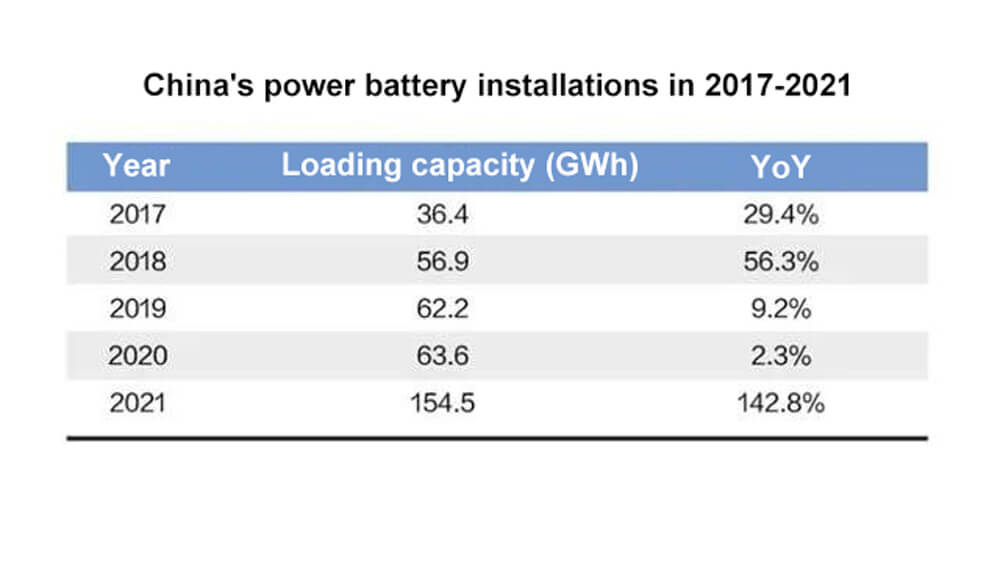
In the past five years, in addition to the increase in the number of vehicles installed, the industry concentration of power batteries has also been increasing.
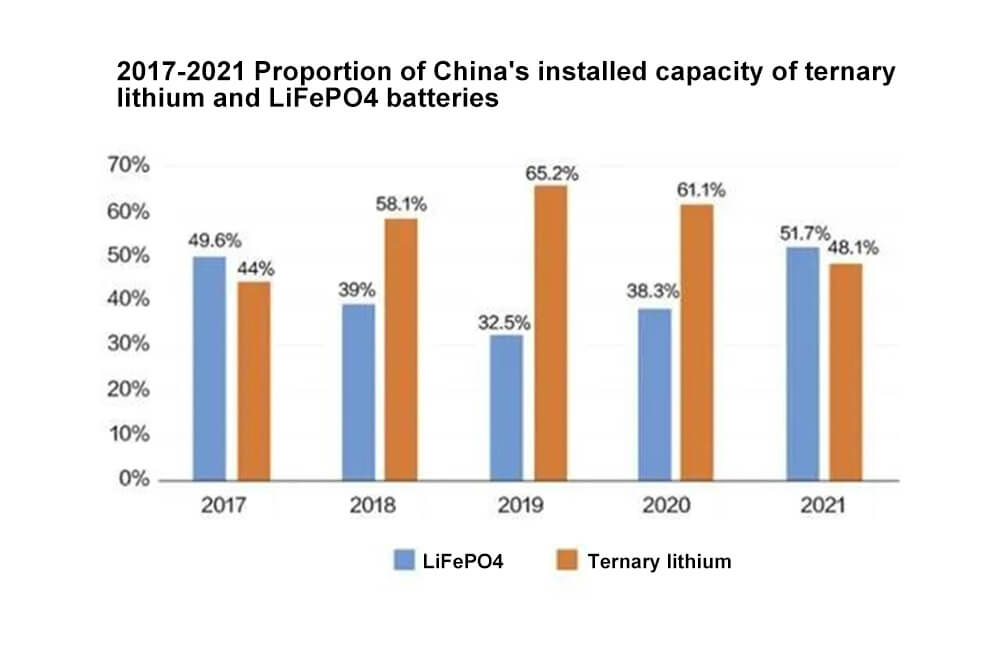
From the perspective of loading volume, in the past five years, batteries of two different materials, lithium iron phosphate and ternary lithium, have shown a competitive situation of chasing each other.
To sum up: In 2017, lithium iron phosphate batteries accounted for more than ternary lithium batteries. Since then, in 2018, ternary lithium has overtaken lithium iron phosphate. In 2019, the proportion of ternary lithium reached twice that of lithium iron phosphate.
In 2020, the proportion of lithium iron phosphate will increase slightly, but it is still lower than that of ternary lithium. In 2021, lithium iron phosphate will rebound strongly, accounting for more than ternary lithium again.
Changes in the top ten factions
In 2021, the top 10 companies in my country’s power battery installations will be CATL (52.1%), BYD (16.2%), CALB (5.9%), Guoxuan Hi-Tech (5.2%), LG Chem (accounting for 5.2%), SVOLT (accounting for 2.1%), EVE (accounting for 1.9%), Tafel New Energy (accounting for 1.9%), Farasis Technology (accounting for 1.6%) , Sunwoda (accounting for 1.3%).
Among them, the installed capacity of the two leading power battery companies, CATL and BYD, together accounted for 68% of the total installed capacity.
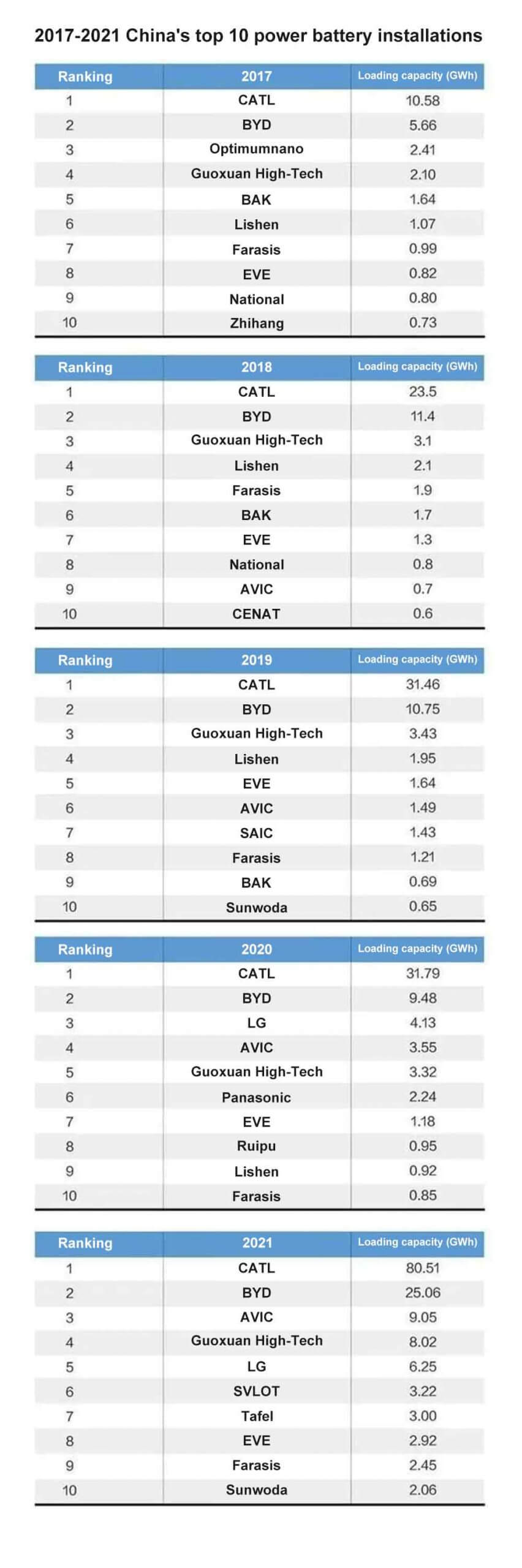
Looking back on 2017-2021, in the past five years, in addition to the Ningde era and BYD in the first echelon, the TOP10 installed capacity of China’s power batteries has also changed.
In the past five years, the Ningde era has dominated the list year after year, and the proportion of installed capacity has shown a rising trend.
In the past five years, BYD has always ranked second. In addition to self-supply, BYD batteries have also started external supply business.
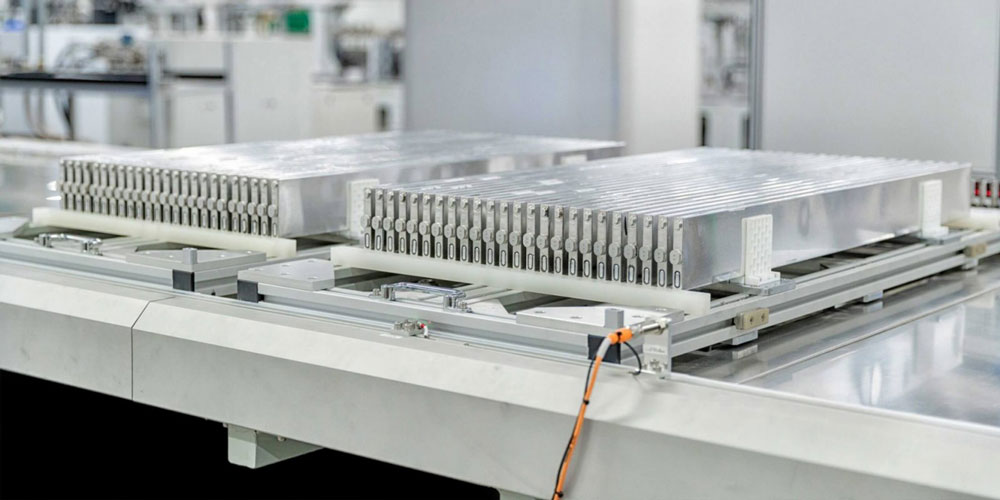
In the second echelon from 3rd to 10th, except for Guoxuan Hi-Tech, EVE, and Farasis Technology, which have remained in the TOP10 ranks in the past five years, the rest of the ranking companies have undergone great changes.
From 2017 to 2021, 5 companies disappeared from the TOP10 list, they are Waterma, BAK Battery, Lishen Battery, Guoneng Battery, and Zhihang New Energy. Among them, three companies, Optimumnano, Guoneng Battery, and Zhihang New Energy, have been suspended.
Compared with 2017, there are 5 new faces on the TOP10 list in 2021. They are China Innovation Aviation, LG Chem, Honeycomb Energy, Tafel New Energy, and Sunwanda.
Sunwoda ranked 10th in both 2019 and 2021. Xiaopeng, Geely, GAC, Dongfeng, Renault, Nissan, etc. are all its customers. In July 2021, Sunwanda, Geely Automobile and Zhejiang Jirun jointly established a joint venture company Shandong Geely Sunwanda, focusing on supporting the production of HEV power battery packs.
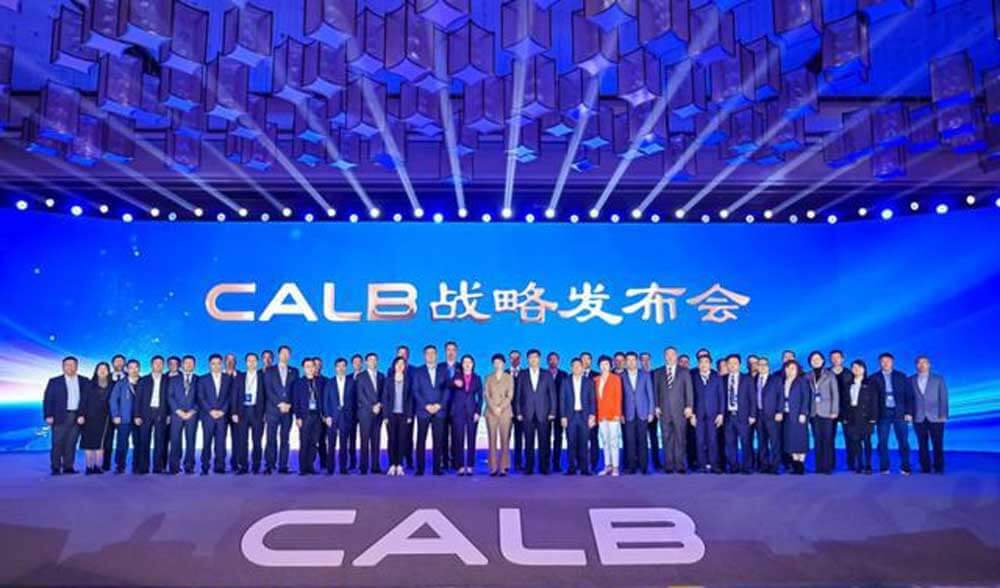
AVIC Lithium Battery, formerly known as AVIC Lithium Battery, has jumped year by year in the industry ranking and has achieved outstanding results in the second echelon of power batteries. From 2019 to 2021, the ranking climbed from No. 6 to No. 4 and No. 3. At the end of 2021, China Innovation Airlines officially launched its listing in Hong Kong.
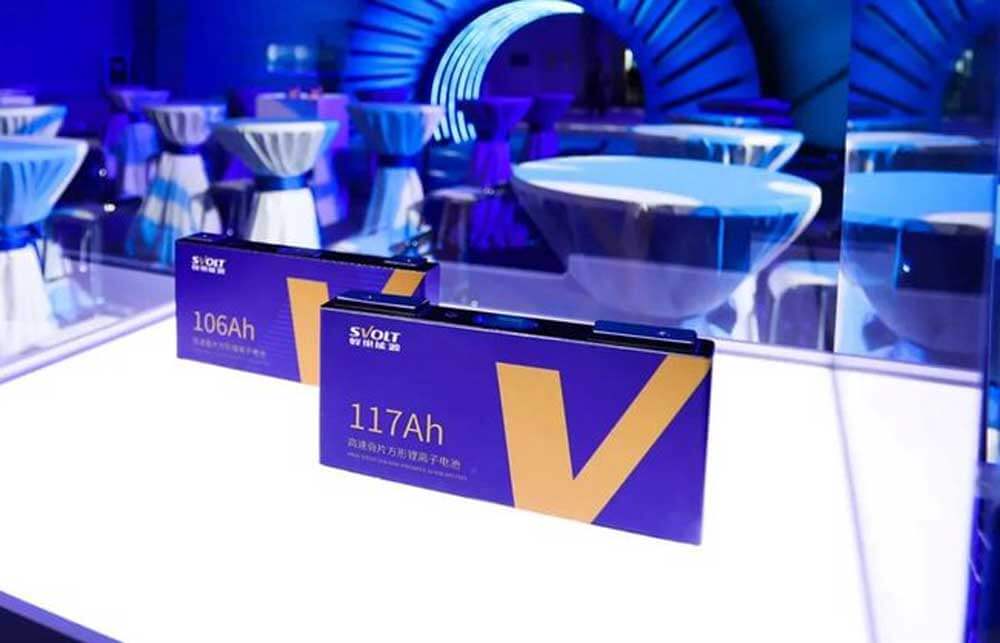
SVOLT ’s 2021 vehicle loading volume is 3.22GWh, ranking sixth. It is another company in the second echelon that is preparing to go public. Supporting car companies include Great Wall, Dongfeng, Hezhong, Jinkang, Leapmotor, etc.
Tafel New Energy will break into the TOP10 for the first time in 2021, ranking 7th.
Interestingly, CATL went to court with three companies, namely China Innovation Airlines, Honeycomb Energy, and Tafel.
In 2021, CATL filed a lawsuit against Tafel and China Innovation Airlines, both of which were patent infringement. In August, CATL won the case against Tafel, who was sentenced to pay CATL more than 23.3 million yuan in compensation. However, the case between CATL and China Innovation Airlines has not yet come to a conclusion. On February 14, 2022, CATL filed a lawsuit against Honeycomb Energy on the grounds of unfair competition.
The status of the first brother in the Ningde era is difficult to shake for a while, and the second-tier battery manufacturers are also showing their magic powers and seeking to expand their market share. The industry leaders have launched a lawsuit to defend the war. From the side, it is a sign that the competition in the industry is heating up.