Skip to content

Theoretical capacity of hard carbon anodes
Although sodium-ion batteries have been developed since the 1980s. However, compared with the rapid commercialization of lithium-ion batteries, it is really slow, and academic research has only prospered again in recent years.
Therefore, the sodium storage mechanism of many materials of sodium-ion batteries is not as clear and clear as the lithium storage mechanism of lithium-ion battery materials, and the lithium storage mechanism cannot be simply used.
Similarly, the sodium storage mechanism of hard carbon has not yet been fully determined, and the theoretical capacity needs to be determined according to the sodium storage mechanism!
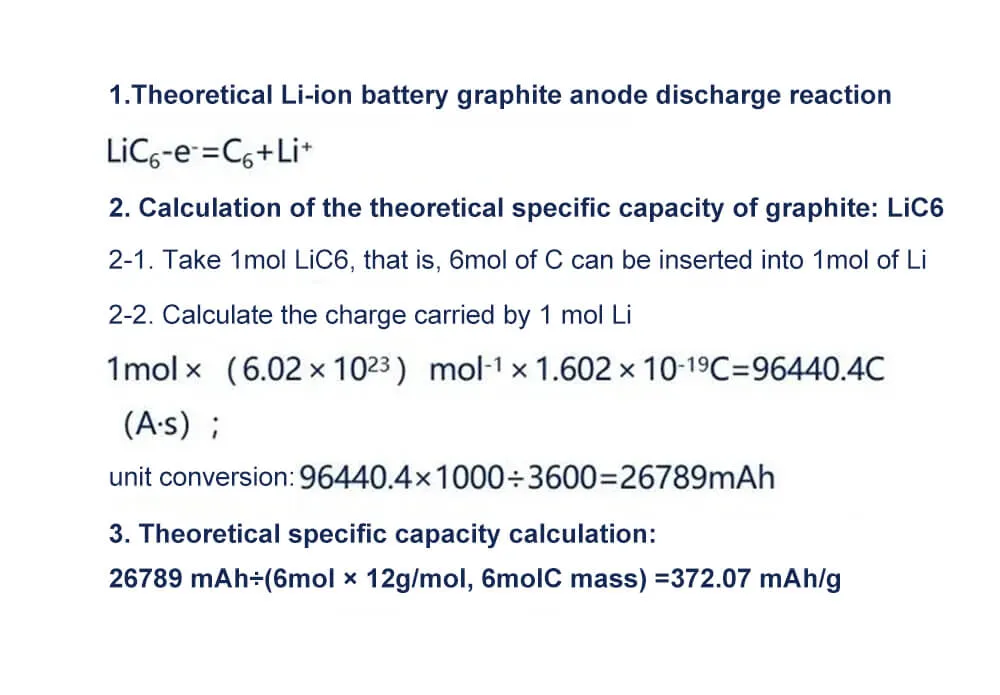
Calculation process of theoretical capacity of graphite anode for lithium ion battery
For hard carbon, during the sodium storage process, the charge-discharge curve can be divided into two regions:
High potential ramp area (2~0.1V)
Low potential platform area (0.1~0V)
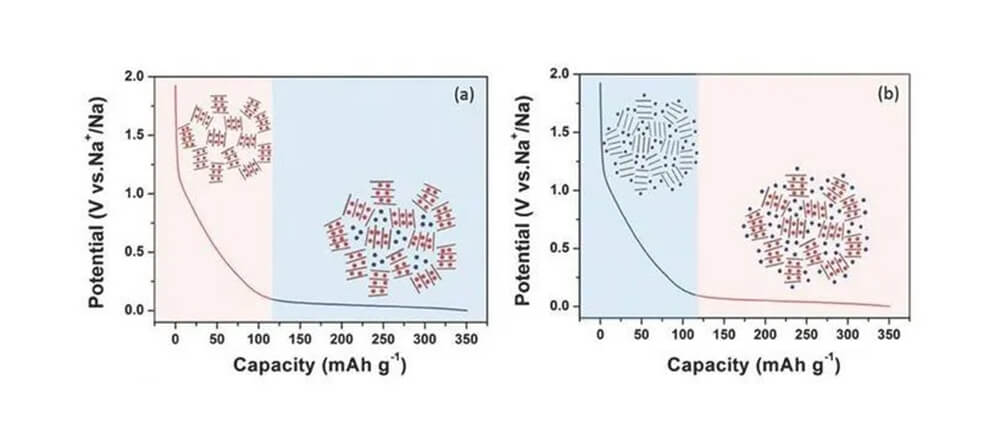
For these two regions, there are two explanations for the mechanism of sodium storage:
•The “intercalation-adsorption” mechanism (Fig. 1a). Jahn et al. proposed for the first time that the capacity of the slope region mainly comes from the intercalation of Na+ in the graphite-like interlayers, while the capacity of the plateau region comes from the filling or deposition of Na+ in the micropores.
•The “adsorption-intercalation” mechanism (Fig. 1b). For the first time, Cao et al. proposed that the capacity of the slope region mainly comes from the adsorption of Na+ on the carbon surface and edge defects, while the capacity of the plateau region mainly comes from the intercalation of Na+ in the graphite-like, similar to the intercalation behavior of Li+ in graphite.
This issue has been controversial in academia. In 2017, an article by the team of Cao Yuliang of Wuhan University and the team of Jun Liu of the Pacific Northwest National Laboratory gave their ideas from experiments and theoretical calculations: in different voltage ranges, the intercalation and desorption behavior of Na+ in hard carbon is more in line with “adsorption”. -Embedding” mechanism.
How did the author prove it? Of course, the two areas were studied separately.
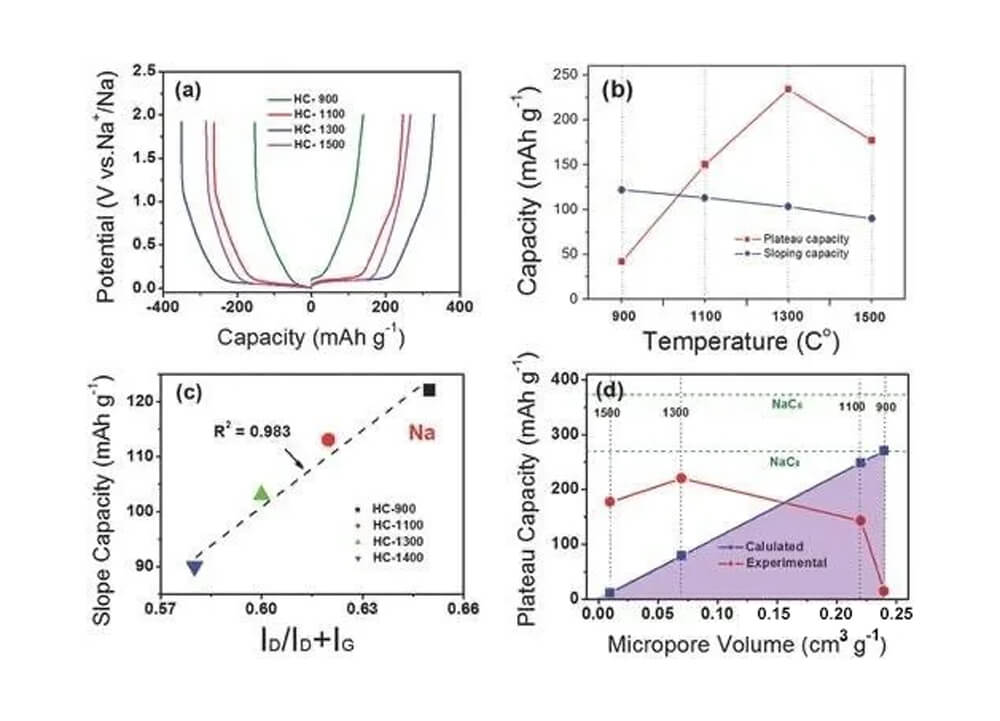
1.The first is the slope area. By comparing the plateau capacity and ramp capacity of cellulosic pyrolysis carbons at different pyrolysis temperatures (Figs. 2a and 2b), the authors found that there is a good linear relationship between the ramp capacity and the defect value (ID/ID+IG) (Fig. 2c), This shows that the slope capacity is related to the defect degree of hard carbon.
Recall how the two mechanisms in the previous slope area are explained:
Jahn et al. believe that the capacity of the slope region mainly comes from the intercalation of Na+ in the graphite-like interlayer, Cao et al. believed that the capacity of the slope region is derived from the adsorption of Na+ on the carbon surface and edge defects. Obviously, the experimental results are consistent with the latter’s “adsorption-intercalation” mechanism.
2.Next is the platform area. The authors calculated the theoretical capacity produced by filling and depositing metallic sodium in the micropores (Fig. 2d), and if the mechanism of Jahn et al. is correct, the larger the pore volume, the higher the capacity should be. However, the authors found that for hard carbon materials with relatively small micropore volumes and pyrolysis temperatures of 1300 and 1500 °C, the measured platform capacity is much higher than the theoretical capacity of micropore sodium storage, which is inconsistent with the “intercalation-adsorption” mechanism. Therefore, the “adsorption-intercalation” mechanism may be more in line with the actual situation.
Moreover, if the platform capacity corresponds to the intercalation of Na+ in the graphite layer to form NaC6 or NaC8 compounds, then it is clear that the theoretical capacity is higher than the measured platform capacity (Fig. 2d), which conforms to the rule that the theoretical capacity is greater than the actual capacity, The possibility of “adsorption-intercalation” mechanism is also verified. The measured first-round discharge capacity of this article is 362 mAh/g, which is very close to the theoretical capacity of NaC6.
So the ultimate question is, what is the theoretical capacity of hard carbon for sodium storage?
For the above article, I believe it. Therefore, I think the mechanism of sodium storage in hard carbon and lithium storage in graphite is very similar, that is, the “adsorption-intercalation” mechanism. The final state of hard carbon should also be NaC6, a compound of sodium and carbon, and adsorbed sodium.
Like graphite lithium storage, 6 carbons and 1 sodium form a compound NaC6, and its theoretical capacity is calculated in the same way as lithium, and the calculated result is 372.07mAh/g. Therefore, the theoretical capacity of hard carbon should be 372.07mAh/g + the adsorption capacity of sodium in the slope region (smaller).
This result is exactly what we hope to see. After all, if the lithium storage mechanism of lithium-ion battery materials can be borrowed, it can save a lot of trouble.
Of course, the theoretical capacity is one thing, the actual capacity is another. After all, the Na ion radius is larger than the Li ion radius (0.102nm vs 0.076nm), and the diffusion rate and intercalation/deintercalation kinetics are still relatively poor compared to Li.
For sodium-ion batteries, it is very important to control the first effect (first Coulombic efficiency) and first capacity of hard carbon, which is an important reference for the capacity level.
Recent scientific research achievements of hard carbon anode lithium ion batteries
At present, the negative electrodes of commercial lithium-ion batteries are mainly made of graphite materials. According to the lithium storage mechanism of LiC6 between graphite layers, its theoretical specific capacity is only 372 mAh/g, the room for improvement is very limited, and the lithium diffusion between graphite layers also restricts its rate performance. It can be seen that with the increasing demand for battery energy and power performance in downstream applications, pure graphite-based anode materials have become insignificant.
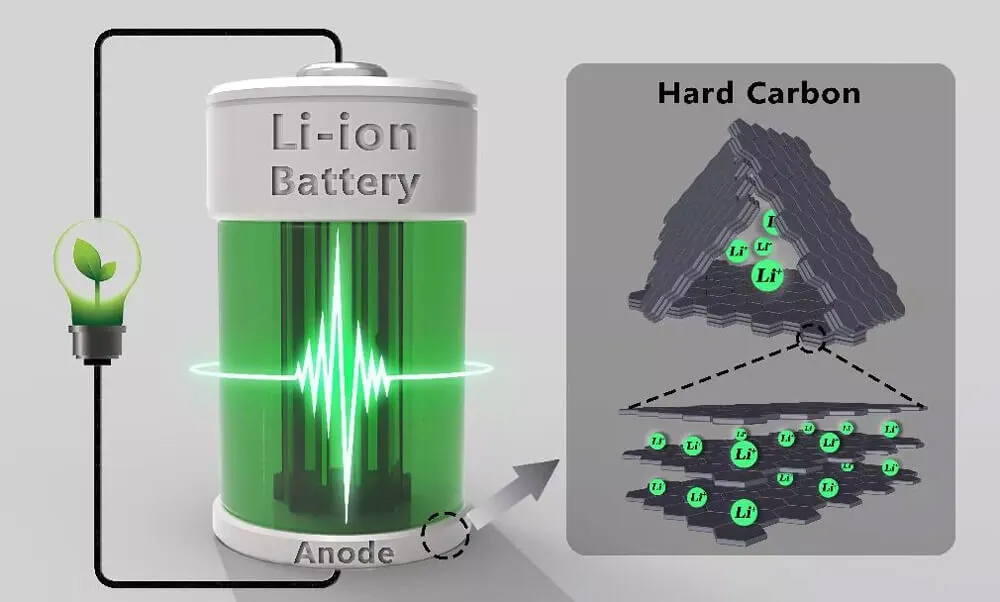
As a new type of anode material, hard carbon has a lithium potential similar to graphite and a higher specific capacity. More importantly, the hard carbon is composed of a graphite-like crystallite structure and open horn-like crystallites. This unique crystallite structure can not only provide more lithium storage sites, but also facilitate lithium ions in the graphite layer. intercalation. Therefore, as a new-generation lithium-ion battery anode material, hard carbon has a very broad development prospect.
Recently, researcher Chen Chengmeng from Shanxi Institute of Coal Chemistry, Chinese Academy of Sciences cooperated with the team of Professor Zhang Qiang of Tsinghua University to systematically review the latest research progress of hard carbon anode materials, focusing on the latest overview of hard carbon materials.
Including the reported structural models, formation processes, lithium storage mechanisms, material classifications, current challenges and potential solutions of hard carbons. Finally, the paper gives an outlook on the application of hard carbon materials in next generation lithium batteries.
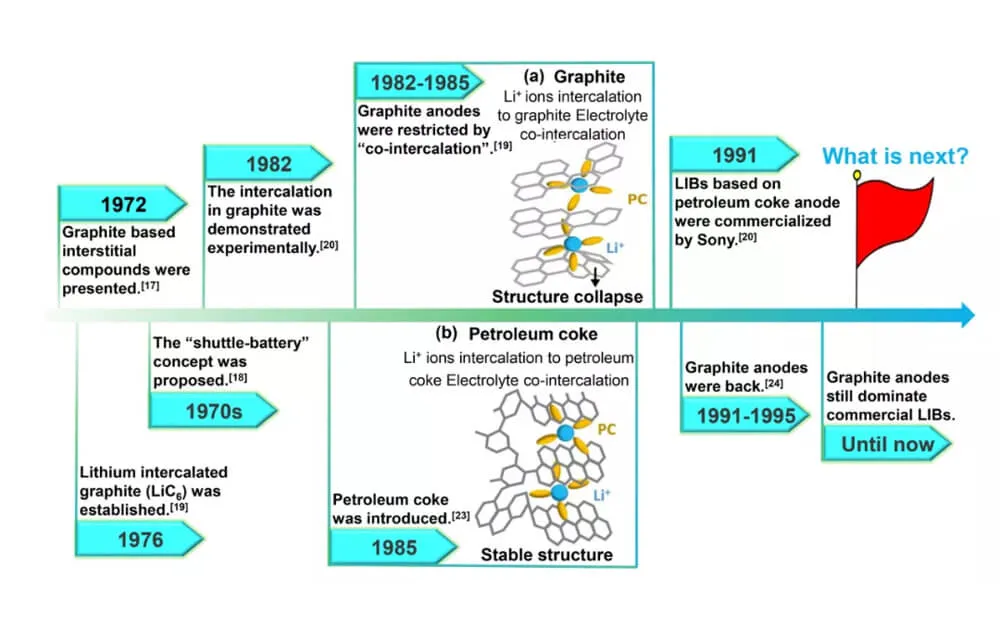
Memorabilia of carbon materials in the birth and development of lithium ion batteries
In the historical process of the birth and development of lithium-ion batteries, carbon anode materials have played an important role in improving battery energy storage performance, improving safety, and reducing costs, and have triggered a research and development boom in global academic and industrial institutions. Before introducing the hard carbon anode, the article reviews a brief history of the development of carbon anode materials for lithium-ion batteries.
Formation of hard carbon and its microstructure
Thermochemical transformations are crucial in the formation of hard carbon. For easily graphitized carbonaceous raw materials, the conversion process can generally be divided into three stages: pyrolysis, carbonization and graphitization. However, due to the existence of molecular cross-linking and covalent C-O-C bonds in the hard carbon precursor, it is easier to form a rigid cross-linked structure during the pyrolysis process, and a large number of defects, micropores and oxygen-containing functional groups are generated.
These structures inhibit the growth and orientation stacking of graphene sheets during the carbonization stage, and form a large number of randomly distributed curved graphene sheets. Even at a temperature of 3000 °C or higher, the material will not form graphite, but only a short-range ordered and long-range disordered graphite crystallite structure. Therefore, hard carbon exhibits the lowest degree of graphitization compared to graphite and soft carbon.

Structural model of hard carbon
Hard carbon does not have a uniform structural model like graphite. Affected by different precursors and preparation conditions, the actual structure of hard carbon is very complex, and it is difficult to build a general model. In 1951, Franklin believed that hard carbons consist of some randomly arranged, locally graphitized structures connected by amorphous carbons.
Afterwards, Ben proposed in 1975 that hard carbon is composed of some intertwined, curved, and graphitized ribbon-like winding structures, but this model cannot explain why hard carbon cannot be further graphitized with increasing temperature. Harris proposed in 1997 that hard carbon is an isotropic three-dimensional structure similar to foams, and the formed micropore walls are composed of curved carbon layers of a fullerene-like structure, in which there are both five-membered rings and six-membered rings.
The five-membered ring makes the carbon layer curved rather than regular, and further high temperature treatment cannot be graphitized. In recent years, although new progress has been made in the study of hard carbon structural models, the understanding of its structure and properties still needs to be deepened, and many models still need more reliable evidence to support.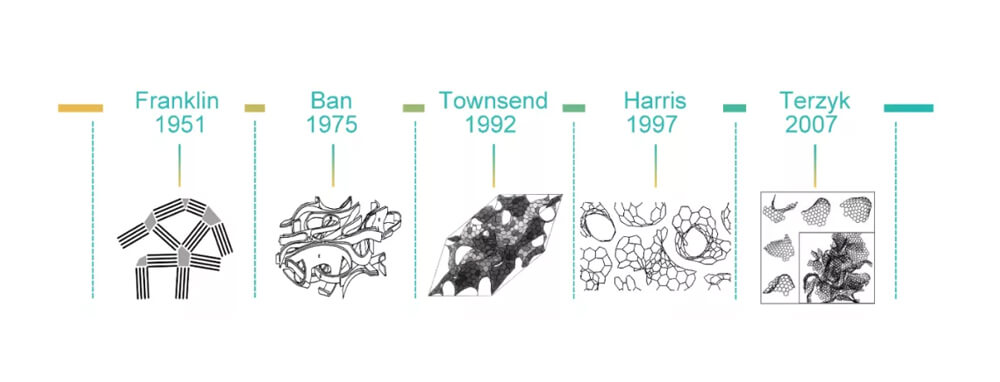
Storage mechanism of lithium ions in hard carbon
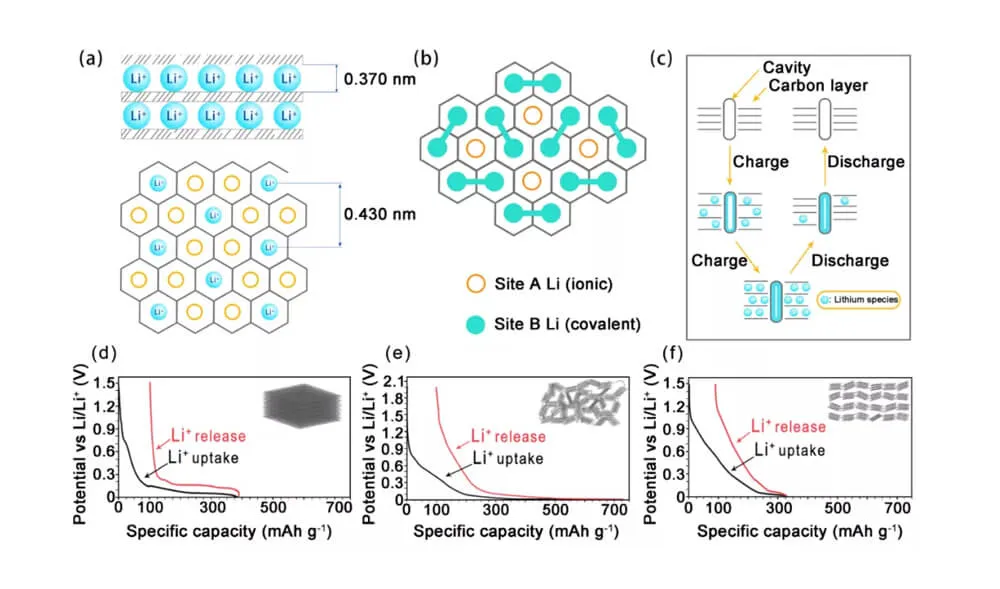
For hard carbon, the electrochemical intercalation of Li+ starts at around 0.8 Vvs Li/Li+, and the entire voltage curve has no obvious plateau and shows a gradual downward trend. Unlike graphite, there is no ordering phenomenon of Li+ intercalation in hard carbon, and the different electrochemical behaviors can be explained by their structural differences.
With the advancement of in situ characterization and computer simulation technology, people’s understanding of the storage mechanism of Li+ in hard carbon is deepening. adsorption, 2) adsorption of Li+ on defect sites, and 3) Li+ intercalation into the graphite layer.
Classification and optimization strategies for hard carbon
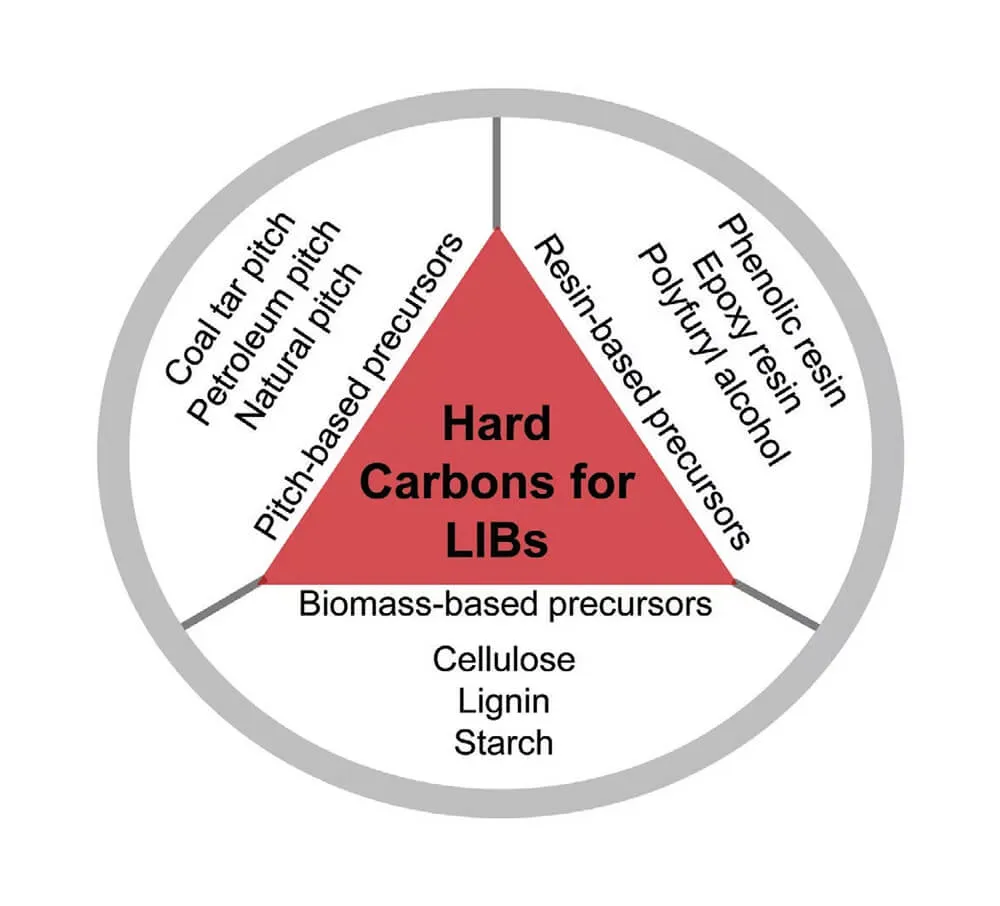
Hard carbons used as anodes for next generation lithium batteries are mainly prepared from resin-based, pitch-based and biomass-based precursors. In this paper, the preparation methods and optimization strategies of hard carbon derived from the above three precursors are summarized.
Summary and outlook
As a key electrode material in next generation lithium batteries, hard carbon can achieve rapid intercalation and deintercalation of next generation lithium batteries during charging and discharging, and it has shown broad prospects in high-energy and high-power energy storage applications.
In recent years, research on hard carbon anode materials has made significant progress, but many challenges/bottlenecks still exist:
1) The lithium storage capacity of most hard carbon materials is still low.
2) The rate performance and cycle performance need to be improved.
3) The first week Coulombic efficiency of hard carbon anodes is usually low.
4) The mechanism of lithium storage is not fully understood.
In order to meet the needs of practical applications of batteries, this paper puts forward the following prospects for the future development of hard carbon anodes on next generation lithium batteries:
1) Optimize the precursor
2) Optimizing micro/nano structures
3) Adopt advanced pre-lithiation technology
4) Develop the capacity of 0 V and below potential
5) Develop low temperature fast charging devices
6) Focus on cost control, quality management and standard formulation, and promote industrialized production
You can get more details by directly reading this review paper from https://doi.org/10.1002/aenm.202101650
FAQ about hard carbon anode
1.What is the theoretical capacity based on?
Hard carbon materials have no theoretical capacity. Some other materials have a stoichiometric number that will work better.
2.May I ask how much the first effect of hard carbon in the industry has been achieved?
The first effect is related to the system, and the differences between different enterprises will be relatively large. The difference may be about 70%, and the good one can reach 83~85%. Of course, it is also related to its capacity design, which is more complicated. According to the needs of the product, use 250 , 280, 300, 350, 400, 500 capacities are available.
3.The test results of the two methods of true density are 1.5 and 2.0, which method is reliable?
The test method of true density is usually measured by the specific gravity method, and now many companies use helium replacement to measure. The atomic radius of helium is slightly smaller than that of lithium ions, so its true density will be higher.
If it is measured with butanol, according to the molecular size of ethanol is about one nanometer, you can refer to it as the test result. As long as there is no human error, the results of the instrument will not be too problematic, so both methods are credible, but the experiments need to be considered in different dimensions to obtain different results.
4.What is hygroscopicity related to?
It is related to surface oxygen-containing functional groups and unevenness. In addition, it is also related to hydrophilicity, physical hydrophilicity or chemical hydrophilicity. When we make the slurry, we will consider a problem, that is, the carbon material is often a hydrophobic material.
In fact, the hydrophilicity of carbon materials is more to consider, what physical hydrophilic process is there when it is used for slurry dispersion.
5.What are the hard carbon precursors?
There are many precursors, such as phenol and asphalt that were mass-produced in the past, and biomass that is now more academically researched in schools, such as coconut shells, nut shells, and so on. Generally, it is easier to obtain hard carbon materials from biomass.
6.Hard carbon materials are highly hygroscopic, so why can they still be mixed with water?
This is very simple. First, oily is not environmentally friendly, and secondly, the cost is relatively high, and water-based is better. And we have done research, water and oil have little effect on the volatilization of the solution, basically no more than 2mAh. Also, the kinetics won’t be very different, so you can do this with both water and oil.
7.Open-pore or closed-pore lithium storage?
Lithium storage is usually open pore.
8.Since the advantage of hard carbon is its kinetic properties, how much is the kinetic difference between it and small particles of artificial graphite?
This also needs to be verified from the cell, not that I can give you a data. Because of different usages, the performance of the batteries is different, and it is not easy to compare them directly. The specific situation still depends on the design of the cell, which is related to the performance of the slurry and the cell, rather than the theoretical calculation of the difference in the dynamic performance.
9.Will the conductive agent carbon black affect the capacity?
Generally does not contribute to capacity.
10.Any suggestions for electrolytes to try on hard carbon?
The electrolyte is generally more compatible with PC, and the others are some commercial electrolytes, mainly in the adjustment of additives. I don’t have any good suggestions here, I still have to rely on customers to explore by themselves.
11.Which organic substances can make hard carbon materials?
According to some basic physical properties of organic matter, it is easy to obtain a hard carbon material if the oxygen content is more during pre-carbonization. In addition, some high molecular compounds, such as vinylidene chloride. Hard carbon materials can also be obtained from 1-2-vinyl chloride, and there are many raw materials.
12.Is coal hard carbon or soft carbon?
Generally, low-rank coal, that is, oxygen-rich coal, is easier to obtain hard carbon materials, while high-rank coals have less oxygen content and higher hydrogen content, and generally obtain graphite materials.
13.What is the recommended lower limit of the full electric discharge voltage for hard carbon?
This also depends on the requirements of the project, as well as the material used for the positive electrode material. This is related to the design of the cell, which is more complicated, not a problem that can be clearly explained in three or two sentences. If you are interested, you can also have the opportunity to communicate and discuss in detail.
14.The volume energy density of hard carbon is so much lower than that of graphite. Is the application prospect in the direction of lithium battery good?
It is because of the low physical energy density that there is not much advantage in benchmarking projects. Even if the power performance, low temperature performance, and cycle performance are all good, due to the low physical energy density, the cell capacity is small.
For example, others are 9~10, and hard carbon may only be about 8. In the future, we will launch the high-capacity hard carbon of the S series at the right time. The energy density of the raw materials of this series will not be lower than that of graphite, you can look forward to it.
15.How to distinguish between hard carbon and soft carbon, is there any standard?
The main difference is whether it is easy to graphitize. In fact, in addition to hard carbon and graphite, there is a transition state in the middle.
16.Will all biomass materials become hard carbon materials after carbonization?
This is not necessarily, I have not done statistics
17.How can the lithium intercalation capacity of the platform area be used when it is fully powered?
The lithium intercalation capacity of the platform area is indeed very close to 0V, even at 0V. Under normal circumstances, we divide it into two sections when charging, namely the CC section and the CV section. It is also mentioned in the course that the kinetic energy of the CC section is very good. It affects the performance of the capacity too much.
However, if the current density in the CV segment is too large, an overpotential may be formed, that is, the dynamics may have a series of risks. So for hard carbon, when charging.
Maybe the first 50% of the capacity can be quickly charged, and the latter capacity may be charged with a small current. The same is true for the full battery, which is a stage of CC to CV, and it is necessary to control the CC to CV. But for hard carbon, there is no requirement for discharge, and it is no problem to discharge at any rate.
The amount of electricity that carbon materials can release is related to polarization, so try to make the internal resistance as small as possible. In the course, we also discussed more about craftsmanship, which is also to give full play to the characteristics of all materials.
18.What is the performance of the blending of hard carbon materials and ordinary graphite materials?
The performance is firstly related to the mixing ratio, and secondly, it is also related to the process. In general, the higher the mixing ratio, the better the rate performance, regardless of whether it is high or low, depending on the process.
So I have been stressing that the performance of the same material, when used by different people, may be much different, and the most important thing is to look at the craftsmanship. After a material manufacturer makes a material, its performance is basically certain. As a terminal, how we make good use of this material is the most important.