Skip to content

Research background
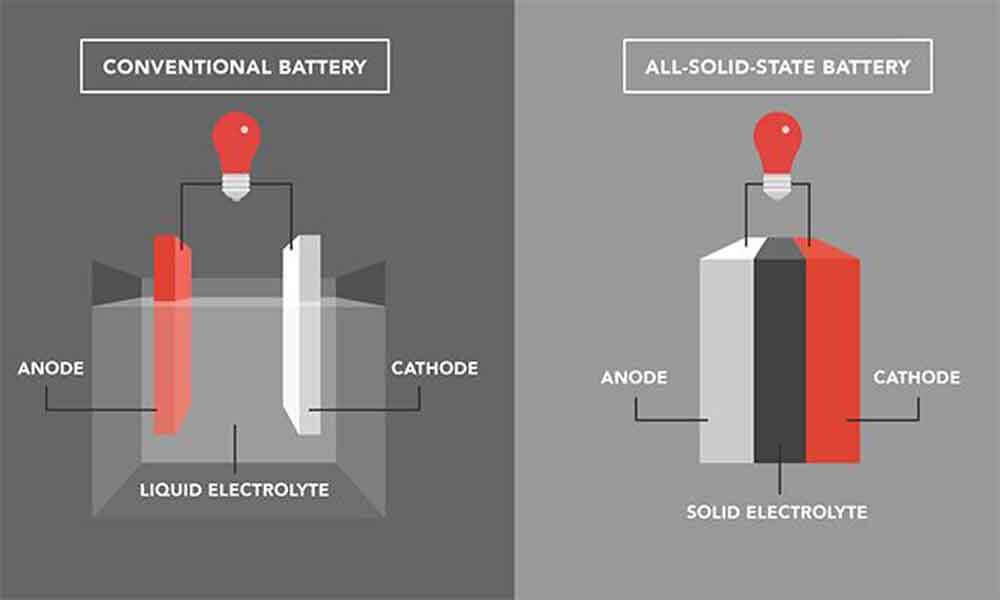
All-solid-state batteries (ASSLBs) are potential candidates for the next generation of safer lithium metal batteries, and so far, most work on solid-state electrolytes (SSEs) has focused on enhancing ionic conductivity and improving interfacial stability.
You can find out what a solid state battery is by watching the video below:
However, less attention has been paid to electrolyte thickness, which actually plays an important role in determining the energy density and electrochemical performance of all-solid-state lithium batteries (ASSLBs). Therefore, there is an urgent need to evaluate SSE beyond conventional factors and provide a comprehensive analysis of the influence of SSE thickness.
Speaking of electrolyte, we have talked about Top 10 lithium ion battery electrolyte company in China in 2022 before.
Introduction
Recently, a team of professors from Huazhong University of Science and Technology published a review entitled “Reducing the Thickness of Solid-State Electrolyte Membranes for High-Energy Lithium Batteries” in the internationally renowned journal Energy & Environmental Science.
The effect of electrolyte thickness on the energy density of ASSLB pouch cells is systematically analyzed, with emphasis on strategies to drastically reduce SSE film thickness without sacrificing its mechanical properties.
The recent progress and challenges of ASSLBs based on high-voltage and high-capacity cathodes, as well as novel configurations such as bipolar and flexible ASSLBs, are discussed, and perspectives and suggestions for future commercialized high-energy-density ASSLBs are provided.
Graphical guide
Effect of SSE thickness on gravimetric and volumetric energy density
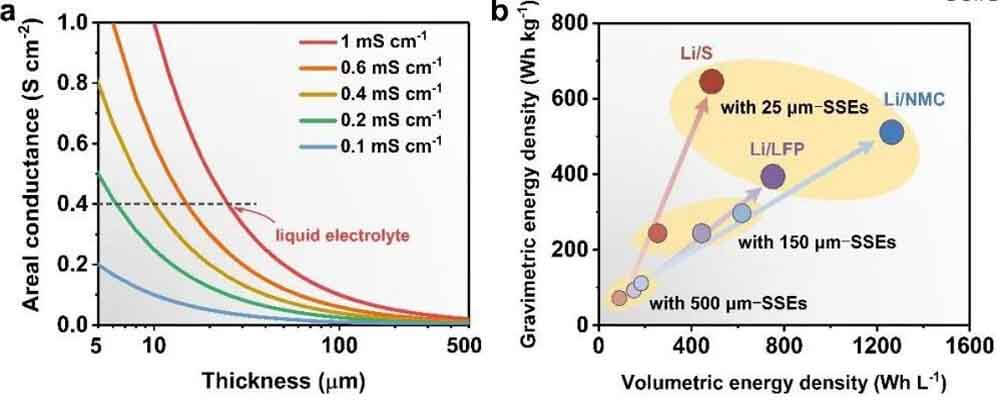
Figure 1. (a) Area-normalized ionic conductivity versus electrolyte thickness for various ionic conductivities of SSE. (b) In Li/NMC811, Li/S, and Li/LFP pouch cells, with the increase of SSE The reduction in thickness from 500 μm to 25 μm corresponds to the gravimetric and volumetric energy densities.
Ideally, the SSE should have high ionic conductivity (above 10-4 S cm-1 at room temperature), and the interface with the electrode should be stable, with a wide electrochemical window and good mechanical properties that can accommodate charge/discharge The electrode volume changes during the process and inhibits the growth of lithium dendrites.
For practical applications in energy storage, processing convenience and low cost are the two main aspects. Second, the thickness of the SSE is also a key parameter to consider as it affects the internal resistance and energy density of all-solid-state lithium batteries (ASSLBs).
The ionic conductance is inversely proportional to the thickness of the SSE film, with higher area-normalized conductance observed in SSEs with reduced thickness due to the shorter time required for ion transport across the SSE (t = L2/D, where t , L and D denote Li+ diffusion time, SSE thickness and Li+ diffusion constant).
As shown in Fig. 1a, to achieve the same area-normalized conductance as the liquid electrolyte using a 25 µm separator, the reduction in thickness is equally important for the improvement of the ionic conductance of the SSE.
If the thickness of the SSE is reduced to 10 μm, the SSE with ionic conductivity (for example, 0.4 mS cm-1) can obtain the same areal conductance as the liquid electrolyte. Ideally, if an SSE is reduced to 1/4 of its original thickness, the Li+ diffusion time across the SSE will be shortened to 1/16, and the area conductance will be quadrupled.
Besides ionic conductance, the cell energy density of ASSLB is also inversely proportional to the thickness of SSE. The energy densities of Li/LiNi0.8Mn0.1Co0.1O2 (NMC811), Li/S and Li/LiFePO4 (LFP) ASSLBs were calculated based on the pouch cell setup.
As shown in Figure 1b, the thickness of the SSE plays a huge role in determining the cell energy density, and thinner SSE is crucial to achieve higher gravimetric and volumetric energy densities.
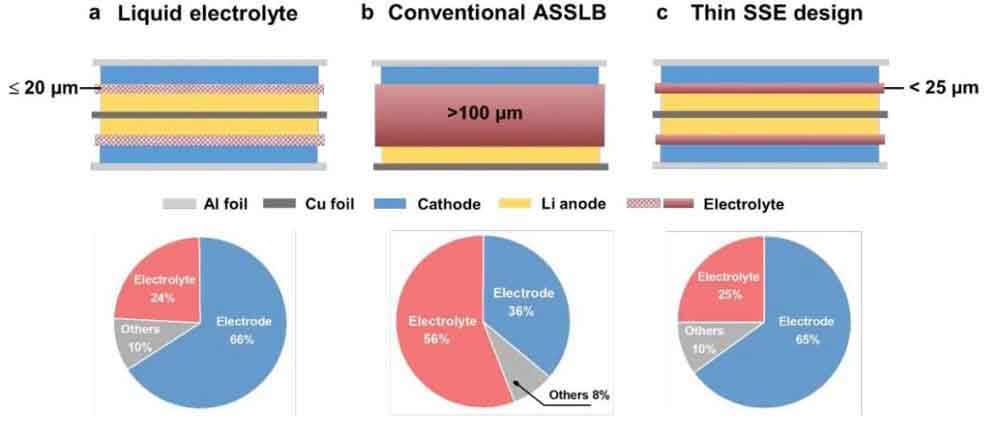
Figure 2. Weight-to-weight diagrams of Li-battery-based battery configurations and components using (a) liquid electrolyte, (b) conventional SSE, and (c) thin SSE.
By rough calculation, if the thickness of the SSE is reduced from 150 μm to 25 μm (assuming a density of 1.96 g cm-3 of sulfide SSE, the cathode contains 80 wt% active material and 15 wt% SSE), then the SSE proportion will be reduced from 56% to 25%, which is comparable to the electrolyte of the liquid electrolyte system (2.5 g Ah-1 mass and 95 wt% cathode active material) (Fig. 2).
However, SSE also acts as a separator, and thinning of the membrane will inevitably reduce its mechanical strength and increase the risk of membrane rupture or Li dendrite penetration, both of which can lead to internal short circuits, triggering battery failure and even safety hazards .
Therefore, the challenges associated with thin SSE design mainly lie in the conflict between minimizing thickness and maintaining mechanical strength. SSE can generally be divided into three categories: solid polymer electrolyte (SPE), inorganic solid electrolyte (ISE) and composite polymer electrolyte (CPE). Most thicknesses are in the range of 80 to 200µm.
ISEs are crystalline or glassy inorganics, powders are pressed to a thickness of up to 1 mm. CPEs composed of SPE matrix and inorganic fillers may overcome their shortcomings at the same time,
However, most CPEs are thicker than 100 µm, and it remains a great challenge to drastically reduce the thickness of CPEs without compromising mechanical properties.
Influence of SSE thickness on energy density
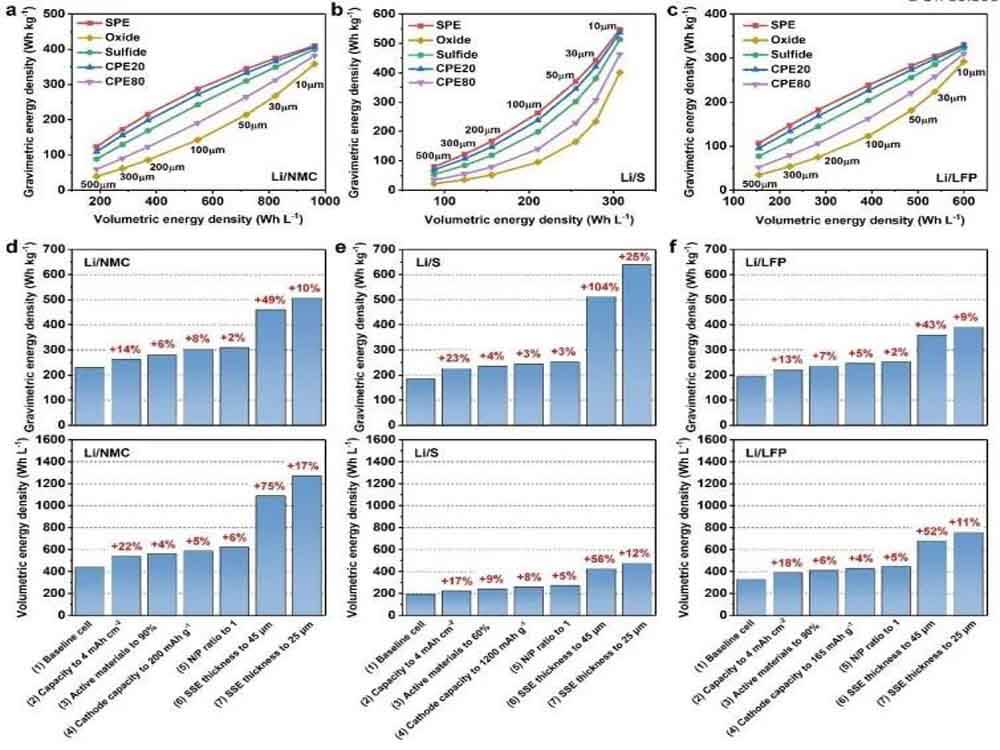
Figure 3. Estimation of the actual gravimetric and volumetric energy densities of (a) Li/NMC811, (b) Li/S and (c) Li/LFP ASSLBs; (d) Li/NMC811, (e) Li/S and (f) Calculated gravimetric and volumetric energy densities of Li/LFP ASSLBs.
ASSLBs, which are expected to power electric vehicles and portable devices, require high gravimetric and volumetric energy densities. To quantify the effect of SSE thickness on energy density, the authors provide the gravimetric and volumetric energy densities of three types of ASSLBs (Li/NMC811, Li/S, and Li/LFP) paired with various SSEs in an actual pouch cell model. simulation. The cathode capacity of all ASSLBs is set to 3 mAh cm-2 with an N/P ratio of 2.
PEO, LLZO, double-layer LPS-LGPS and two LLZO/PEO hybrids were selected as SPE, respectively. As shown in Fig. 3a,b and c, as the thickness of the SSE decreases, both the gravimetric and volumetric energy densities increase. Lightweight SPE and CPE20 are more promising in delivering high gravimetric energy density compared to heavy oxide ISE and CPE80.
Compared with Li/NMC811 and Li/LFP ASSLB, the gravimetric energy density of Li/S ASSLB increases more significantly with the decrease of SSE thickness. Figure 3d illustrates achieving the goals of gravimetric energy density of 500 Wh kg-1 and volumetric energy density of 1000 Wh L-1 under different scenarios.
In general, to achieve gravimetric energy density above 500 Wh kg-1 in Li/NMC811 ASSLB, the thickness of SSE should be controlled below 30 μm (for SPE), 25 μm (for CPE20), 20 μm (for sulfide ISE) and 10µm is suitable for oxide ISE and CPE80. For Li/S ASSLB, gravimetric energy densities higher than 500 Wh kg-1 can be achieved using 10 µm SPE or CPE20 (Fig. 3b).
On the other hand, Li/S ASSLB has relatively low volumetric energy density due to the high porosity and low density of the sulfur cathode. Finally, for the Li/LFP ASSLB, it is impossible to provide a high gravimetric energy density of 500 Wh kg-1 due to the relatively low capacity of the LFP cathode (Fig. 3f).
It should be pointed out that some parameters in the calculations are difficult to achieve in practice, so for practical ASSLBs, the requirements for SSE thickness should be more stringent. Nonetheless, the development of ultrathin SSEs is crucial to achieve high energy density ASSLBs.
Strategies to reduce SSE thickness
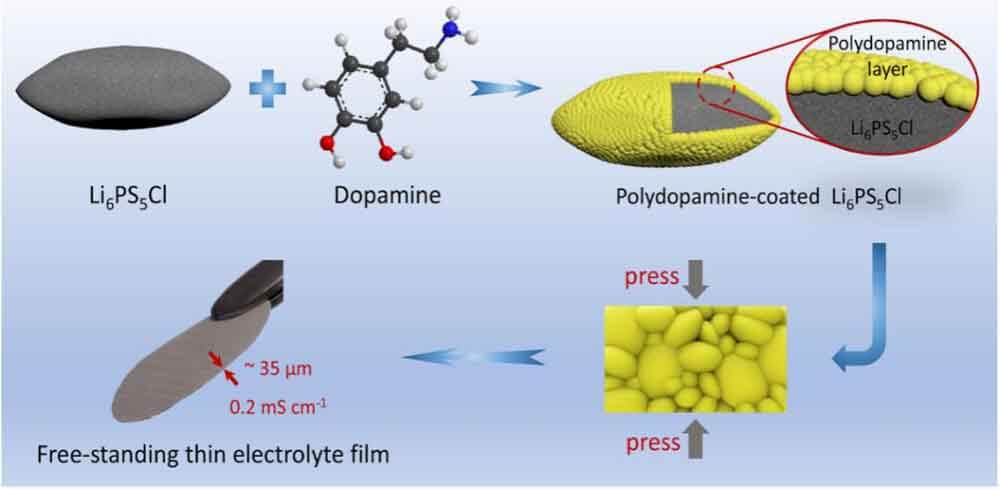
The SSE not only acts as an ionic conductor, but also acts as a separator, avoiding contact between the cathode and anode. In recent years, various strategies have been employed to successfully fabricate SSE films with sufficient mechanical strength. Infiltration of solid electrolytes into porous frameworks is an effective strategy to fabricate thin SSEs with enhanced mechanical stability.
The strong and flexible framework provides a mechanical backbone for soft polymer electrolytes or brittle ceramics, which can suppress the growth of Li dendrites during cycling even when the thickness of the SSE is reduced, and the thickness of the resulting SSE is determined by the thickness of the framework, which provides a facile and feasible way to reduce the thickness of the electrolyte while maintaining the mechanical properties.
Since polymer backbones are often poor or non-ionic conductors, and ion transport occurs only in the impregnated electrolyte region, large porosity and interconnectivity of pores are important to achieve high ionic conductivity.
From traditional polyolefin separators to ultra-thin PET non-woven fabrics containing macropores, porous polyimide (PI) membranes, electrospun PAN fiber membranes, and fibrous polytetrafluoroethylene (PTFE) as base materials, When the polymer electrolyte or softer sulfide electrolyte is impregnated or pressed into it, the electrolyte as a whole exhibits excellent mechanical properties.
Due to the flexible nature of the polymer backbone, the possibility of roll-to-roll assembly is enhanced, providing a possibility for ASSLB industrial manufacturing. Future development of polymer backbones needs to focus on pore structure engineering and the creation of cost-effective polymers with abundant vertically aligned ion channels.
Biomass with well-aligned channel structures may be promising electrolyte supports due to its low cost and natural abundance. Whereas the continuous porous 3D ion-conducting inorganic ceramic network as a framework provides additional ion channels at the expense of mechanical strength and the SSE is relatively thick.
The sintered ceramic network is not strong enough to withstand rolling, which results in limited scalability and presents significant challenges for the practical application of this method. Inorganic porous frameworks need to have large aspect ratios and highly entangled structures.
Electrode support coating is another possible thinning method. With the help of mature casting technology, the slurry is scraped on the positive electrode with a doctor blade to form a film, which can make the interface have good contact, and the advantage is that it can reduce the impedance.
But the disadvantage is that the two layers may be mixed together, and the thickness uniformity and mechanical strength of the SSE layer may not be high enough, especially when the thickness of the SSE is reduced. However, the mechanical strength of the self-supporting SSE ceramic film formed by tape casting depends largely on the thickness. Only a certain thickness can meet the mechanical requirements of battery components. At the same time, due to the brittleness of processing, it is difficult to reduce the thickness.
While the design of porous-dense multilayer ceramic membranes can be seen as a compromise between electrode support and self-supporting ceramic membranes, for porous layers, a trade-off between sufficient mechanical strength and large porosity needs to be considered to provide interconnected channels, Also avoid small holes.
Furthermore, in addition to the highly mobile molten sulfur, the penetration of other electrode slurries such as LFP and NMC into the porous framework remains problematic.
Other thinning strategies such as 3D printing, a revolutionary process introduced into the design of fine structures in electrolytes, have proven to be an effective engineering strategy, but suffer from high cost and difficulty in large-scale fabrication.
In addition, solvent-free hot-pressing processes such as Tesla’s “dry electrodes” have also been considered for the production of electrolyte membranes. In addition, by utilizing the high reactivity of lithium metal, some specific precursors can spontaneously react on the surface of the lithium negative electrode to form a thin film electrolyte in situ. Facilitates thinning of the electrolyte while providing interfacial contact. But similar to cathode-supported SSE, the conundrum between thickness and mechanical properties has not been fully resolved.

Other matching designs
In addition to electrolyte thinning, high energy density requires electrode materials to have high-voltage and high-capacity properties. High-voltage cathodes and lithium metal anodes are ideal choices.
Therefore, the electrolyte is required to have high redox stability. Gel polymer electrolytes such as PVDF and PAN can meet this requirement, but a large amount of liquid additives are required, and the safety is limited.
In addition, some oxidation-resistant polymers, such as PAN, are incompatible with lithium metal anodes.
The asymmetric design of multilayer polymer electrolytes and Janus interfaces is an expedient solution and is considered as a potential direction for the construction of thin SSEs in high-pressure ASSLBs. It is worth noting that the oxidative stability of SSE is close to 5 V, although many studies report that by CV or LSV scanning.
But during full-cell testing, the lower test voltage is mainly due to electrolyte decomposition and interphase instability at higher voltages, and further extending the voltage window of SSE is beneficial to improve the energy density of the cathode.
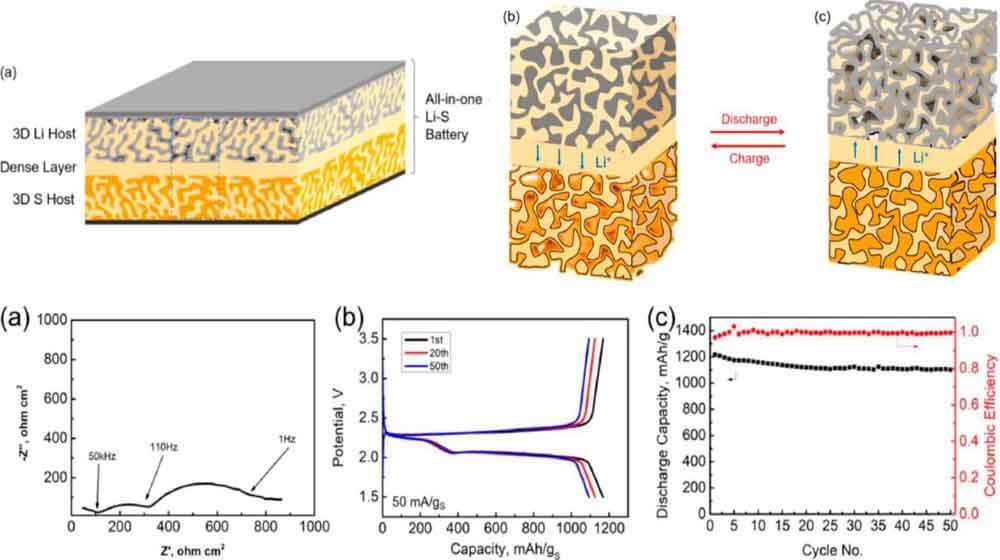
Solid-state electrolytes offer a possibility for the development of Li–S batteries because they are thought to suppress the shuttle effect.
Integrating sulfur cathode with SSE can reduce interfacial resistance and provide the opportunity to form thin SSE, furthermore, similar to high-voltage ASSLBs, bilayer or asymmetric designs of SSEs with different functionalities should be explored to address the challenges of polysulfide shuttles, ionic conductivity, and mechanical strength.
In addition, the application of electrode-supported SSE in bipolar plate batteries and framework-supported SSE in flexible batteries has also received increasing research attention.
Summary and outlook
Replacing liquid electrolytes with SSE makes LMBs promising for next-generation energy storage systems. The authors briefly introduce the main challenges and recent developments in SSE, and analyze the relationship between electrolyte thickness and energy density (gravimetric and volumetric energy density) for various systems.
The respective strategies for minimizing SSE film thickness for different electrolyte systems are highlighted, and solutions suitable for large-scale production are highlighted. In addition, recent advances in ASSLB paired with high-voltage and high-capacity cathodes are discussed, and the potential and challenges of bipolar and flexible ASSLBs are presented, finally providing a perspective on high-energy-density ASSLBs for future commercialization.
The authors point out that fabrication convenience and cost are key parameters in the process from laboratory studies to industrial batch production, and SSE synthesized using commercially available materials or biomass seems more promising for short-term applications of high-energy-density ASSLBs.
It is also reminded that there is still a large gap between laboratory-scale scientific discoveries and industrial-level applications, and in order to obtain practical assessments of electrochemical performance and energy density, the real-world performance of thin solid-state electrolytes must be tested in a large pouch battery environment close to commercial implementation. There are already a few solid state battery companies working on it. The design and development of thin and robust SSE films have attracted increasing attention from academia and industry, and more breakthroughs are expected in the near future.