Skip to content

Basic knowledge and current situation of ternary materials
Common lithium-ion cathode materials are generally embedded compounds. Including: lithium cobalt oxide with layered structure, lithium manganate with spinel structure and lithium iron phosphate with olivine structure, etc. Developed with higher redox potential and output voltage, higher reversible charge-discharge specific capacity, better electronic and ionic conductivity, a cathode material system with good cycle stability is an important research content in the field of lithium-ion batteries.
Ternary nickel-cobalt-manganese materials generally refer to nickel-cobalt-manganate lithium LiNi1-x-yCoxMnyO2. The material has a ternary synergistic effect, and its electrochemical performance is better than any single material, the cycling stability of LiCoO2, the high specific capacity of LiNiO2, and the thermal stability, safety, and low price of LiMn2O4 are combined.
Increasing the nickel content in the ternary nickel-cobalt-manganese material can improve the reversible lithium intercalation capacity of the material. However, the phenomenon of cation mixing is prone to occur. With the increase of nickel content, the more serious the mixing of nickel and lithium in the material, the irreversible capacity loss of the material occurs.
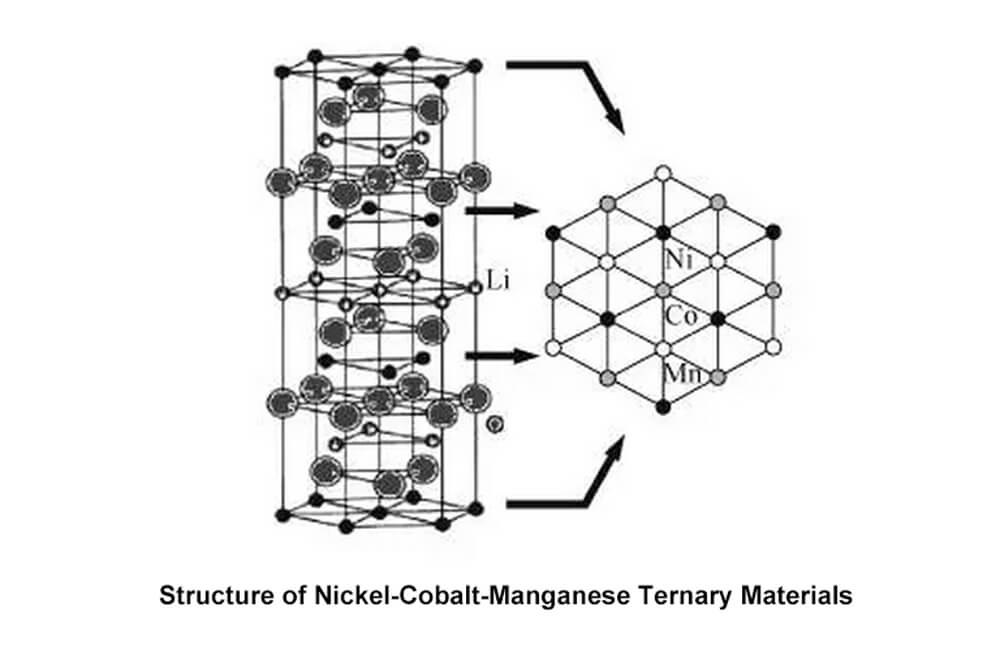
The introduction of cobalt can improve the electronic conductivity of the material, reduce the phenomenon of ion mixing, stabilize the layered structure of the material, and improve the rate and cycle stability of the material. Reasonably adjusting the ratio of ternary materials to obtain optimized ternary materials is a research hotspot and focus in the field of lithium ion electrochemistry.
At present, according to the ratio of nickel, cobalt and manganese, commercial ternary material product models range from 111 ternary material to 424, 523, 622, 811 ternary material, and even higher nickel content. As the nickel content increases, the battery energy density also increases accordingly.
Among them, the 111-type material is the most mature material for industrial application in the current market due to its easier control of the preparation process and use environment. The 622 product series has a higher energy density. With the increasingly mature and stable production process, the 622 product has entered the stage of industrial application. 811 products still need to continue to be developed, and no battery manufacturers have put them into large-scale commercial applications. This is because the nickel content is too high, the alkalinity is too high, and the preparation and use of materials are very difficult.
Influencing factors of electrochemical performance of cathode materials
There are many factors affecting the electrochemical performance of cathode materials. In addition to the crystal structure of the material itself, there are also the following factors: crystallinity, particle size distribution, stoichiometry, etc.
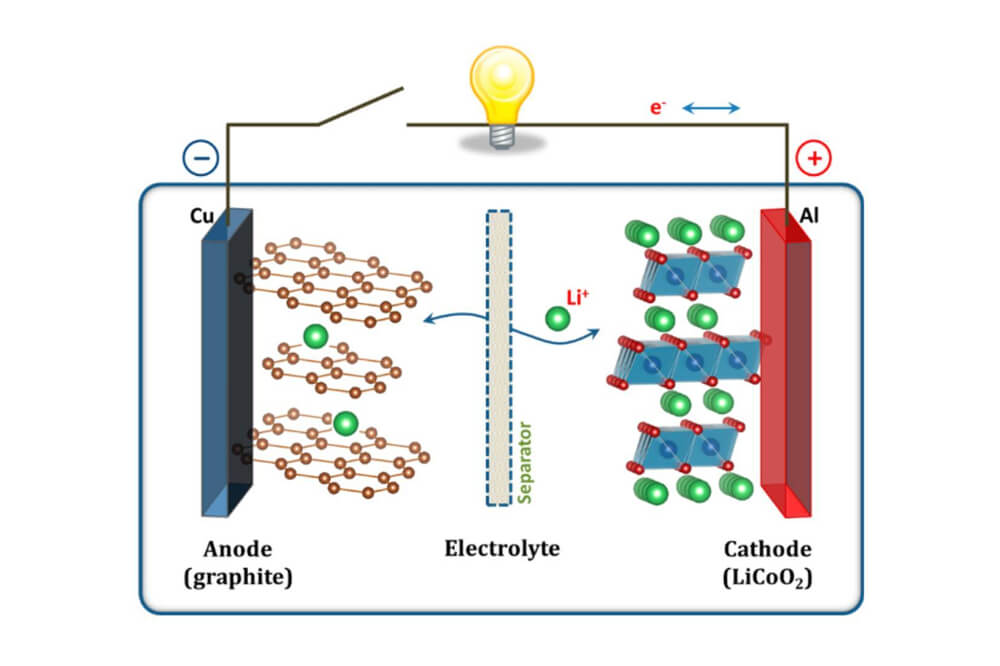
Lithium-ion batteries realize the conversion of electrical energy and chemical energy through the intercalation and deintercalation reactions of Li+ between the positive and negative electrodes. The higher the reversibility of Li+ intercalation and deintercalation and the smaller the influence on the host structure, the better the cycle performance of the material.
The better the crystal structure of the cathode material is, that is, the higher the crystallinity, the more conducive to the diffusion of Li+, and the better the electrochemical performance of the material. On the contrary, poor crystalline properties or containing impurities have a greater impact on the electrochemical properties of materials.
Different morphology and particle size distribution will affect the tap density and compaction density of the material, and determine the volume energy density of the material. In general, the larger the particle size of the material, the smaller the tap density, and the smaller the specific surface area, the less conducive to the extraction and embedding of Li+ in the material. Therefore, controlling the microstructure and particle size of the material can improve the performance of the ternary material.
The stoichiometric ratio and distribution uniformity of nickel-cobalt-manganese ternary materials have a great influence on the synthesis and electrochemical properties of the materials. In-depth study of the ratio of nickel, cobalt and manganese is of decisive significance for the preparation of materials with stable electrochemical properties.
Deviations from stoichiometric ratios and uneven distribution of elements can lead to impurity phases in the material. In addition to the above influencing factors, the residual alkali, pH, single crystal particle size, lithium salt type, moisture, impurities, etc. of the ternary material also have a great influence on the electrochemical performance of the material.
Preparation method of ternary material
The microstructure, particle morphology and electrochemical performance of the cathode material are closely related to the preparation method of the material. Nickel-cobalt-manganese ternary materials belong to the same layered structure as LiCoO2.
Therefore, the preparation of ternary materials also mostly follows the preparation methods of LiCoO2, mainly including high temperature solid phase method, co-precipitation method, sol-gel method and spray drying synthesis method.

High temperature solid phase method
The high-temperature solid-phase method is the most commonly used method for preparing metal oxides. The so-called solid-phase method generally refers to a method in which a solid compound is used as a raw material and is mixed uniformly in a stoichiometric ratio, and then calcined for a period of time under a certain atmosphere and temperature to obtain the desired sample.
Among them, factors such as the degree of mixing uniformity of raw materials, roasting time, heating and cooling rate, atmosphere, and temperature stability determine the microstructure and electrochemical properties of the product.
Solid-phase synthetic materials have the characteristics of low equipment requirements, simple process, easy operation, mature technology, low cost, and large output.
The biggest disadvantage of using this method is that the quality of the material is difficult to control, including the particle morphology, composition and size of the material, resulting in poor consistency, stability and reproducibility of electrochemical performance.
Xu et al. used Ni(OH)2 and Li2CO3 as raw materials, with an excess of 10% lithium, and sintered them in an oxygen atmosphere at 750 °C for 12 h to obtain LiNiO2.
A button half-cell was prepared by using active material, small particles of conductive carbon black and polyvinylidene fluoride in a mass ratio of 8:1:1. The test voltage range was between 2.7 and 4.3 V. At 0.1C, the first discharge specific capacity was 205mAh/g, the first discharge efficiency is 84.7%, and it shows good cycle performance.
Co-precipitation method
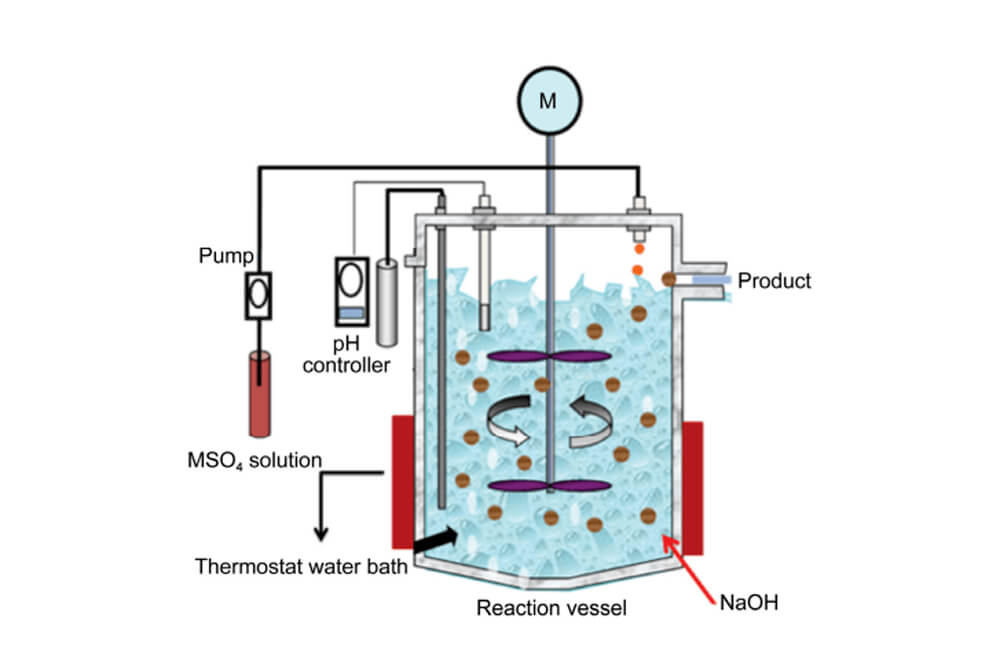
The co-precipitation method, also known as the liquid phase method, is based on the precipitation reaction. Generally, the salt solution of one or more metal ions is used as the raw material, and the precipitate is produced by the co-current reaction under the action of the precipitant and the complexing agent.
The product or precursor is obtained after filtration, washing and drying processes, mixed with a solid phase of lithium salt, and calcined in a certain temperature and atmosphere for a certain period of time to obtain a positive electrode material.
The co-precipitation method has the advantages of accurate reaction measurement, low reaction temperature, simple operation, easy control of conditions, good reproducibility, and stable electrochemical performance, and has become the most important method for commercial synthesis of this material.
However, in the co-precipitation process, the concentration of reactants, temperature, pH value, feeding rate and stirring rate determine the particle size, element distribution, crystal form and other physical parameters of the material. Therefore, each process parameter needs to be strictly controlled.
Li et al. used high temperature solid-state reaction to prepare ternary layered oxide LiNi0.5Co0.2Mn0.3O2 with good spherical particles. Using Ni0.5Co0.2Mn0.3(OH)2 and Li2CO3 as raw materials, the lithium content is 1.06. The sintering treatment plan is to pre-sinter at 500 °C for 5 h, and then sinter at 960 °C for 12 h in an air atmosphere to obtain the sample.
Hua et al. prepared a layered Ni1/3Co1/3Mn1/3(OH)2 precursor by a mixed hydroxide co-precipitation method. The effects of pH control on particle structure, morphology, particle size distribution and tap density during the reaction were investigated.
The characteristic peaks of (006, 102) and (108, 110) split in the test results of X-ray diffraction spectrometry indicate that the material has a layered structure. Transmission electron microscopy test results show that the (001) crystal plane is the preferred orientation during the co-precipitation reaction. The electrochemical performance test results show that the layered structure of the precursor determines the electrochemical performance of LiNi1/3Co1/3Mn1/3O2.
Sol-gel method
The sol-gel method uses metal organic salt or inorganic salt solution as raw material, and undergoes hydrolysis, condensation and other reactions under the action of complexing agent to form a metastable sol system. Under the action of aging and other conditions, the sol forms solid particles with relatively fixed positions the gel,
The gel is dried to remove the solvent to obtain a dry gel with a well-developed spatial structure and uniform distribution of metal ions, heating to remove residual organic impurities in the dry gel system, and then heat treatment to prepare the desired target product.
The product prepared by this method has the advantages of uniform chemical composition, high purity, narrow and uniform particle size distribution, low heat treatment temperature, and precise control of the stoichiometric ratio. However, the shortcomings of this method are also obvious, including: the morphology of the product is difficult to control, the cost is high, the operation is complicated, and the industrialization is difficult. The method is currently limited to laboratory studies.
Luo et al. used LiAc·2H2O, Co(Ac)2·4H2O, Ni(Ac)2·4H2O, Mn(Ac)2·4H2O as raw materials and citric acid as complexing agent by sol-gel method according to the stoichiometric ratio ( Li:Ni:Co:Mn=1.05:0.5:0.2:0.3) mixed the raw materials uniformly to obtain a sol, and heated in a water bath to remove the moisture in the sol to obtain a gel.
LiNi0.5Co0.2Mn0.3O2 material was synthesized by sintering the colloid at 450℃ for 5h in air atmosphere and sintering at 900℃ for 12h, and then modified by double-sided coating. Under the condition of 55℃, the voltage range is 2.5-4.5V, the first discharge specific capacity at 1C is 116.6mAh/g, and the capacity retention rate after 50 cycles is 74.2%. Compared with the sample before modification, it shows excellent electrochemical cycle performance.
Zuo et al. prepared LiNi1/3Co1/3Mn1/3O2 with layered structure by sol-gel method. The effects of subsequent heat treatment temperature and treatment time on the crystal structure, microscopic morphology and electrochemical properties of the materials were investigated by XRD, scanning electron microscopy and charge-discharge tests.
The sample sintered at 700℃ for 2h has a good layered a-NaFeO2 type structure, the discharge specific capacity is 169.2mAh/g, and the capacity retention rate is 89.2% for 30 cycles at 0.1C in the voltage range of 2.8-4.4V.
Spray drying method
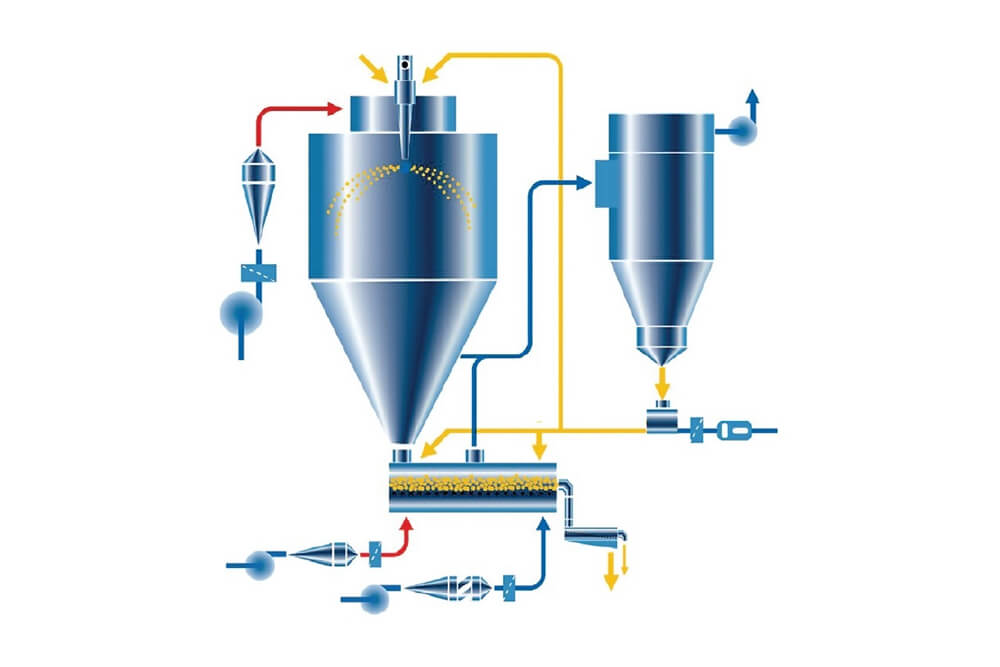
The spray drying method refers to the atomization of the metal soluble salt mixture in the drying chamber to form small droplets, the droplets are in contact with hot air in the form of spray, and a dry product is obtained through evaporation, precipitation, decomposition, sintering and other processes. method.
The method has the advantages of less material powder agglomeration, good and uniform morphology, good particle monomer dispersibility and high tap density. The spray drying method is regarded as a production method of ternary materials with very broad application prospects due to the advantages of high degree of automation, short preparation period and no industrial waste water.
Piskin et al. used nickel nitrate, cobalt nitrate, manganese nitrate and citric acid as raw materials to prepare precursors with good performance by ultrasonic spray high-temperature pyrolysis. The LiNi1-x-yCoxMnyO2 positive electrode material (x is 0.2 to 0.06). In the 2.75 ~ 4.25V voltage range.
At 0.1C, the prepared LiNi1/3Co1/3Mn1/3O2 material has a specific discharge capacity of 188mAh/g for the first time, a specific discharge capacity of 180.5mAh/g after 30 cycles, and a retention rate of 86%, indicating that the material has good cycle performance. .
Kim et al. spray pyrolyzed the raw materials, and sintered them in a box furnace at 900 °C for 20 h to obtain LiNi1/3Co1/3Mn1/3O2. Under the current density of 0.2mA/cm2, the first discharge specific capacity is 204mAh/g.
In addition to the above methods, there are Pechini method, hydrothermal synthesis method, ion exchange method, irradiation gel polymerization method, microwave synthesis method, spontaneous combustion method, pulsed laser deposition, chemical vapor deposition method, etc. Different preparation methods have a great influence on the mixing degree and physical properties of the materials.
There are advantages and disadvantages in the synthesis of ternary materials. Because some methods have some defects in some aspects, such as: poor product cycle performance or low capacity, the production process pollutes the environment, and the cost is high, so it is not suitable for Large-scale industrial production requires improvements in these methods.