Skip to content


Ore lithium extraction technology
Lithium and its compounds are widely used in various fields. In recent years, with the further promotion of new energy electric vehicles, the demand for lithium continues to increase, and the extraction of lithium from lithium-containing minerals in basic rocks has attracted more and more attention, and related companies include top 10 lithium mining companies in China.
In nature, lithium-containing ores mainly include lepidolite, spodumene and petalite. The methods for extracting lithium, rubidium, cesium and other valuable metals from lithium ore mainly include limestone method, sulfuric acid method, sulfate method, chloride method and pressure cooking method.
Limestone roasting method
The limestone calcination method is to mix lepidolite and limestone (general mass ratio 1:3), fully grind and roast at a temperature above 800°C. The crystal form of lithium-containing ore is transformed, and the insoluble lithium salt in lepidolite is transformed into a lithium salt that is easily soluble in water.
The reaction principle is as follows: The main advantage of this method is that it is very practical and can be used for almost all lithium minerals. The disadvantages are that the lithium content in the leaching solution is low, the evaporation energy consumption is large, and the recovery rate of lithium is low.
Sulfuric acid method
The treatment of lithium ore by sulfuric acid method needs to pre-roast the lithium ore at high temperature to make the structure change from dense to loose, and then mix it with excess sulfuric acid after ball milling. Roasting and dissolving in a rotary furnace at 250°C, soaking in water to obtain a crude lithium sulfate solution, and obtaining a lithium carbonate product after purification, lithium precipitation, evaporation and concentration.
Advantages: low energy consumption, small material flow, high production efficiency, especially easy mixing of liquid and solid phases, high concentration of lithium in the leachate, and high recovery rates of lithium and potassium.
Disadvantages: The impurity content of the leaching solution is high, the subsequent purification load is heavy, the technology is difficult, and a large amount of sulfuric acid is used, which requires high anti-corrosion performance of the equipment.
Sulfate method
The sulfate method is often used to treat silicate minerals, but when it is used to extract lithium from lithium ore, it needs to go through the mixing of lithium ore and potassium sulfate (sodium), pelletizing, and high-temperature roasting. Lithium in the ore is replaced with soluble lithium sulfate, leached with dilute sulfuric acid, and the leaching solution is purified and precipitated to obtain lithium carbonate.
Advantages: short roasting time and leaching time, high concentration of lithium in the leach solution, small evaporation, low energy consumption, etc.
Disadvantages: Potassium salt consumption is very large, and the requirements for roasting temperature are very strict.
Chlorination roasting method
The chlorination roasting method mainly uses a chlorination agent (calcium chloride) to convert lithium and other valuable metals in lithium ore into chlorides. It is divided into two processes: medium-temperature chlorination and high-temperature chlorination.
Advantages: high conversion rate of lithium, low energy consumption, short roasting time, high recovery rate of valuable metals such as lithium and potassium, high concentration of lithium in the leach solution, etc.
Disadvantages: The roasting process requires high anti-corrosion equipment, and the use of sodium carbonate for lithium precipitation in the later stage greatly increases the cost.
Pressure boiling method
Similar to the sulfuric acid method, the pressure cooking method also needs to transform or defluorinate the lithium ore in advance, and then mix the roasted ore with a certain amount of Na2CO3 evenly. Treat at 200°C and under pressure (0.2~2MPa), use Na to replace Li and then pass CO2 into the water immersion slurry to convert lithium carbonate into LiHCO3 with high solubility. After separating the residue, heat the solution to precipitate lithium carbonate product.
This method has a shorter process flow and lower cost, but has stricter requirements on process conditions and mineral types. Through technological innovation and transformation, further cost reduction is the development trend of ore lithium extraction technology. Compared with the limestone roasting method, the sulfuric acid method, sulfate method, chlorination roasting method, and pressure cooking method have low energy consumption and high lithium leaching rate, and have a tendency to replace the limestone method.
Salt lake lithium extraction technology
The endowment of salt lake is different, and the lithium extraction technology is different. According to the resource endowment of salt lake brine, salt lake lithium extraction technology can be divided into high magnesium lithium ratio salt lake lithium extraction technology and low magnesium lithium ratio salt lake lithium extraction technology.
At present, most of the salt lakes that have been industrialized are low-magnesium-lithium ratio salt lakes (magnesium-lithium ratio is lower than 8), including sedimentation methods and solar pond methods, among which sedimentation methods are mostly used in South American salt lakes. The lithium extraction technology of high-magnesium-lithium ratio salt lakes is becoming mature, and China is actively exploring the extraction methods of high-magnesium-lithium ratio salt lakes.
At present, the relatively successful lithium extraction methods include adsorption method, membrane method, extraction method, calcination leaching method, and electrodialysis method. If you want to know about lithium salt enterprises, please refer to top 10 lithium salt enterprises in China.

(1) Precipitation method: The brine is dried in the sun to allow it to evaporate and concentrate naturally. After removing impurities such as boron, calcium, and magnesium, a precipitating agent or a salting-out agent is added to the mother liquor to separate lithium in the form of precipitates. The precipitation method has been applied in industry earlier, the process is mature and reliable, and the production cost is low, but it is not suitable for salt lakes with high magnesium-lithium ratio.
(2) Solar pond method: use the low-temperature climate in the region to obtain high-lithium mixed salt brine (lithium is close to the saturation point), and then evaporate and heat up through solar pond technology to obtain lithium-rich mixed salt and thenardite precipitation. At present, this method has been used by Tibet Zabuye Lithium High-tech Co., Ltd. in Zabuye Salt Lake.
Although this method has achieved industrial production, it is demanding on the occurrence of resources and local natural conditions. At present, this method has been used in the Ngari area of northern Tibet in China and some areas in Argentina.
(3) Adsorption method: Adsorb lithium in brine with an adsorbent selective to lithium, then desorb with fresh water to separate and enrich from other impurities, and then concentrate and chemically precipitate lithium in small salt pans. Adsorption method is a lithium extraction technology with great advantages from the perspective of environment and applicability, especially for low-grade high-magnesium-lithium ratio brine and seawater lithium extraction. The difficulty of this method lies in the development of adsorbents with excellent performance. At present, the adsorbents are mainly divided into manganese-based, titanium-based ion sieves and aluminum-based adsorbents.
(4) Membrane method: Mostly in the industrial test stage, various types of filter membranes are used to gradually separate the impurity components in the brine, enrich and concentrate lithium, and then chemically precipitate lithium.
The advantages are strong adaptability to brine, simple process, high recovery rate of lithium, good selectivity, and little impact on the environment; the difficulty lies in developing a filter membrane with high selectivity, low energy consumption and good cycle performance.
(5) Extraction method: the separation and concentration of lithium and other impurity components are achieved by extracting lithium with organic solvents, and the high-concentration back-extraction liquid is further produced into various lithium salts. The advantage is that it can handle brine with a high magnesium-lithium ratio, and it is easy to industrialize, but the high requirements for extraction equipment and large research investment make this technology immature.
The extraction agents used in the extraction method include organic solvents and ionic liquids. Organic solvents have high extraction selectivity but are easy to corrode and pollute the environment; ionic liquids are green and environmentally friendly, but the extraction agents are complicated to prepare.
(6) Calcination method: the brine after boron extraction is concentrated and dried, calcined and decomposed into magnesium oxide, and then the soluble lithium salt in the magnesium oxide is dissolved with water, and then the lithium carbonate product is precipitated.
The production process of calcination and leaching method is a salt field old brine process developed by Qinghai CITIC Guoan Technology Development Co., Ltd. It is mainly aimed at salt lakes with high lithium content and high magnesium-lithium ratio, and is easy to industrialize. However, it has high energy consumption, strong corrosion, great environmental impact and high cost.
(7) Electrodialysis: Under the action of an external DC electric field, the solid or liquid ion exchange membrane is selective for ions in water, part of the ions in the water are transferred to another part of the water through the exchange membrane, so as to achieve the purpose of separating magnesium and concentrating lithium.
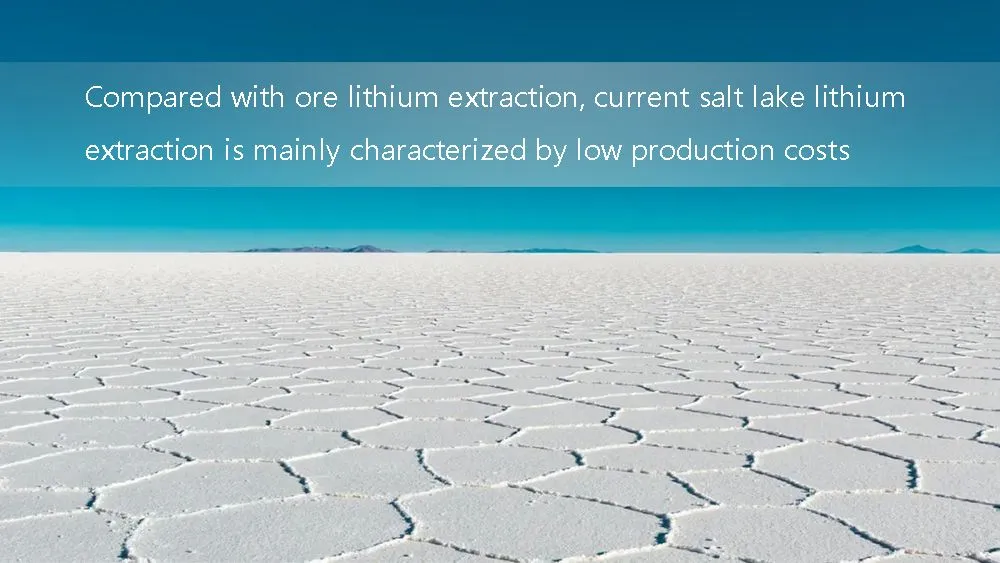
Its advantage is that it can handle high magnesium-lithium ratio salt lakes and high efficiency; the difficulty lies in the development of lithium capture materials with excellent selectivity, high lithium capacity and high stability. Compared with ore lithium extraction, current salt lake lithium extraction is mainly characterized by low production cost, but long production cycle and poor capacity guarantee. With the development and maturity of technology, the development direction of salt lake lithium extraction in the future is as follows:
(1) Expansion of mining scope: the development and utilization of low-concentration, high-magnesium-lithium ratio salt lake brine that was not economical in the past has been realized through technologies such as membranes, adsorbents, extraction, and electrodialysis.
(2) Continuous improvement of production capacity: At present, salt lake lithium extraction mainly adopts the concentration and precipitation method, so it is affected by factors such as weather and natural environment. In the future, with the development of emerging technologies, the limit of external environment will be reduced.
(3)The production cycle is continuously shortened: using emerging technologies, continuous optimization and improvement in enrichment, separation and concentration, and continuous industrial production to improve efficiency.
China’s salt lake lithium extraction is continuously optimized, and the cost reduction has economic value. In the early stage of development of lithium extraction in China’s salt lakes, the technology was not mature enough to lead to high costs, and the production did not have economic value.
According to research, with the continuous upgrading of technology and optimization of technology, the cost of lithium extraction technology for emerging high-magnesium-lithium ratio salt lakes has basically not exceeded 40,000 yuan/ton LCE.
Compared with the cost of lithium extraction of ore, there is no disadvantage. It is expected that with the continuous improvement of technology and the expansion of production scale, the cost of lithium extraction in salt lake is still expected to decline.
The scale is still small and the utilization rate is insufficient. According to data, in 2019, my country’s main salt lake output was about 45,000 tons of LCE, and the industry’s average capacity utilization rate was only 52%.
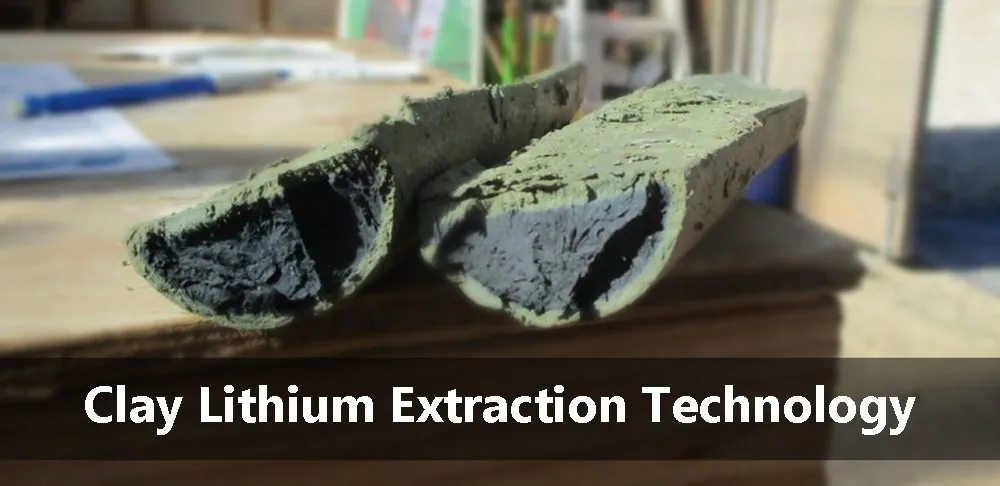
Clay lithium extraction technology
The clay lithium extraction process is determined by the state of occurrence. The occurrence state of lithium is the key factor determining the clay lithium extraction process. The main material composition and chemical composition of clay-type lithium ore determine the subsequent extraction process and even the purification and impurity removal process.
In terms of types, carbonate clay-type lithium ores are mainly leached with sulfuric acid after roasting; volcanic rock clay-type lithium ores can be leached directly, roasted with additives, and chlorinated and vulcanized; Jadar-type lithium ore can be leached with concentrated sulfuric acid after multi-stage crushing and wet closed-circuit gravity separation washing.
Lithium clay lithium extraction process is characterized by the ability to combine the advantages of ore lithium extraction and salt lake lithium extraction, the lithium extraction process can be completed in a short time at the speed of ore lithium extraction, and the lithium extraction can also be completed at a lower cost at a cost similar to that of brine lithium extraction. For more lithium battery related articles, please refer to battery materials, lithium battery coating materials, anode material manufacturers.