
Basic principles of energy storage battery factory construction
The construction of energy storage battery manufacturing plants mainly considers the safety, qualification rate, efficiency, system flexibility and construction speed of battery manufacturing under the condition of battery performance, so as to quickly adapt to market demand and bring the greatest economic benefits.
Conditions for mass production of energy storage batteries
In order to meet the rapidly growing market demand for energy storage batteries, how to ensure the mass production of energy storage batteries is an important issue that needs to be considered at present. High quality, high safety, and low cost – this is the industry’s long-standing pursuit of energy storage battery production, and it is also the key to ensuring mass production. It is also what TYCORUN ENERGY odm lithium ion battery energy manufacturer has always attached importance to.
Considering the support capabilities of current battery technology, materials, and equipment, the large-scale intelligent manufacturing of power batteries should meet the following basic conditions:
● Simplification of production models: 1-2 sizes, specifications and models produced by a single production line;
● Manufacturing capacity of the whole line: more than 4GWh, the production capacity of a single device is not less than 0.5-1.0GWh; Manufacturing pass rate: over 96%;
● Material utilization rate: over 95%;
● Manufacturing cost: 0.08-0.1 RMB/Wh;
● Safety control, environment, environmental protection indicators, energy consumption indicators control and optimization measures;
● Incoming material digitization, process digitization, equipment network interconnection, big data optimization.
Manufacturing qualified rate decomposition
The energy storage battery cell factory is mainly divided into six modules. The primary task of energy storage battery design is to select a reasonable battery structure, aiming at the pass rate index, according to the difficulty of process control and the possible goals, the overall pass rate target is decomposed into major modules according to the principle of core influencing factors, and the process capability (CPK) of the key product characteristics KPC (Key Product Characteristics) of the module is determined, then further decompose CPK into the core process in the module, which is a decomposition from top to bottom.
Then, according to the key control characteristics KCC (Key Control Characteristics) of each process process method, the process control capability CPK value and equipment investment that may be achieved are comprehensively analyzed.
The overall calculation of the equipment investment of the whole line and the guarantee ability, reliability and stability of CPK of each process control point can achieve the optimization of equipment investment and manufacturing quality. The breakdown of energy storage battery manufacturing pass rate is shown in the figure below.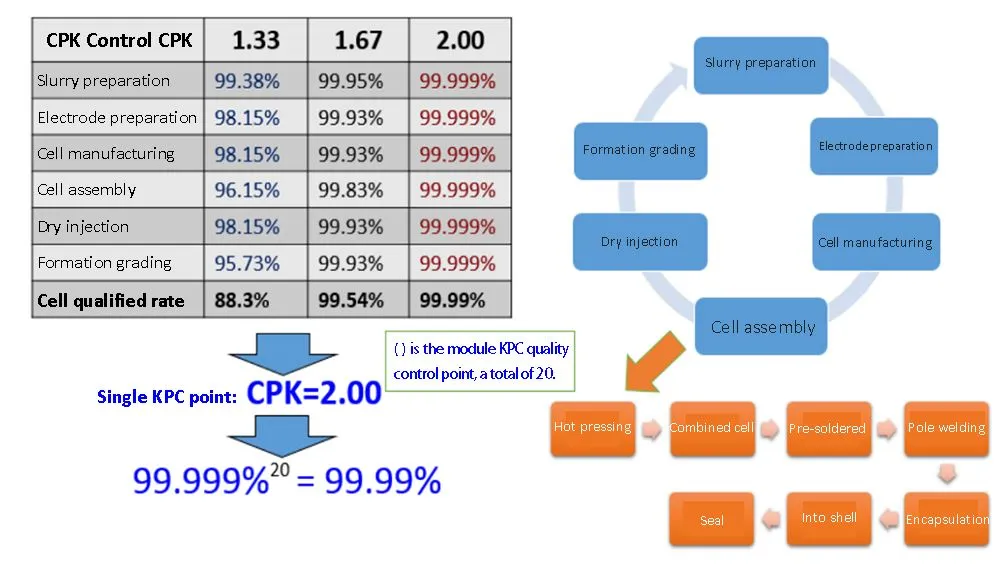
Decomposition of energy storage battery manufacturing qualification rate target
In equipment planning, CPK is generally decomposed and balanced according to the difficulty of process quality control and production line input cost, and iteratively optimizes to the best design. That is, the same investment to achieve the best quality; or the minimum equipment investment under the premise of ensuring quality requirements, while also considering the comprehensive output capacity of equipment and production lines.
Because these devices are provided by different manufacturers, they also adopt many different protocols and standards, and are oriented to various application requirements. Therefore, smart factory integration not only needs to combine different products provided by different manufacturers, but also has scientific methods to allow them to be interconnected and interoperable without conflicts. More importantly, the whole system should achieve optimal system performance, lowest cost, best quality of produced products, and easy expansion and maintenance in the future.
Selection principle of energy storage battery production equipment
(1) Equipment selection principle
The selection of energy storage battery production equipment should follow the following principles: technological advancement, production adaptability, economic rationality, mutual compatibility, and man-machine friendliness. Related battery equipment companies include top 10 lithium battery production equipment companies in China.
(2) Comprehensive selection of equipment
Equipment is to improve the manufacturing qualification rate and manufacturing efficiency. Equipment investment affects the quality of the equipment, and the qualification rate of battery manufacturing is also high. As shown in the figure below, the vertical axis represents the cost (equipment input cost, and the change in pass rate brings about cost change), and the horizontal axis represents the pass rate.
Curve ① in the figure is the equipment investment curve. The increase in equipment input will also increase the pass rate; Curve ② reduces cost loss due to the increase in pass rate; ③ is the combination of curves ① and ②. It can be seen that the curve ③ indicates that the input in equipment increases, the pass rate increases and the comprehensive cost gradually decreases.
However, with the increase in equipment input, the pass rate is limited, and the degree of reducing waste loss is gradually reduced, so the overall cost will gradually increase. In short, there is an optimal point in equipment input and cost, which is the best choice for equipment input.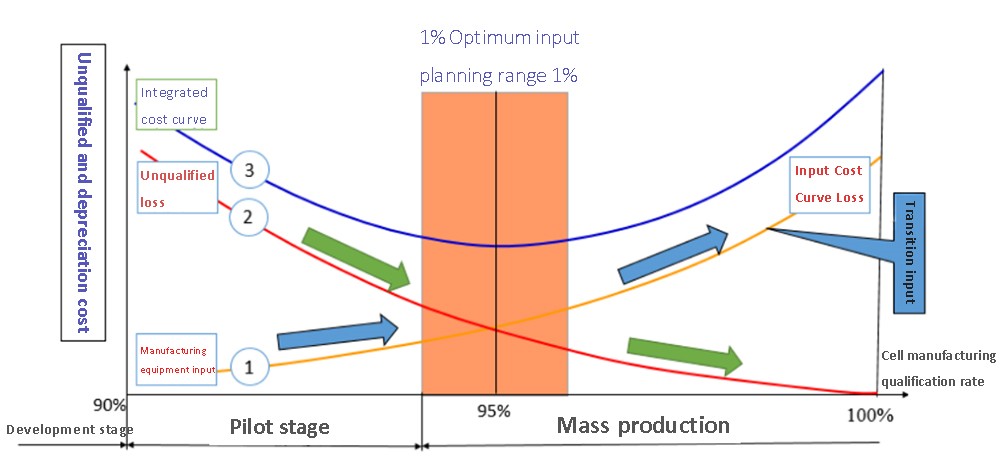
① Equipment input curve ② Quality loss caused by unqualified manufacturing ③ Comprehensive cost curve qualification rate and equipment input, manufacturing loss
Smart factory design process
The planning and construction of a smart factory is a very complex system engineering. How to design a lithium battery smart factory is also a difficult problem. It requires detailed analysis and planning, after a detailed project plan review, and then to the implementation and design of the plan. The design process of the smart factory is shown in the figure below.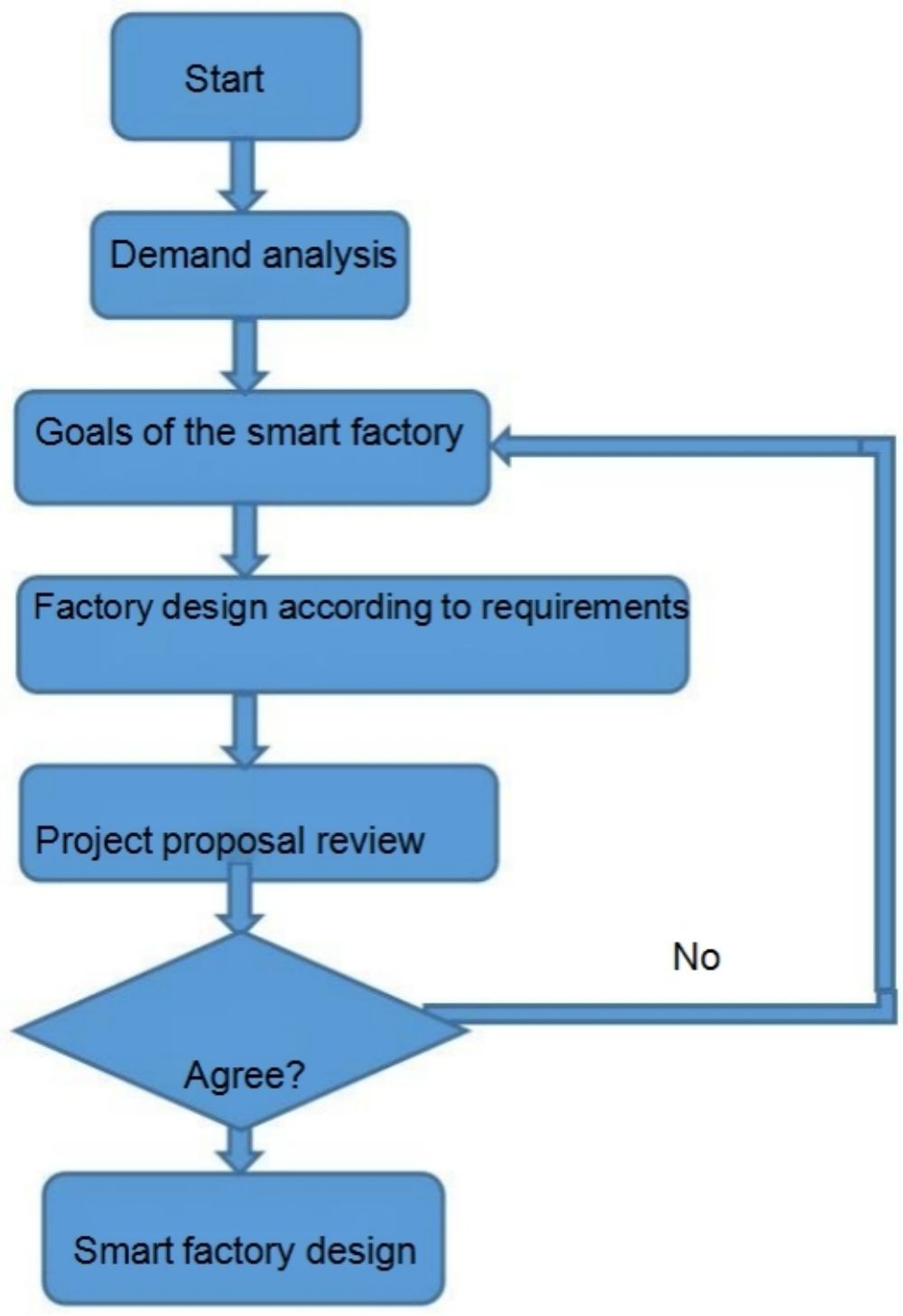
Smart factory design process
The planning and design of an energy storage battery smart factory is generally divided into six steps;
1) The total input of the smart factory is the development strategy of the enterprise.
2) First of all, do detailed market research and analysis to determine the application fields of the project products.
3) According to the identified needs, at the height of the smart factory, diagnose and evaluate the enterprise’s organization, management model, business process, technical means, data development and utilization, etc.
4) According to the product positioning and factory goals, carry out the product design of the battery cell, and design the basic parameters of the battery cell.
5) Project plan review, including reviewing project investment budget and plan feasibility.
6) Confirm the project plan and implementation plan of the project, and implement the person in charge and team of the overall project and sub-projects.
The overall design idea is shown in the figure below.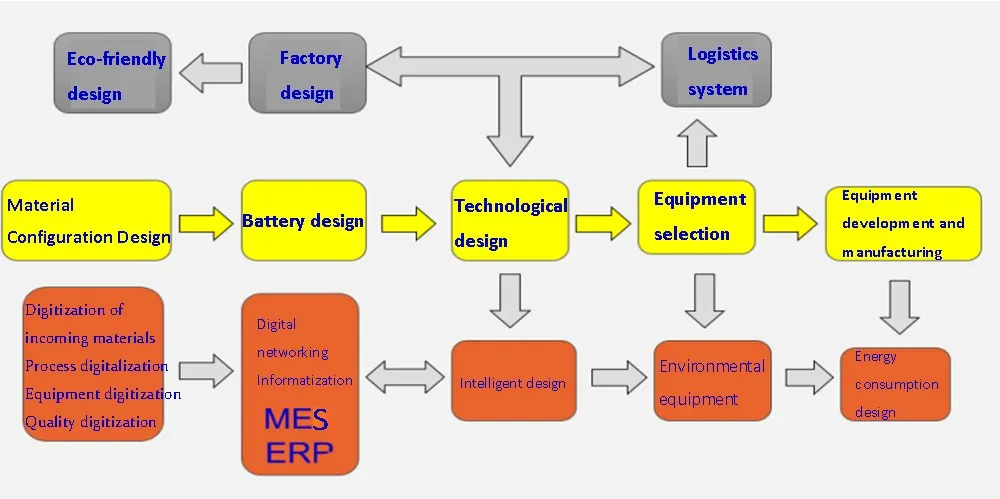
Intelligent factory design ideas
The main process is to carry out material selection configuration design, battery design, process design, equipment selection, equipment development and manufacturing according to battery performance requirements. Others are auxiliary design process.