Skip to content

The electrolyte market continued to improve, and the Q1 performance of related companies surged.
Since 2022, the power + energy storage market has maintained a high degree of prosperity, which has led to a substantial increase in the shipment of lithium-ion batteries, which in turn has led to a jump in the demand for electrolytes and their upstream raw materials. The electrolyte and battery raw materials have been listed as Top 10 lithium ion battery electrolyte company, Top 10 Lithium salt enterprises and Top 5 lithium iron phosphate cathode material companies, etc. there may be something you are interested in.
The massive downstream market demand provides a solid market soil. However, the supply of electrolytes, lithium hexafluorophosphate, VC and other raw materials is tight, and their prices enter the upward channel. This is undoubtedly a big positive for the performance of enterprises in the electrolyte industry chain.
Recently, a number of listed companies in the electrolyte industry chain released Q1 quarterly reports (announcements). Overall, performance continued to improve, and net profit achieved substantial growth.
| Performance of listed companies in the electrolyte industry chain in Q1 in 2022 | |||
| Company | Net profit | YoY growth | Related products |
| TINCI | 14.98 | 422.19% | Electrolyte, Lithium Hexafluorophosphate |
| DFD | 7.46 | 631% | Lithium Hexafluorophosphate |
| CAPCHEM | 4.82-5.13 | 210%-230% | Electrolyte |
| YONTA | 3.72-4.23 | 410%-480% | Electrolyte, Lithium Hexafluorophosphate, VC |
| Tonze | 4-4.4 | 742.8%-827.08% | Lithium Hexafluorophosphate |
| SH | 4.45-4.72 | 91.86%-103.5% | Solvents, Electrolytes |
| OXIRAN | 0.95-1.05 | 85.84%-105.4% | VC |
Specifically, except for OXIRAN, which has a relatively low proportion of solvent materials business, the year-on-year increase has little impact, other companies’ net profit increased by 1-8 times, and Tonze ranked first with a 7-8 times growth rate.
Compared with last year, the net profit of DFD, TINCI and TonzeQ1 has reached half of the net profit of last year, and YONTA even surpassed the net profit of last year.
However, it should be noted that the price of lithium hexafluorophosphate has dropped recently, from 590,000 RMB / ton at the beginning of this year to 450,500 RMB / ton, a drop of 23.6%.
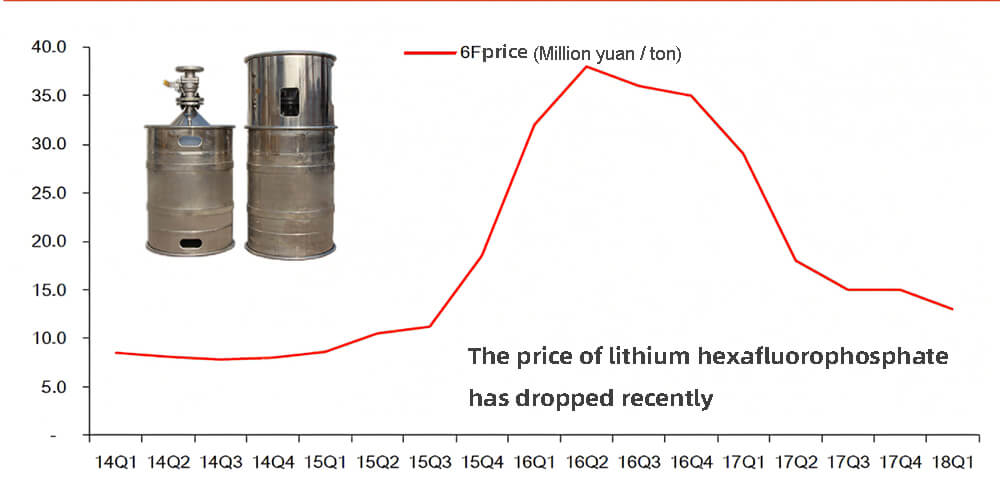
It is expected that with the release of new production capacity of electrolyte raw materials such as lithium hexafluorophosphate and VC this year, the relationship between supply and demand will ease, prices will decline, and the decline is expected to exceed 50%. Enterprises related to the electrolyte industry chain should be alert to changes in the market situation and take countermeasures in advance.
Looking at the development of each player in the electrolyte track, we can get a glimpse of the current industry status and development pattern in this field:
The amount of electrolyte and its raw materials rises rapidly
It can be clearly seen from the quarterly reports of listed companies that the growth rate of net profit is significantly higher than that of revenue. This means that the profitability of electrolytes and their upstream raw materials has increased significantly.
On the one hand, the strong demand in the downstream market and the increase in product prices provided support for its net profit growth. Data show that in the first quarter of 2022, the installed capacity of power batteries in my country is about 46.87GWh, a year-on-year increase of 140%.
According to the calculation that 1GWh power battery needs 1,300 tons of electrolyte, 46.87GWh drives the market demand of about 61,000 tons of electrolyte, and the demand for upstream raw materials such as lithium hexafluorophosphate and VC is also rising.
Both TONTA and Tonze said that, affected by the overall development trend of the new energy industry, the production and sales of lithium hexafluorophosphate and other products have been booming, and the price has risen sharply, which has boosted the company’s profitability. OXIRAN even stated that during the reporting period, the company’s lithium battery electrolyte solvent gross profit was about 65 million RMB, a year-on-year increase of about 475%.
On the other hand, the release of new production capacity provides a long-term guarantee for the growth of corporate net profit. The CAPCHEM Hunan bisfluorosulfonimide lithium salt project is expected to be put into operation in the first half of this year, and the new Polish project is expected to be put into operation in the second half of the year. The US project is also under active planning. It is expected that the electrolyte production capacity will reach 240,000 tons by the end of 2022.
At the end of June this year, TIANCI’s solvent production line with an annual output of 70,000 tons is expected to be completed.

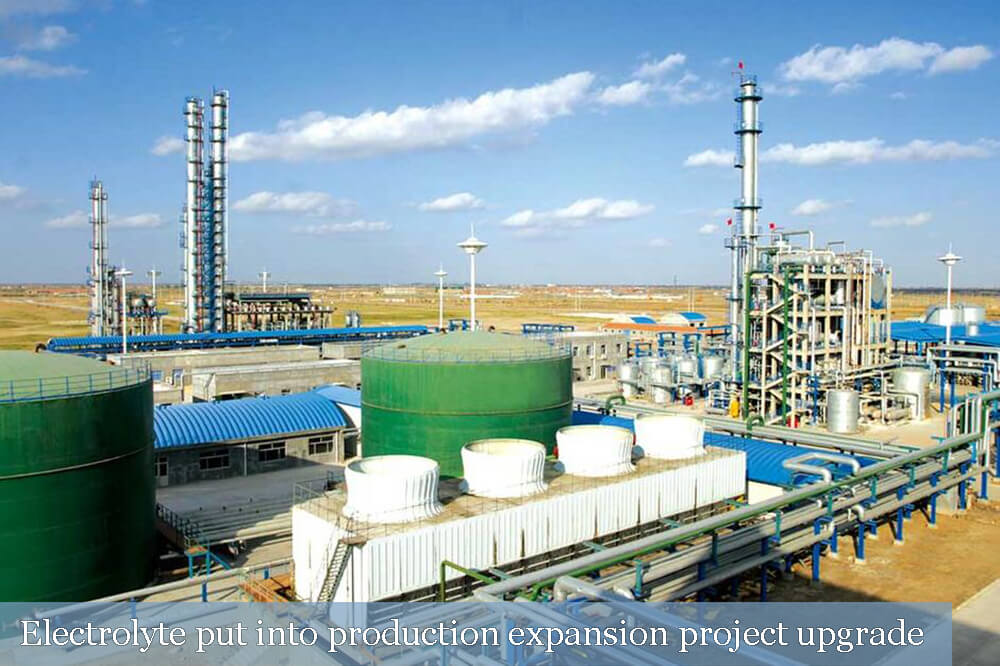
Electrolyte put into production expansion project upgrade
The direction of the TWh era has been determined, and the leading power battery companies have launched a charge towards the production capacity of 100 GWh, and the demand for electrolytes has accelerated to hundreds of tons or even millions of tons.
Under this scenario, relevant companies have invested heavily to expand production to strengthen their own large-scale production capacity output capabilities. According to statistics, since the first quarter of 2022, 11 electrolyte-related projects have been involved, with a scale of 922,300 tons and an investment of over 14.3 billion RMB.
Among them, the minimum annual production capacity of a single project is also 100,000 tons, and the maximum annual production capacity is 300,000 tons. The scale of electrolyte layout is increasingly large-scale.
For example, in February, the first phase of the Hangsheng Lithium Energy 100,000-ton lithium battery electrolyte project officially started. The first phase invested 380 million RMB to build an automated electrolyte production line. It is expected to be completed and put into trial production in October this year.
In January, Ruitai New Materials, a subsidiary of Jiangsu Guotai Holdings, planned to set up a wholly-owned subsidiary to invest in a lithium-ion battery electrolyte project with an annual output of 300,000 tons, with a total investment of 1.51 billion RMB and a construction period of 24 months.
It is worth noting that large-scale production expansion projects have been launched one after another, and there may be a structural overcapacity situation in the future.
The vertical integration layout of leading enterprises has been deepened
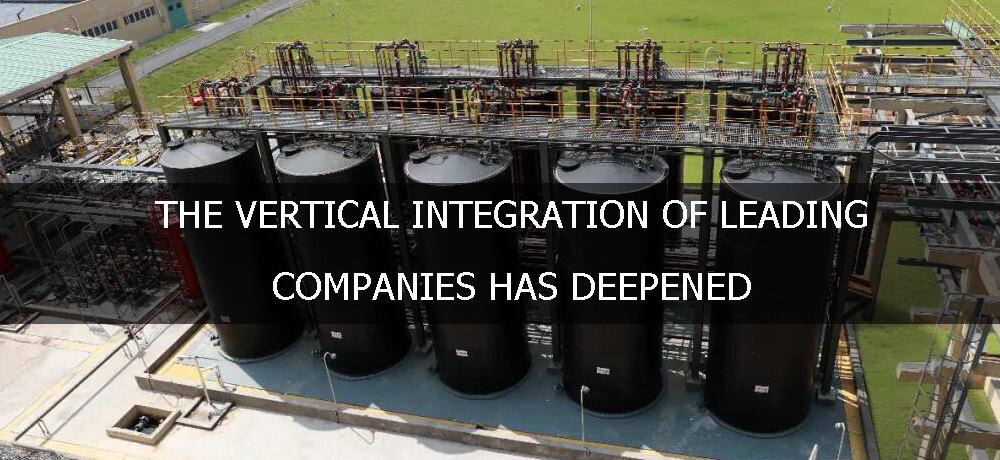
With the advent of the new cycle of power batteries, the strong downstream market demand will only increase, the price of upstream raw materials for electrolytes will rise, the supply will be tight, and the cost of electrolytes will continue to rise. Faced with this situation, building a closed loop of raw materials such as solvents, additives, and electrolytes, and a deep integrated layout can build its own competitive advantage.
For example, CAPCHEM has core products and technical advantages in new lithium salts, solvents and additives, and has made a relatively comprehensive upstream integrated layout, including self-built capacity for new lithium salts, carbonate solvents and additives;
TIANCI focuses on expanding the production capacity of lithium battery materials, increasing the self-supply ratio of liquid lithium hexafluorophosphate, additives and new lithium salts, and consolidating the strategic layout of the integrated industrial chain.
It is not difficult to see that the in-depth integrated layout has become a consensus among enterprises. Through this “moat”, ensuring the long-term stability of its own supply chain and raising costs will become a powerful weapon for companies to stand out in the increasingly fierce competition.
The right to speak in the market is gradually returning to the buyer’s market
Since last year, power battery companies have in-depth cooperation with electrolyte industry chain enterprises by locking long orders, investing in shares, increasing capital, etc., to strengthen the control of electrolyte supply, lock in high-quality production capacity supply, and reduce procurement costs.
At present, many battery companies including CATL, EVE, Guoxuan, BYD, etc. are constantly strengthening the construction of their own electrolyte supply chains. For example, CATL signed a long-term order with YONTA, and invested 500 million RMB in Yongtai High-tech, a subsidiary of YONTA, to deeply lock in lithium hexafluorophosphate; BYD signed a long-term order with Huasheng Lithium Energy, etc.
It is predicted that in 2022, the concentration of leading enterprises in China’s electrolyte market will continue to increase, and the binding between leading electrolyte enterprises and downstream leading customers will continue to deepen; the electrolyte market will gradually shift from a seller’s market to a buyer’s market. Product performance, cost, etc. The elements of industry competition have increasingly become the focus.
In the future, it remains to be seen how the market performance of enterprises related to the electrolyte industry chain will continue to maintain a strong growth trend.