Skip to content

However, Si will undergo a huge volume change (about 300%) during the lithium storage process, which will lead to problems such as electrode pulverization, current collector detachment, and unstable SEI, which severely limit its commercialization process.
Silicon suboxide (SiOx) is a derivative material of Si, because the inert matrix such as Li2O and Li2SiO4 produced during the first lithium intercalation process reduces the expansion rate, it has obvious advantages in ensuring high energy density and simultaneous cycle performance, making it considered to have better industrial application prospects.
Structure of silicon suboxide
Silicon suboxide is not a single phase, A. Hohl et al. based on random bonding (RB) and random mixing (RM) model high-resolution transmission electron microscopy (HR-TEM), X-ray photoelectron spectroscopy (XPS) and other test results, a structural model of silicon suboxide material – interfacial cluster mixing (ICM) model is proposed.
In the ICM model, silicon suboxide is described as composed of many uniformly distributed nano-scale Si clusters, SiO2 clusters and sub-oxidized interface regions between them. On this basis, Schulmeister et al. observed through experiments that there is a silicon suboxide interface boundary layer between the amorphous Si and SiO2 phases, the number of atoms in the interface layer accounts for about 20%–25% of the total number of atoms in SiO, and the ratio of Si and O is close to 1:1.
In 2016, Chen et al. reported for the first time the relevant experimental evidence of the atomic scale imbalance of amorphous SiO. Using Angstrom beam electron diffraction (ABED), the coordinates corresponding to the silicon suboxide tetrahedron were detected at the Si/SiO2 interface layer; Based on the results of ABED and synchrotron radiation X-ray scattering, combined with computer simulations, the team proposed a structural model of disproportionated SiO.
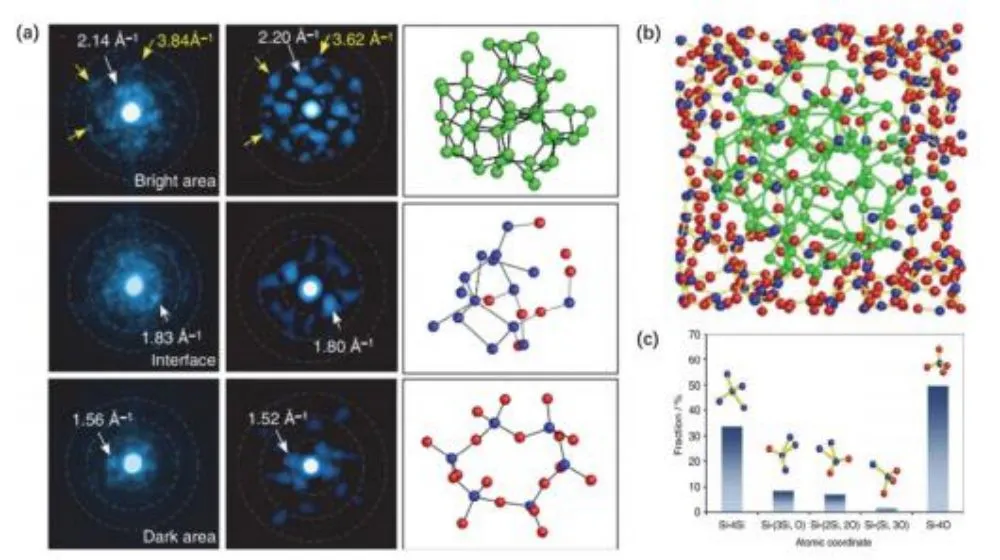 Structure model of disproportionated SiO
(a) In situ structures and atomic structure models of amorphous Si, silicon suboxide, and SiO2;
(b) Structural model of amorphous SiO;
(c) The proportions of the five components present in amorphous SiO
By increasing the x value in the silicon suboxide, the irreversible Li2O phase can be generated during charging and discharging, and the kinetics can be accelerated, and the stress generated by the volume expansion can be effectively released, thereby achieving smaller volume expansion.
Therefore, by increasing the oxygen content in the silicon-oxygen anode material, the problem caused by the high expansion rate of the silicon-based battery can be alleviated, and the cycle stability can be greatly improved.
However, as the oxygen content in silicon-oxygen anode materials increases, the electrochemically active lithium storage phase (α-Si) decreases, resulting in the increase of irreversible phases Li2O and Li4SiO4, so the specific capacity decreases and the first coulombic efficiency (ICE) decreases.
Silicon suboxide lithium storage mechanism
Compared with the lithium intercalation mechanism of simple silicon, the presence of oxygen makes the reaction mechanism between silicon suboxide and Li more complicated. At present, people’s general understanding of the lithium intercalation mechanism of silicon suboxide is:
Silicon suboxide reacts with lithium first to form elemental silicon, Li2O and lithium silicates (Li4SiO4, Li2SiO3, and Li2SiO5, etc.), and elemental silicon further reacts with Li to form LixSi alloy, resulting in reversible capacity. The generated Li2O and lithium silicate no longer participate in the reaction during the subsequent electrochemical cycle, resulting in a low ICE of the material, but it can buffer the volume expansion and protect the active material.
In addition, in the irreversible matrix, the proportion of lithium silicate is significantly higher than that of Li2O, despite the small proportion of Li2O in the lithiated component, the diffusion rate of Li+ in Li2O is at least two orders of magnitude higher than that in lithium silicate. Therefore, it can serve as a Li+ transport channel, thereby improving the capacity and rate performance of the silicon suboxide anode.
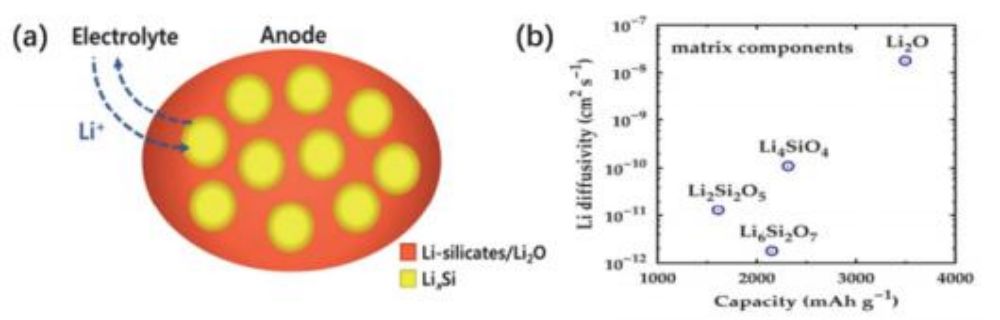
(a)Schematic diagram of SiO anode lithiation and delithiation process; (b) Li+ diffusivity coefficient and capacity relationship diagram of different components produced during SiO anode lithiation process
Defects and optimization measures of silicon suboxide
At present, silicon suboxide anode materials mainly have the following problems:
● The volume expansion is still large (~200%);
● The first coulombic efficiency and specific capacity are low;
● Low conductivity. In order to promote the practical commercial application of silicon suboxide anode materials, it is necessary to further explore its structure and lithiation mechanism, and further modify and adjust the structure and interface of the material on this basis.
Structural optimization
The electrochemical performance of silicon suboxide anode materials can be improved by reducing the particle size of the particles, disproportionation reaction of the heat treatment silicon suboxide material, and constructing a porous structure.
 Schematic diagram of the preparation process of porous SiO by Ag-catalyzed etching
Material composite
(1) Carbon compounding: the advantages of coating the carbon layer on the surface of material particles or compounding with carbon materials are:
● Carbon material itself has good electrical conductivity, and compounding with silicon suboxide can improve electrical conductivity;
● The volume change of carbon material intercalation and desorption of lithium is small, and the composite with silicon suboxide can reduce the overall expansion of the electrode;
● Carbon materials can protect active materials, avoid direct contact with electrolyte, and improve cycle stability.
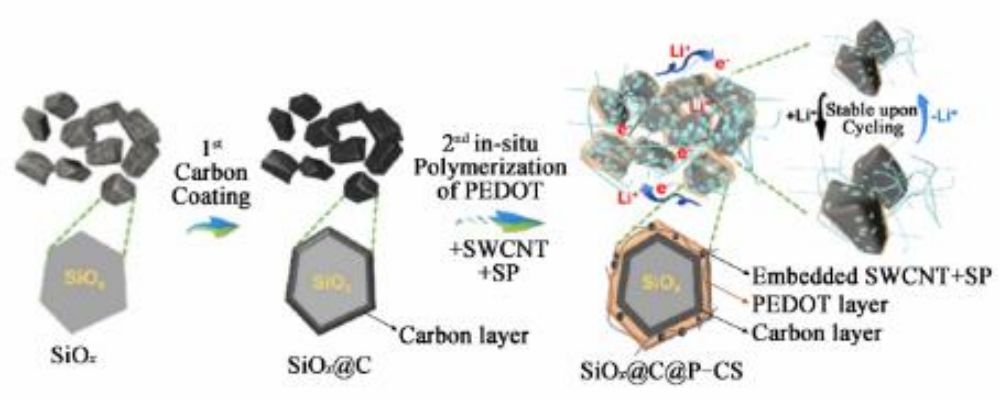 Schematic diagram of the preparation process of silicon suboxide@C@P-CS composite
(2) Elemental silicon compound: silicon suboxide has a lower specific capacity than elemental silicon due to the presence of oxygen, so silicon suboxide is compounded with elemental silicon. It can not only increase the capacity, but also use the irreversible components generated by silicon suboxide during the first lithium intercalation process to protect the elemental silicon and buffer the volume expansion of the elemental silicon.
(3)Metal and oxide composite: Wang et al. successfully prepared Si@silicon suboxide/Ni/G composite anode by two-step ball milling method using SiO, metal nickel powder, graphite, etc. as raw materials. Metal nickel particles and graphite not only significantly improve the conductivity of the silicon anode, but also have a good supporting effect on the electrode structure.
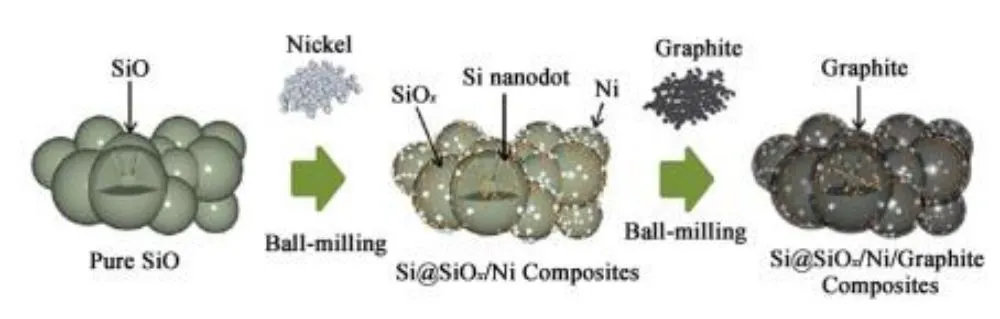 Schematic diagram of the synthesis route of Si@silicon suboxide/Ni/G composites
In addition to simple metals, metal oxides are also commonly used to increase the capacity of silicon suboxide, or as a coating layer of silicon suboxide to improve the structural stability of the material. Commonly used metal oxides are iron oxide, aluminum oxide, titanium oxide, etc.
Prelithiation
In addition to the formation of the SEI film, the silicon suboxide anode material also forms a large number of irreversible phases during the first charge and discharge process, which further aggravates the loss of active lithium.
Pre-lithiation technology can greatly improve the first coulombic efficiency of silicon suboxide, thereby increasing the energy density of the entire battery. The commonly used pre-lithiation technologies mainly include electrochemical pre-lithiation, chemical pre-lithiation, direct contact with lithium metal, and direct addition of pre-lithiation reagents.

Conclusion and outlook
The current silicon-based anode materials with a high degree of commercialization mainly include silicon-carbon composite materials and silicon-oxygen composite materials. Silica material has a smaller volume effect and more stable cycle performance, and is more widely used. It can be used in various batteries such as steel shells, pouch batteries, and prismatic aluminum shells.
At present, through structural optimization and interface modification of silicon suboxide anodes, the volume effect of electrode materials has been suppressed to a certain extent, and its long-term cycle stability has been significantly improved. However, the problem of low Coulombic efficiency for the first time in the silicon suboxide anode battery is still a key bottleneck that plagues its industrial application.
Therefore, silicon suboxide anode materials still need further efforts and exploration. It is believed that in the near future, silicon suboxide anode materials will surely make a breakthrough, and will occupy an important position in the anode material market for next-generation high-energy-density lithium-ion batteries.
If you are interested in battery anode material industry information, you can refer to top 10 anode material manufacturers.