Skip to content



When the nickel content in the material is greater than or equal to 0.6, it is defined as a high nickel ternary cathode material. In recent years, high nickel ternary cathode materials have been extensively studied due to their high energy density and high operating voltage.
Comparison of single crystal and polycrystalline ternary materials
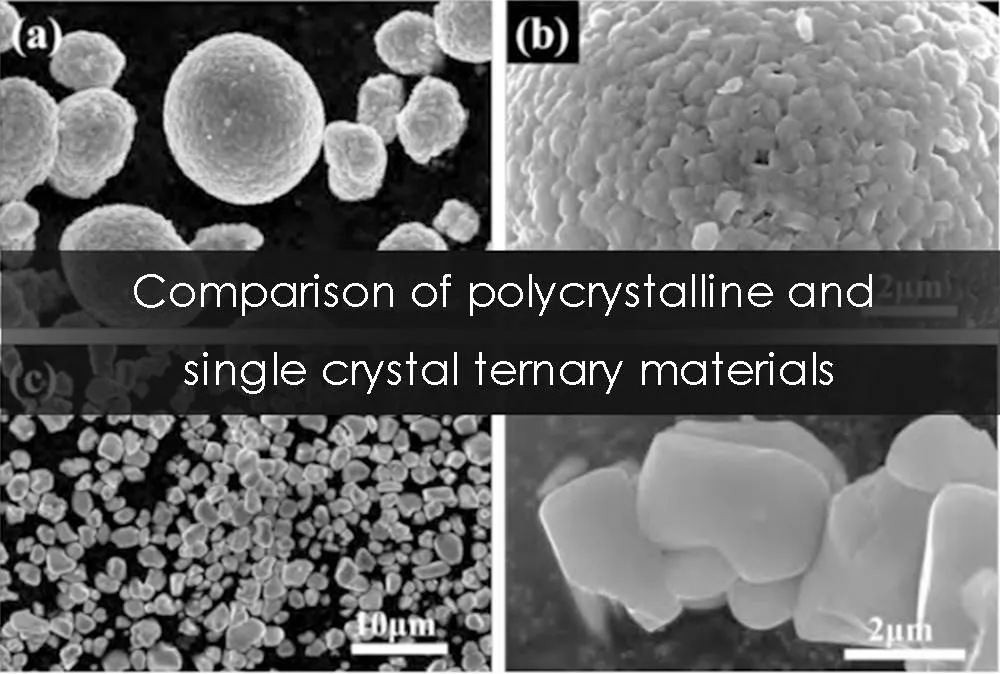
According to the difference in the microscopic morphology of materials, ternary materials can be divided into polycrystalline materials and single crystal materials.
The preparation process of polycrystalline materials is relatively mature and stable, and the current market share is higher. The secondary particles usually formed by the agglomeration of primary particles with smaller particle size are mostly spherical in shape, the particle size is usually about 10 μm, and there are a large number of grain boundaries inside the particles. The microcracks formed during charging and discharging of polycrystalline high nickel ternary cathode materials are one of the important factors restricting their large-scale application.
The development of single crystal ternary materials can better solve the above problems. The single crystal ternary cathode material consists of primary particles with a diameter of 2-5 μm. Compared with polycrystalline materials, there are no grain boundaries inside single crystal materials, and the mechanical strength of particles is higher, which greatly reduces the microcracks caused by anisotropic volume changes, and the material cycle performance is improved.
In addition, compared with polycrystalline materials, single crystal materials have significant advantages in terms of gas production, compaction density, thermal stability, and high-temperature cycle performance. At present, the preparation of single crystal ternary materials with low nickel content has accumulated a certain process foundation, while the preparation of single crystals with high nickel content of ternary materials still faces challenges.
The synthesis of high nickel ternary cathode materials requires lower synthesis temperature to maintain structural stability, while the synthesis of single crystal materials requires high temperature and long-term annealing process. The contradiction between the two makes the industrialization of single-crystal high nickel ternary cathode materials face difficulties.
Preparation processes of single crystal high nickel ternary cathode material
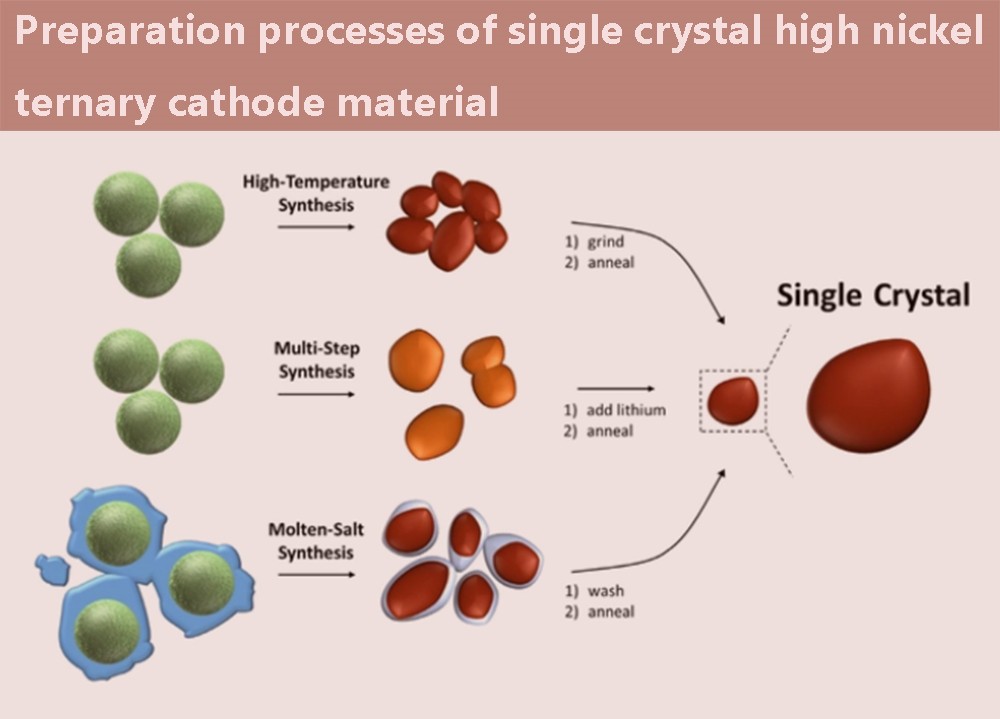
Common preparation processes for single crystal high-nickel ternary cathode materials mainly include single-step high-temperature synthesis process, multi-step high-temperature synthesis process and molten salt-assisted synthesis process.
Single-step high-temperature synthesis process
Raising the sintering temperature is an effective way to prepare large-grained single-crystal materials. A higher temperature can effectively increase the rate of ion migration, thereby promoting the growth of particles. It should be noted that while increasing the sintering temperature, the amount of lithium should also be increased to offset the lithium volatilization during high-temperature sintering.
Large single crystal particles are hardly seen at low temperature, but large single crystal particles can only be obtained at high temperature when the lithium content is high. However, excessive lithium will increase the residual lithium content of the material, resulting in increased gas production in the battery.
Generally speaking, the sintering temperature of high nickel ternary cathode materials will be significantly lower than that of low-nickel materials. For example, the optimized sintering temperatures for NCM811 and NCM523 materials are 750°C and 900°C, respectively. The temperature of sintering single crystal is 80°C and 70°C higher than that of sintering polycrystalline material, respectively, and the sintering temperature of single crystal high nickel ternary cathode material is lower than that of low-nickel material.
Single crystal high nickel ternary cathode materials require high temperature during the sintering process, which will not only make the primary particles grow, but also cause the secondary particles to stick together, so grinding and pulverization is required after sintering.

Multi-step high-temperature synthesis process
Although the annealing treatment can solve some problems in the synthesis of single crystal materials, studies have shown that excessively high temperature and excessive lithium content during the synthesis of NCA materials will cause the generation of Li5AlO4 heterophase. Therefore, the single-step high-temperature synthesis method is difficult to apply in the production and application of single crystal high nickel ternary cathode materials.
Therefore, people have developed a multi-step synthesis method. In this method, the precursor is first mixed with a lower amount of lithium, and sintered at low temperature for multiple times. Finally, the remaining lithium is added and sintered at high temperature.
Molten salt-assisted synthesis process
In addition to the above-mentioned high-temperature synthesis method, another main method for synthesizing single crystal high nickel ternary cathode materials is the molten salt method. This method needs to add lithium salt several times the amount of the precursor during the synthesis process.
The molten lithium salt can effectively promote the diffusion of atoms, thereby promoting the growth of particles. Therefore, large-sized particles can be synthesized at a lower temperature, thereby effectively reducing cation mixing and particle agglomeration, but this method requires cleaning of the lithium salt after synthesis.
Another huge advantage of the molten salt sintering method is that the morphology of the material particles can be adjusted through the selection of the molten salt. At the same time, the redundant amount of lithium salt will also have a significant impact on the growth process of single crystal materials. More and more molten salts will reduce the mixing of cations, thereby improving the cycle stability of the material.
Modification method of single crystal high nickel ternary cathode material

Although compared with polycrystalline high nickel ternary cathode materials, single-crystal high nickel ternary cathode materials have significant advantages in terms of interface stability, gas production, thermal stability, and mechanical properties. However, the problems caused by the high nickel system cannot be completely eradicated by single crystallization, and there is still a lot of room for improvement in the performance of single crystal NCM.
Therefore, it is necessary to modify single crystal NCM to further expand its application prospects. For the modification of single crystal ternary materials, you can also refer to the modification methods of other high nickel ternary materials. The main method is still doping and coating.
Conclusion
The single crystal high nickel ternary cathode material can simultaneously have high specific capacity and high structural stability, and is a kind of cathode material for power batteries with great research value and development prospects. At present, the large-scale production of single crystal high nickel ternary cathode materials has not yet been realized, and how to obtain high-performance single-crystal NCM is still an urgent problem to be solved.
At this stage, it mainly focuses on modifying it by coating and doping to improve its shortcomings such as fast capacity decay and poor rate performance, and some progress has been made. It is believed that with the continuous deepening of preparation technology and electrochemical mechanism exploration, single crystal high nickel ternary cathode materials have broad application prospects in the field of power battery companies in the world in the future.