Skip to content


We define the longest side of a cuboid as the length, the second longest side on the same horizontal plane as the width, and the shortest side as the height, as shown in the following figure in the coordinate system: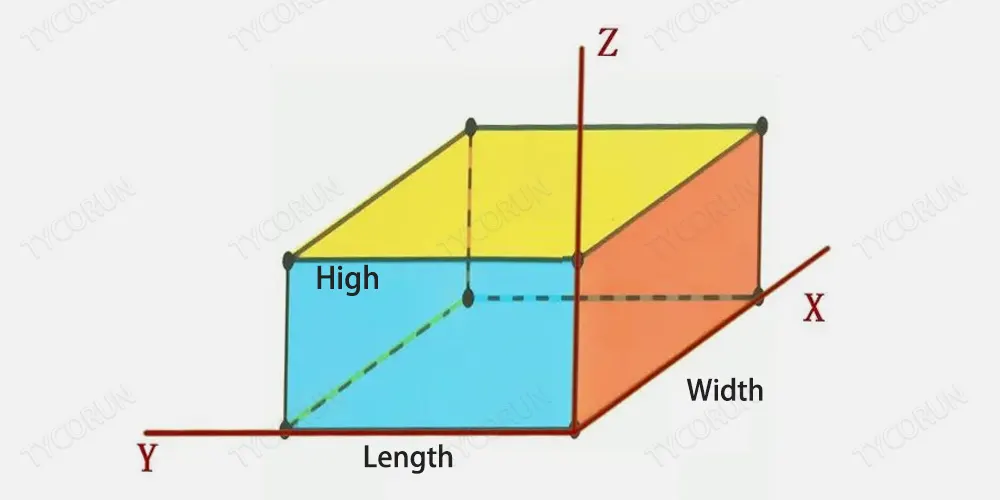
Changes of battery packs in different axial lengths
Through the above definition, we can compare the volume change of a standard rectangular parallelepiped battery pack when its axial length changes:

Therefore, the arrangement structure of the battery cells has become a research topic. For example, some of the top 10 power battery companies in the world adopt a ‘flat’ battery arrangement, which is a typical case to improve the utilization rate of the Z-axis.
New technology support improves space utilization
In order to further improve the volume utilization rate, the technical route of removing the battery case and directly integrating the winding core into the module (‘big battery’) has also been studied.
One of the top 10 lithium ion battery manufacturers in China, Gotion High-Tech’s JTM technology starts from this direction and improves the volume utilization rate again.
In addition to maximizing the use of space from a structural point of view, some companies are currently using new technology to improve the utilization of space. When packing the power battery, in addition to the battery cell and the case.
Electrical parts such as wiring harnesses also play an important role and require a lot of space. If the wiring harness can be reduced, it is also an effective means to improve space utilization. The current wireless BMS technology can reduce the use of wiring harnesses in battery packs.
Battery cell volume utilization
For the calculation of the volume utilization rate of the power battery, we divide it into two parts: the volume utilization rate of the battery cell and the volume utilization rate of the battery pack.
Improving the volume utilization rate of the battery cell is also a form of increasing the volume utilization rate of the battery pack.
Cell volume utilization: For cylindrical cells, when calculating their volume utilization, we use the following method for boundary values.
Cylindrical cells: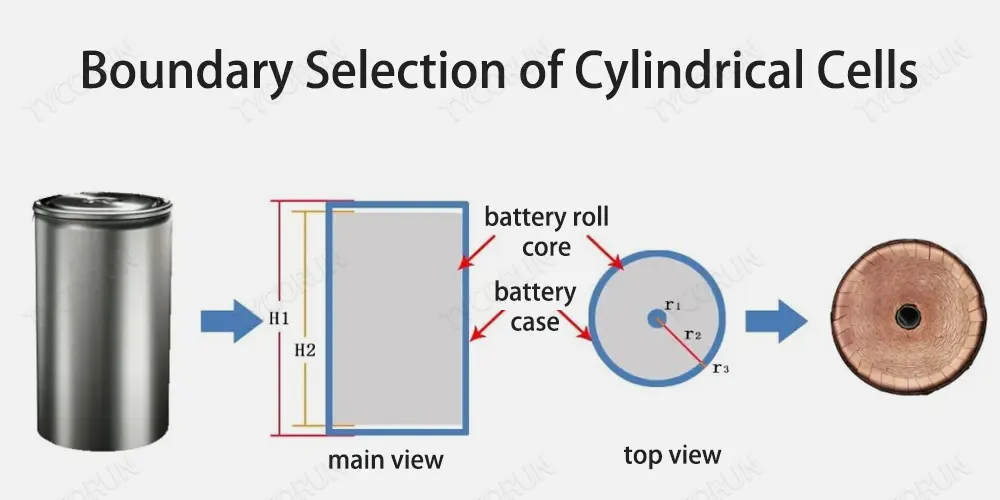 The Z-axis, R-direction, and volume utilization can be calculated respectively through the values in the above figure. The calculation formulas are organized in the following table:
 According to the formula in the above table, we can obtain the utilization ratios of different axes respectively:
Battery pack volume utilization
After the cell volume utilization is calculated, the battery pack volume utilization follows. When calculating the volume utilization of the battery pack, the calculated boundary of the pack used also has a great influence on the result.
Here we need to specify the operation rules first. The calculation method for the battery space utilization rate applying CTC technology is that the space required for electrical parts, lifting points, etc. has been integrated into the chassis.
Therefore, these data are not used in the calculation, only the actual occupied space of the battery cell in the chassis is used.
The space utilization rate of the battery pack in the above method = (cell volume * number of cells) / space occupied by the cells on the chassis.
According to different design methods, the number of batteries is also different. To maximize utilization in a fixed space, the number of cells needs to be maximized.
But at the same time, the space required for heat dissipation, wiring harness, and heat insulation will also increase, and it is necessary to balance each other to obtain the optimal value.
The battery pack using CTP technology is part of the battery pack because the electrical components and lifting points are on the battery pack shell. Therefore, when calculating the overall space utilization rate, it is recommended to add this part of the volume to the calculation.
Summary
In summary, accurate calculation of traction battery volume utilization is critical for designing and optimizing battery systems for maximum efficiency and performance. By understanding the concepts and calculations involved in power battery volume utilization, we can continuously optimize battery solutions to meet users’ needs for high performance and high efficiency.