Skip to content

Problems such as energy loss, heat dissipation, aging, electromagnetic interference, and impact on the battery itself caused by the increase in current will all be exposed.
At the same time, high-current fast charging can only achieve maximum power charging under the condition of 10-30% SOC, and cannot meet the 4C charging requirements.
When the charging power reaches 200kW, the charging current of the vehicle on the 400V voltage platform can reach 500A, and most of the current vehicles cannot bear such a large charging current.
In contrast, using the method of increasing the voltage to replenish energy for the vehicle can not only improve the charging safety and conversion efficiency, but also maintain a higher charging power in a larger SOC range, and the charging speed is faster.
If a vehicle with an 800V high-voltage platform is used, its charging current is only 250A. Moreover, the high-voltage low-current charging method can also prolong the cycle life of the battery.
Therefore, increasing the charging power while reducing the current by increasing the voltage has become the research direction of more manufacturers. This leads to new technologies such as high-voltage charging piles and 800V high-voltage platforms for vehicles.
Fast charging of electric vehicles on the market
Inventory and sort out some models that support fast charging on the market, the results are shown in the table below:
The AION V in the above table is taken as an example. If the peak power is 480kW for 10 minutes, the vehicle can be charged with 80kwh.
If the power consumption per 100 kilometers of this model is 16kwh, then it can reach a battery life of 500km.
In contrast, for electric vehicles that only support ordinary DC charging, the general DC charging power is within 60kW. Then charge for 10 minutes, and the achievable cruising range is generally about 60~70km.
High-voltage system architecture of the vehicle
When the charging power is increased, the whole vehicle can adapt by increasing the charging voltage or charging current.
However, the increase of the charging current will increase the requirements of the vehicle in terms of heat dissipation and efficiency and the difficulty of technical processing. Therefore, high-voltage fast charging has become the choice of most car companies.
In this context, the high-voltage system architecture of the vehicle has also developed multiple development routes.
It can be divided into three categories according to high-voltage voltage: full-stack high-voltage architecture, multi-voltage architecture and full-stack low-voltage architecture.
Full-stack high-voltage architecture: There are only two high-voltage/low-voltage platforms of 800V/12V in the whole vehicle. All high-voltage components including AC and DCDC use 800V voltage, and all low-voltage components use 12V voltage. The topology diagram is as follows: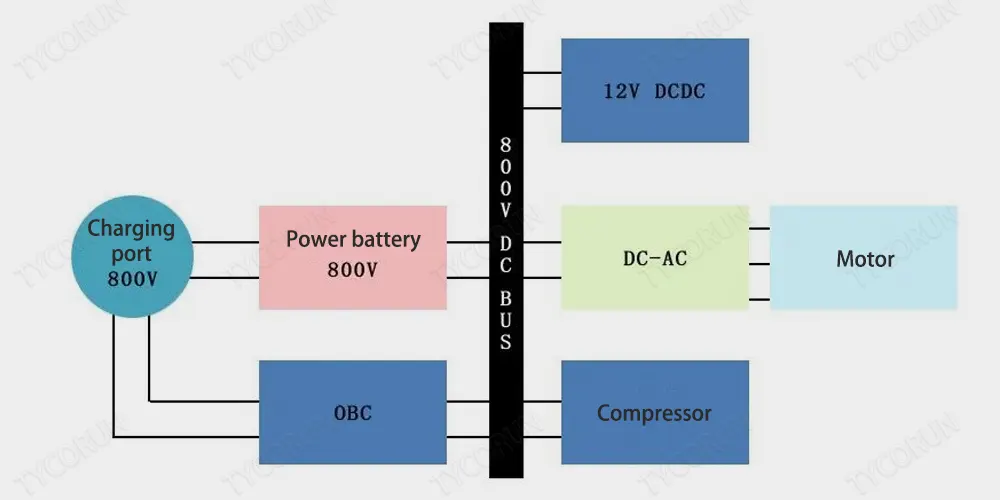
Multi-voltage architecture: local 800V high voltage, that is, the whole vehicle is equipped with an 800V power battery. The 800V voltage is reduced to 400V through DCDC for use by other high-voltage components on the vehicle. The topology diagram is as follows: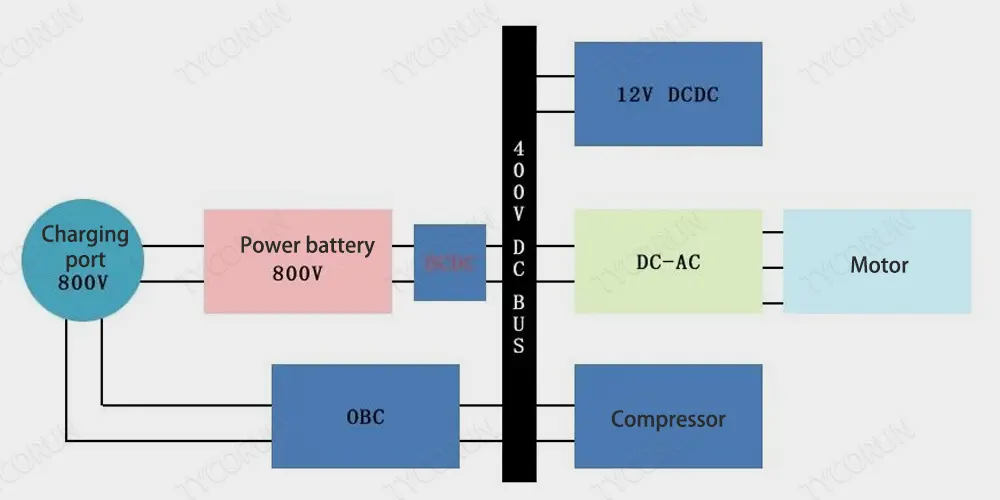
Full-stack low-voltage architecture: The ‘low voltage’ here refers to 400V relative to 800V, not the low voltage of 12V. The architecture has two modes of dual-battery and single-battery. Among them, the dual-battery mode uses two 400V power batteries, which are used in combination with a high-voltage power distribution box. The topology diagram is as follows:
The single-battery mode: it follows the current 400V platform, but installs a DC/DC between the charging port and the battery to step down the voltage. The topology diagram is as follows:
Therefore, fast charging/supercharging can only be realized under the premise of external charging device and the support of the vehicle’s high-voltage architecture. Otherwise, using too much power to charge the car will damage the vehicle power battery itself, which is what the top 10 power battery companies in the world hope to avoid.
Changes in vehicle parts
With the development of DC fast charging technology, coupled with restrictions on the installation of AC charging piles in some communities, at the same time, car companies have unified standards in order to reduce costs.
At present, there is a faint voice – DC charging piles may gradually replace AC slow charging piles. What followed was the transformation of car companies’ parts for complete vehicles, that is, the removal of OBC (on-board charger) (about 2000-3000 yuan for a single part).
For example, NIO ET7 has canceled the on-board OBC. Without the OBC, there will naturally be no AC charging port on the car, and only one DC charging port will remain.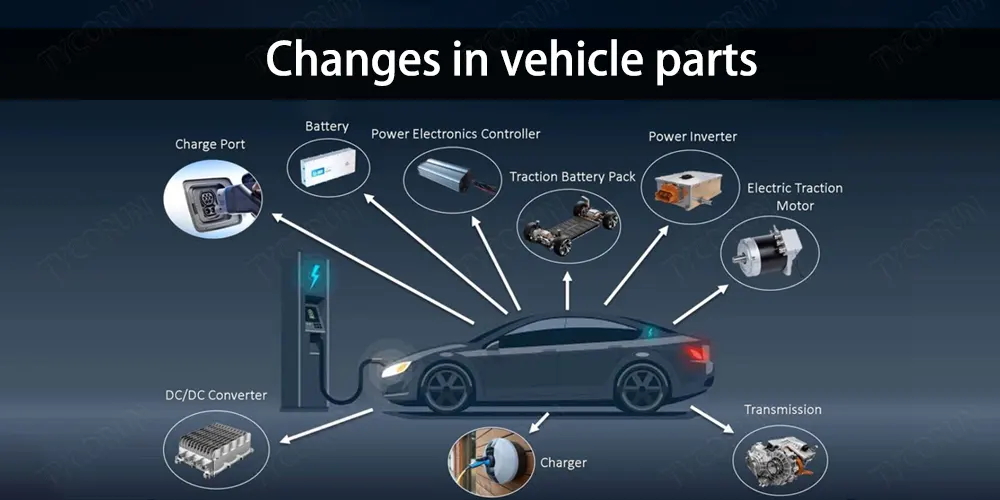
The cancellation of OBC plays an important role in the lightweight and cost saving of the whole vehicle. At the same time, this move can also shorten the cycle of vehicle development and testing, which is beneficial to the development of electric vehicles.
But whether it is in line with the current industry background and user habits is open to question. After all, the AC/DC ratio of public charging piles will remain at around 6:4 for a long time. But in the future, the proportion of DC piles should gradually increase.
Summary
To sum up, with the increasing popularity of electric vehicles, fast charging has become the focus of attention of charging pile manufacturers and car companies.
The article discusses the current status of fast charging, fast charging of electric vehicles in the market, high-voltage system architectures of vehicles, and changes in vehicle components.
The development of electric vehicles in the future requires not only more efficient battery solutions, but also the improvement of charging facilities.