Skip to content

The growth rate of the industry is faster than that of downstream power tools
The compound growth rate of power tools in 16-20 years is 6%, and the cordless rate will be close to 50% in 2020.
In 2020, the global power tool market size is about 29.1 billion US dollars, a year-on-year increase of 5%. From the perspective of compound growth rate, the global scale of power tools has increased from 22.8 billion US dollars in 2016 to US$29.1 billion in 2020, with an average annual compound growth rate of about 6%.
The cordless rate is rapidly increasing, and the growth rate of lithium batteries is faster than that of the industry. The cordless rate of power tools has increased from 42% in 2016 to 47% in 2020. In 2020, the global power tool cordless, corded, parts & accessories accounted for 35%, 40%, and 25% respectively.
Since most cordless power tools use lithium ion power tool batteries, as the penetration rate of cordless power increases, lithium batteries are expected to grow faster than the industry.
Lithium-ionization of outdoor power equipment is a new increase, the market size is about 60% of tools, and the cordless rate is less than 20%.
Market scale
In terms of scale, the market size of outdoor power equipment will be 25 billion US dollars in 2020, which is about 60% of the size of power tools.
In 2020, the market size of outdoor power equipment (mostly garden tools) is 25 billion US dollars, with an average annual compound growth rate of 6% from 2016 to 2020, accounting for about 60% of the global power tool scale.
Power source
In terms of power source, the main source of power for outdoor power equipment is still gasoline engine, and the cordless rate is less than 20%.
The power sources of outdoor power tools can be divided into gasoline engines, corded, cordless, etc., accounting for 66%, 4%, and 14% respectively in 2020, and the current cordless rate is at a low level.
Garden tools use 10-20 lithium batteries, higher than 3-10 power tools
Battery cell
From the perspective of battery cells, the batteries used in power tools and garden tools are not much different. For example, the products listed on Samsung’s official website, power tools and garden tools use basically the same battery model. However, from the perspective of product solutions, the number of lithium batteries used in garden tools is generally 10-20, with a charge of 46.8-144wh, while the number of lithium batteries used in power tools is 3-10, with a charge of 16.2-72wh.
Product side
From the product side, lawn mowers, riding & push lawn mowers and other products are expected to accelerate lithium-ion batteries. The lawn mowing robot has the advantages of simple operation, reduced labor and time costs, and low noise. With the improvement of product power, the penetration rate of lawn mowing robots is expected to increase rapidly. In 2020, the global lawn mowing robot market will sell 900,000 units, and the market size will exceed 1 billion US dollars.
Households in Europe and the United States mainly rely on traditional hand-push and riding traditional lawn mowers, with annual shipments reaching 11.5 million units, and the penetration rate of lawn mowing robots is only 8%. Compared with traditional lawn mowers, mowing robots have the advantages of simple operation and high mowing efficiency, which can reduce labor costs and time costs. Robot lawn mowers are economical for lawn maintenance as product prices drop.

Borderless planning mowing redefines the product. No.9 is the first to launch a borderless planning lawn mowing, which is 6 times more efficient than traditional lawn mowing robots.
Most of the current mowing robots use random mowing, resulting in cluttered mowing paths, easy repeated coverage or incomplete coverage, and low efficiency. The lawn mowing robot of No. 9 adopts EFLS fusion positioning system technology, which integrates various sensor information, so that the robot can achieve precise positioning in various lawn environments, and the mowing efficiency on the same lawn is increased by 6 times.
The power performance and driving experience of the lithium-ion riding lawn mower are improved. Cherfeng Holdings has built its own EGO brand, among which lithium-electric riding lawn mowers are equipped with brushless motor technology, providing power and performance comparable to gasoline engines, and each riding lawn mower can be equipped with up to six EGO 56V Arc LithiumTM batteries , the top speed can reach 8 miles per hour, and the cutting range can cover up to two acres (about 8,100 square meters) of grass on a single charge. Additionally, the adjustable hydraulic seat suspension provides the end user with a comfortable mowing experience.
Lawn mower products are diversified to improve mowing efficiency and user experience. Chervon’s line of walk-behind mowers feature intuitive left and right flexible self-propelled controls, variable speed discs, brushless motors and multi-blade cutting systems that deliver exceptional power, performance, versatility and long run time. High-quality products are expected to create demand, and with the advancement of lawn mower battery technology and continuous cost reduction, garden tools are expected to accelerate lithium-ionization.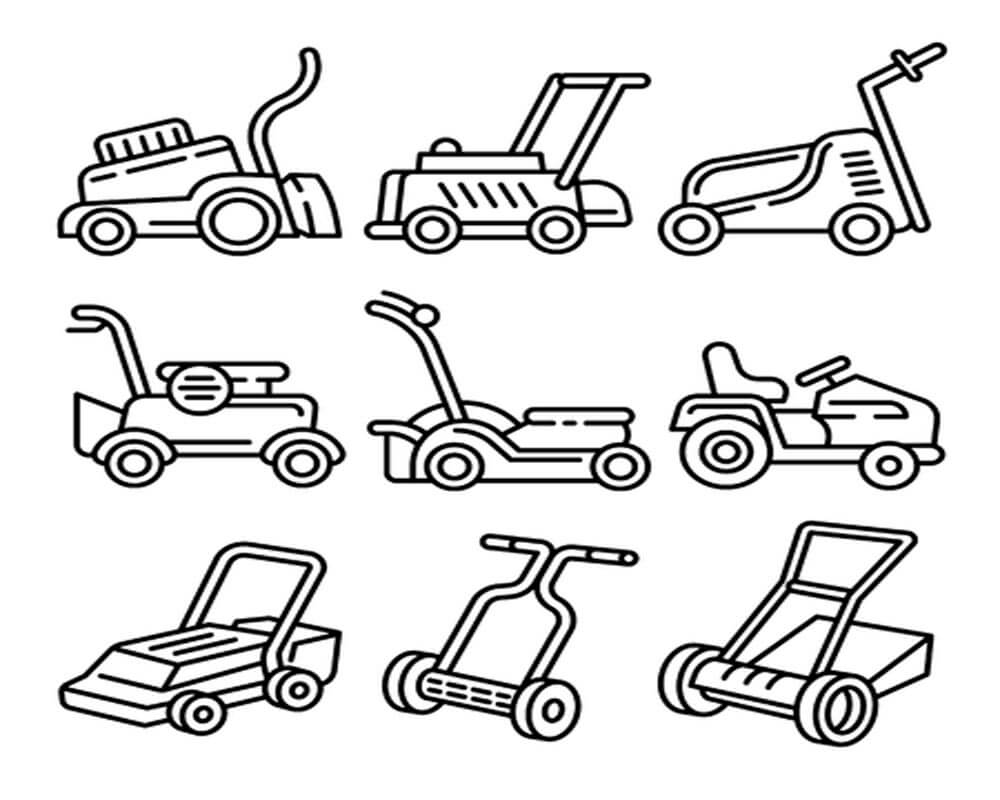
Product iteration is expected to widen the gap between products and profitability
Compared with power and energy storage batteries: tool batteries take into account both capacity and rate, with many categories and various application scenarios
Compared with power and energy storage batteries, tool batteries take into account both capacity and rate. Power batteries have higher requirements on energy density, and energy storage batteries have higher requirements on the number of cycles. Both power and energy storage batteries need large capacity to improve product performance and reduce costs. The tool battery needs instantaneous high-power charging and discharging, so it is necessary to balance the capacity and the rate.
There are many types of tool batteries, various application scenarios, and a higher degree of customization. Compared with power and energy storage batteries, small power batteries can be used in power tools, electric treadmills, vacuum cleaners, electric bicycles, electric motorcycles and other markets, and there are many downstream application scenarios. According to different application scenarios, the capacity and magnification of the cells are also different, and the degree of customization is higher.
Capacity increase: 2ah→2.5ah, 18650→21700, improve battery life
The battery cell has been increased from 2.0ah to 2.5ah, which can provide more durable working time for power tools. Taking Tianpeng power products as an example, the nominal capacity of the 18650 battery is 1.5-2ah, while the capacity of the Samsung SDI power tool 18650 battery is 1.3-2.5ah. The Samsung 18650 battery has a larger capacity range and a higher maximum capacity.
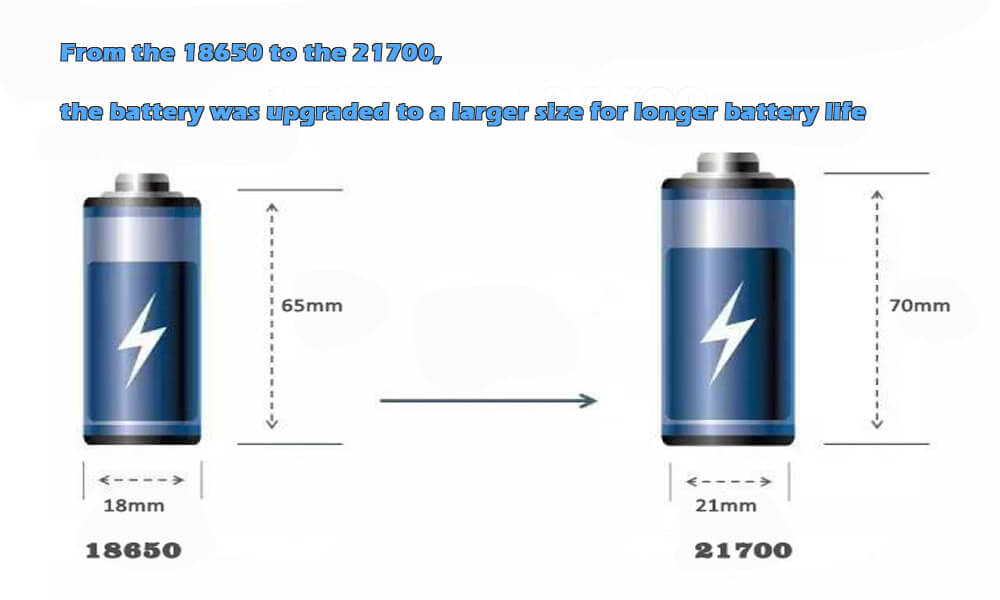
From the 18650 to the 21700, the battery was upgraded to a larger size for longer battery life. Taking Tianpeng Power’s official website products as an example, there are two 21700 batteries, 30TG and 40TG, with nominal capacities of 3ah and 4ah respectively, which are much higher than 1.5-2ah of 18650 batteries.
Rate increase: high-efficiency output, increase continuous discharge current
The rate is an indicator of the charge and discharge capacity. The higher the charge and discharge rate, the greater the battery power and the faster the charge and discharge speed. The advantages of high rate batteries are:
1) Excellent high current discharge performance and sufficient explosive power.
2) High efficiency output and better temperature stability. Taking Tianpeng power products as an example, the cells are divided into medium-rate, high-rate, and ultra-high-rate batteries. The continuous discharge current of medium-rate batteries reaches 10A, while the high-rate and ultra-high-rate batteries reach 20A and 45A respectively.
China power tool battery manufacturers focus on 2.0ah, and the capacity of 2.5ah and above needs to be broken through
From the perspective of product structure, the high-rate lithium battery products of Chinese power tool battery manufacturers are mainly concentrated in 1.5Ah and 2.0Ah. In 2020, 2.0Ah products account for about 74%, and 1.5ah products account for 21%. Some power tool battery manufacturers have begun to gradually mass-produce 2.5Ah products, but the proportion is still relatively low. Large-capacity batteries of 2.5Ah and above are currently dominated by Japan and South Korea.
Japanese and Korean power tool battery manufacturers mainly focus on 2.5Ah products. In 2020, 2.0ah products will account for 36%, and there are almost no products below 2.0ah, and 2.5ah capacity products will account for 62%. Chinese power tool battery manufacturers dominate products with a capacity of 2.0ah and below, but products with a capacity of 2.5ah and above need to break through.
The products are constantly iterating, the difficulty of high-performance batteries is increasing, and the share of Chinese power tool battery manufacturers is expected to increase
From the perspective of battery performance, Chinese power tool battery manufacturers are catching up quickly, and the performance of some products has been better than that of other countries’ power tool battery manufacturers. Comparing Samsung and Tianpeng power products with the same size and capacity, Tianpeng power products have higher continuous discharge current. Taking Samsung 20Q and Tianpeng power supply 20SG products as examples, they are all 18650, 2.0ah, 3.6V products. Samsung’s continuous discharge current is 15A, while Tianpeng power supply reaches 30A.

Chinese power tool battery manufacturers have made breakthroughs in high-rate battery performance and life, and gradually replaced by other countries’ power tool battery manufacturers. In 2019, Tianpeng Power made breakthroughs in the life of 30A high-rate batteries, and its 18650 series 1.5/2ah-30A products solved the problems of short travel discharge life and rapid temperature rise. This technological breakthrough knocked on the door of the world-class electric tool market and broke the monopoly pattern of Japan and South Korea.
The battery products are still iterating and the difficulty is increasing. The head power tool battery manufacturers are expected to widen the gap with other companies. The difficulty of high-performance battery products has increased. With the improvement of Chinese top power tool battery manufacturers in product technology, material system, process control, automated manufacturing, etc., The industry is expected to usher in a reshuffle, and head power tool battery manufacturers are expected to gain a higher share.
The price of upstream materials has risen, but the cost of tool batteries can increase
Lithium carbonate increased from 50,000/ton to 500,000/ton, and the cost of ternary battery increased by about 40%
Lithium carbonate has increased from 50,000/ton in early 2021 to more than 500,000/ton in March 2022, and the price has risen 10 times in more than one year.
At the beginning of 2021, lithium carbonate is only 50,000/ton. Due to the slow release of supply and strong demand from downstream industries such as electric vehicles, the price of lithium carbonate continues to increase, and will exceed 500,000/ton in March 2022.
The price of lithium carbonate has risen from 50,000/ton to 500,000/ton, and the cost of ternary batteries has increased by about 40%. When the price of lithium carbonate is 500,000/ton, we estimate that the cost of cell materials is about 773RMB/kWh, the cost of other materials is 30RMB/month, and the cost of other materials is 100RMB/month. The cost of the battery system is 873RMB/yuan, which is 40% higher than when the price of lithium carbonate was 50,000/ton at the beginning of 21.
Batteries only account for 10-20% of the tool cost. Against the background of the sharp increase in the price of lithium carbonate, the cost increase is small.
Batteries only account for 10%-20% of the cost of power tools. Taking Cherfeng Holdings as an example, the largest power tool battery manufacturer provides lithium-ion batteries, which accounted for 10.9%, 11.9%, and 16.1% of the total procurement from 2018 to 2020, respectively.

Taking Greebo as an example, from 2018 to 2020, lithium battery cells accounted for 24%, 24%, and 19% of the raw material purchase amount, respectively, and raw materials accounted for about 80% of the overall cost. Therefore, we expect lithium batteries to account for less than 10% of the overall cost. 20%.
Assuming a 40% increase in battery costs and a 4%-8% increase in overall tool costs. If the battery cost increases by 40%, the battery cost accounts for 10-20% of the tool cost, and the power tool cost increases only 4-8%. Due to the low proportion of batteries in the cost of power tools, we believe that the downstream is also less sensitive to battery costs.
Most downstream demand is in Europe and the United States, and the price sensitivity is low
The downstream market of power tools is mainly in Europe and the United States, and the price range is from tens to hundreds of dollars. In terms of global regions, in 2020, the downstream markets of power tools in North America, Europe, Asia Pacific, and other regions accounted for 40%, 36%, 17%, and 6%, respectively, and Europe and the United States accounted for 76%.
Taking Cherphon’s power tools products as an example, the main products include cutting tools, fastening tools, and surface treatment tools. The suggested retail price in the United States on June 30, 2021 ranges from $24 to $649. Power tools are consumer products with low purchase frequency. We believe that consumers are relatively easy to accept the transmission of raw material price increases and are less price sensitive.
Analysis of key power tool battery manufacturers
TENPOWER
TENPOWER focuses on consumer small power batteries, and its global market share has increased from 6.5% in 2017 to 8.8% in 2020.
Aoyang Shunchang acquired TENPOWER in May 2016 and entered the field of lithium battery manufacturing. In 2020, the listed company changed its name to Azure. TENPOWER was established in 2006 and mass-produced 2.0Ah high-rate cylindrical lithium batteries in 2013, leading the rate market.
From 2015 to 2017, TENPOWER expanded the electric vehicle market, but because the company believed that the application of cylindrical batteries in electric vehicles was limited, the gross profit margin of the electric vehicle market was low, and the revenue and accounts were not very good, so the company made strategic adjustments. , focusing on small power batteries.
TENPOWER’s global market share of power tool batteries increased from 6.5% in 2017 to 8.8% in 2020. Samsung’s SDI market share dropped from 46.1% in 2017 to 36.1% in 2020, Samsung+LGES+Murata’s share dropped from 75% in 2017 to 50% in 2020, and Tianpeng’s market share increased from 6.5% in 2017 to 2020 8.8%.
Azure
Excellent customer structure, signed long-term orders with first-line power tool battery manufacturers.
The customer structure is excellent, and it has entered the high-end products of tool companies such as TTI, Bosch, and Stanley Black & Decker. The company’s lithium-ion tools serve global high-end customers who have high quality requirements. Each tool giant in other countries has different product technical requirements. The company has entered the global TOP5 power tool supply chain (TTI, Bosch, Makita, etc.).
In addition, there are different levels of product demand among international power tool manufacturers. Different power tool manufacturers provide products with different performance, specifications and prices. TENPOWER has a certain leading advantage.
Signed long-term orders with Bosch, Stanley Black & Decker and other power tool manufacturers. The company signed a long order with Bosch to provide 18650 ternary cylindrical batteries in 2022, including 1.5Ah, 2.0Ah, and 2.5Ah products, with a total supply of 87 million cells.
The company also signed an order with Stanley Black & Decker for 2022-2024, and the supply of ternary cylindrical lithium batteries in 2022-2024 will be 120, 240, and 280 million, respectively. Among them, in 2022, with the agreement of both parties, it can be increased to a maximum of no more than 200 million.
Products cover multiple downstream, high-energy, high-rate products are under development
From the product point of view, the company’s products cover multiple downstream, and there are already some 21,700 large-capacity products. The downstream of the company includes power tools, industrial power tools, garden tools, etc. The company already has some 21700 battery products, such as 40TG with a nominal capacity of 4.0ah and a continuous discharge current of 45A.
High-energy, high-rate batteries are under development, and high-end products are reserved. The company is developing 21700-5.0Ah high-energy, high-rate cylindrical batteries. A number of R&D projects have been closed, including 21700-4.0Ah high-rate cylindrical battery with high nickel-silicon anode, 21700-3.0Ah low-temperature fast-charging ultra-high-rate battery, etc.
EVE
Comprehensive layout of consumption and power batteries, entering the field of power tools in 2018.
From electronic cigarettes to ETC, TWS, and power batteries, Yiwei Lithium Energy has a comprehensive layout in the battery field. The company was optimistic about the electronic cigarette track in 2010, developed button batteries in 2013, seized the opportunity of ETC, deployed power technology, and made forward-looking layouts in multiple sub-tracks in the battery field. The company has accumulated various types of battery technologies, quickly broke through important customers in subdivided tracks, and enjoyed industry growth dividends.
In 2018, it entered the field of power tools and conquered TTI, a major international customer within one year. In 2015, Yiwei Lineng invested in the production capacity of ternary cylinders and put it into production in the second half of 2016. It was originally planned to be positioned in the special-purpose vehicle market.
However, due to the special vehicle technology route from ternary to LFP, the company decisively turned to power tools in 2018, and conquered TTI, a major international customer within one year, and turned losses into profits in 2019, with revenue nearly doubled in 2019 and gross profit margin. Increased from 15% to 24%.
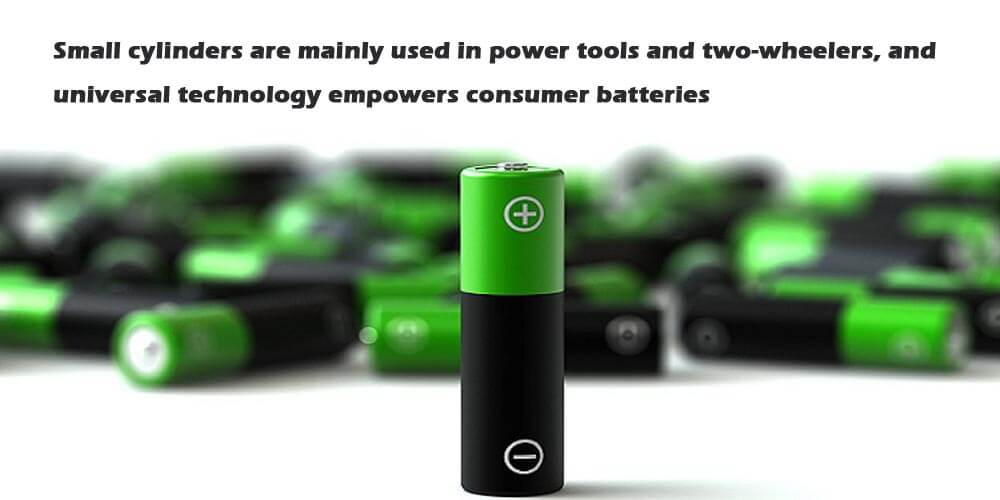
Small cylinders are mainly used in power tools and two-wheelers, and universal technology empowers consumer batteries
Entering the international power tool supply chain such as TTI and Bosch, the global market share will reach 7.9% in 2020, ranking third among power tool battery manufacturers. Compared with battery power tool manufacturers such as Tianpeng and Haisida.
EVE entered the tool battery field relatively late (2018), but its market share has increased rapidly. In 2020, the global market share will reach 7.9%, second only to Samsung SDI with a market share of 36.1% and TENPOWER with a market share of 8.8%.
From the product point of view, the company’s small cylindrical products are mainly used in power tools and two-wheelers. The company’s products support up to 8A charging, up to 50A continuous discharge, and 100A pulse discharge current.
The company is developing high-rate and high-capacity power tool batteries, 18650 batteries for electric scooters/bicycles, and general-purpose technologies such as pole piece slurry, high-performance SiO negative pre-lithiation technology, etc., which can also empower consumer batteries. Performance products lay the foundation. For two-wheeler battery companies, please refer to Top 10 two-wheelers battery manufacturers in China.