Skip to content


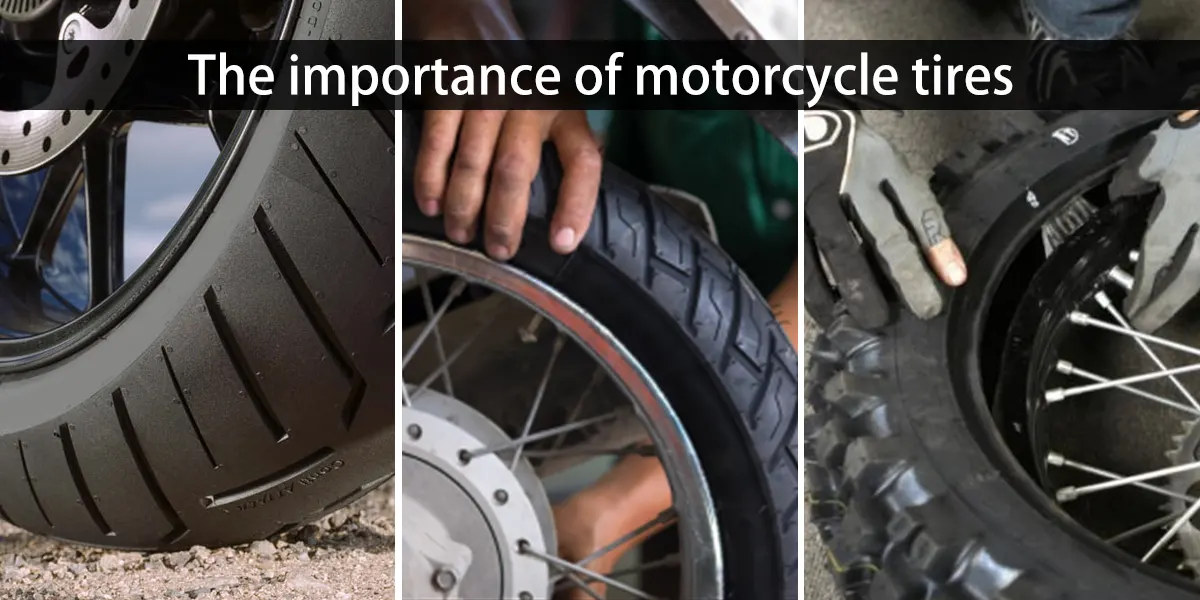
High-performance motorcycle tires can provide better grip, stability, and durability, enhancing riding safety and comfort.
Grip
High-quality tires have good grip and can provide stable handling on various road conditions, preventing slipping.
Durability
Durable motorcycle tires can extend their service life, reduce replacement frequency, and lower usage costs.
Comfort
Premium motorcycle tires perform well in terms of shock absorption and comfort, enhancing the overall riding experience.
Depending on the motorcycle’s use and riding environment, different types of motorcycle tires can be chosen. For example, all-terrain tires are suitable for various road conditions, road tires are designed for road riding, off-road tires are suitable for uneven and challenging terrain, and wetland tires are designed for wet surfaces. Additionally, high-performance motorcycle tires typically have optimized suspension and grip, suitable for high-speed riding and track use.
All-terrain tires
All-terrain tires are the most popular among off-road enthusiasts, featuring rugged treads. This design can increase noise but enhances durability and traction. The larger the tread contact area, the better the road handling; the smaller the contact area, the deeper the grooves, the better the off-road performance. Deep grooves can quickly expel mud while effectively increasing friction between the motorcycle tire and the road surface, maintaining strong grip to prevent wheel slippage.
Road tires
Road tires are designed for hard, smooth surfaces, featuring fewer and shallower treads. This design reduces resistance, provides a smooth driving experience, and improves fuel efficiency. Road tires are typically made of durable rubber compounds. Due to their design, road tires are usually quieter, suitable for city roads, highways, and other hard surfaces.

Off-road tires
Off-road tires are suitable for unpaved and uneven terrains, used in off-road driving and extreme environments. These motorcycle tires have deep and wide treads and rough surfaces, providing good traction on mud, sand, and rocks. They are usually made of rubber compounds with strong puncture resistance to handle harsh conditions. Although they may feel rough and uncomfortable on roads, off-road tires are ideal for deserts, muddy areas, rocky trails, and other uneven terrains.
Wetland tires
Wetland tires are specifically designed for wet, muddy, and puddled surfaces. They usually have deep and wide treads, allowing self-cleaning on muddy and slippery surfaces while maintaining good traction. Wetland tires are made of wear-resistant and tear-resistant rubber compounds, able to withstand impacts and pressures in muddy environments. Although they may be bumpy and noisy on hard surfaces, wetland tires are perfect for muddy, slippery, and swampy areas.
Motorcycle tire size and width: Tire size should match the motorcycle rim size. When purchasing tires, refer to the motorcycle manufacturer’s recommendations or check the label on the motorcycle rim for the correct tire size. Tire width affects the motorcycle’s grip and stability; wider tires usually provide better grip but may reduce vehicle agility. Therefore, choose the appropriate tire width based on driving needs and habits.

These motorcycle tires come in various sizes, such as 90/90-18, 100/90-18, etc., to meet different models and needs.
In 90/90-18, the first “90” indicates the motorcycle tire width is 90 mm, which is the width of the motorcycle tire when viewed from the side.
In 100/90-18, the “100” indicates the motorcycle tire width is 100 mm.
The second “90” in 90/90-18 and 100/90-18 indicates the aspect ratio, which is the tire sidewall height as a percentage of the tire width.
The “18” in 90/90-18 and 100/90-18 indicates the rim diameter the tire fits, which is 18 inches. This is the internal diameter of the tire, matching the rim size.
Tread affects grip and drainage performance, so choosing the appropriate tire tread for the driving environment and needs is crucial.
Motorcycle treads mainly come in three types. Regular treads are suitable for hard road surfaces, with not too deep treads that balance drainage performance. Street riding is less likely to skid laterally, suitable for city riding, cornering, and hill riding, but not for sand or mud.

Off-road treads provide 1.5 times the traction of regular treads, but such tires can be very bumpy on asphalt roads and wear out more quickly.
Hybrid treads are transitional treads between regular and off-road treads, suitable for both hard and snowy muddy roads.
Setting the correct tire pressure is crucial for motorcycle handling and safety. Refer to the motorcycle manufacturer’s recommendations or check the label on the tire for the correct tire pressure.
Maintaining proper tire pressure is important. Overinflated tires wear out quickly at the crown, and high speeds in hot summers can cause tire bursts. Underinflated tires wear out over a large area, deform significantly during driving, generate heat, accelerate rubber aging, and cause ply separation and breakage.
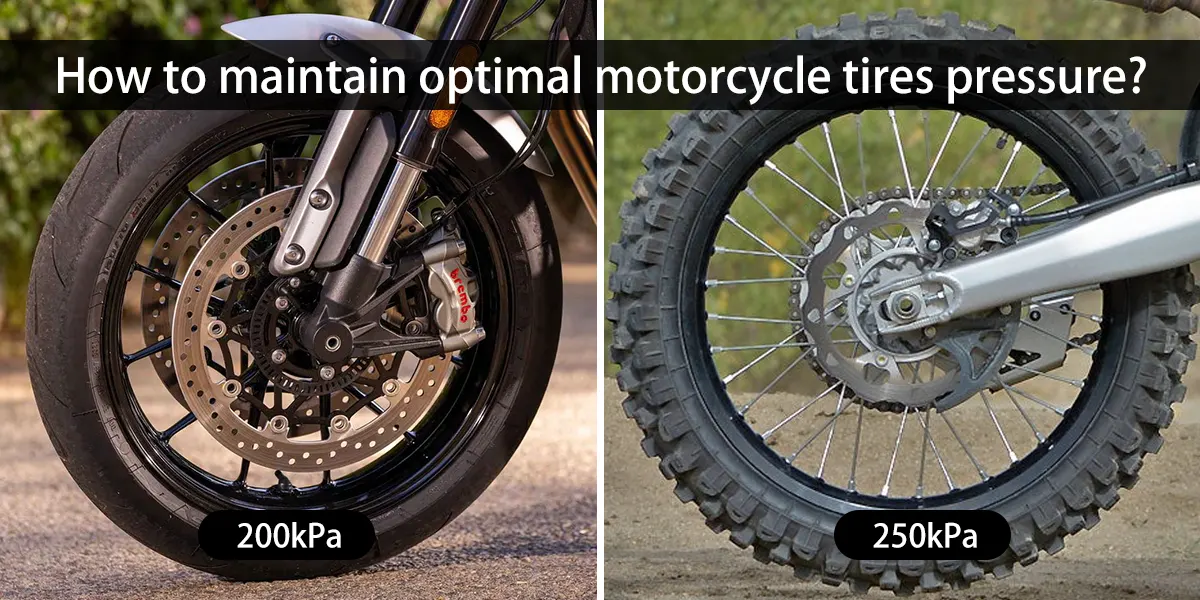
Generally, front tire pressure is around 200kPa, and rear tire pressure is around 250kPa, varying by model. Always check the manual.
Regularly check for stones, glass, or other hard objects embedded in the motorcycle tire tread grooves. These embedded objects not only affect tire traction but also pose a puncture hazard. Remove them with a small tool if found.
Tires are rubber products, susceptible to moisture and heat. Avoid storing the motorcycle in damp places for long periods and avoid long-term storage or exposure in high-temperature environments.
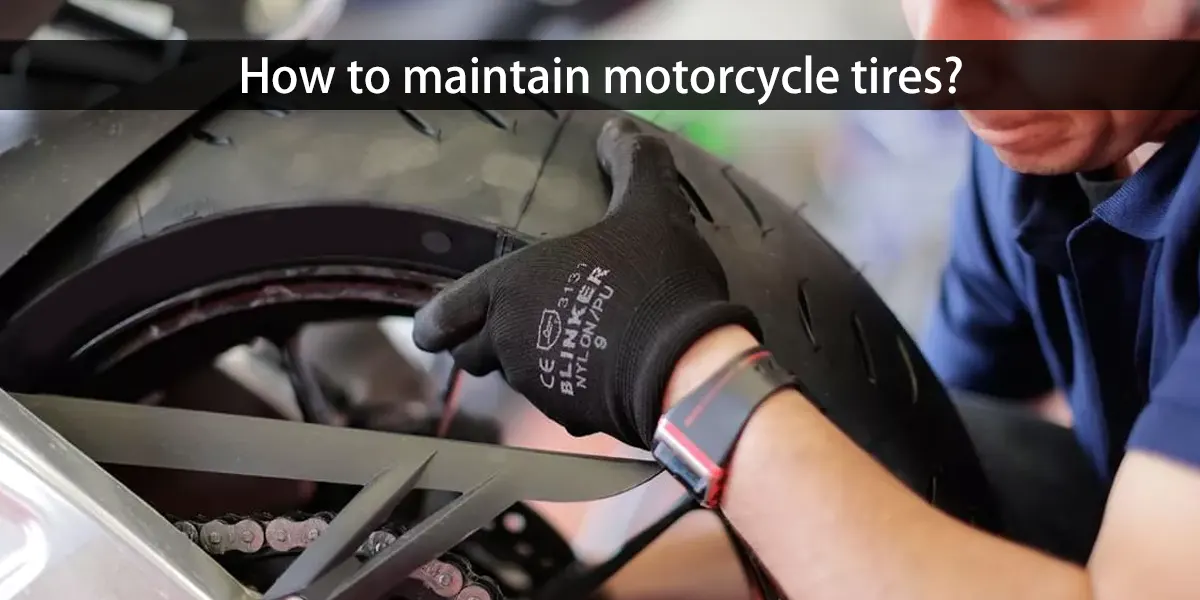
Motorcycle tires should not come into contact with oils and other substances. If they do, clean them off as soon as possible. Otherwise, these factors will accelerate tire aging. Tires have a certain load capacity range; overloading will increase deformation, enlarge the contact area, and accelerate wear.
Frequent braking, especially emergency braking, significantly increases tire wear. Therefore, maintaining stable speeds and minimizing braking is important when driving. Use the throttle to control deceleration whenever possible, reducing motorcycle tires wear and brake pad consumption.