Skip to content


SVOLT into the battery recycling field
With the rapid development of new energy vehicles, and increased demand for golf cart batteries, the installed capacity of power batteries has also entered a period of explosive growth. If the service life of power batteries is 5-6 years as the benchmark. From 2014, the first year of the application of new energy vehicles, it is estimated that the first installed power batteries are facing the problem of retirement. It is estimated that by 2030, the scale of China’s lithium battery recycling market will reach 84.02 billion RMB.
In the face of this market that is about to break through the 100 billion level, many companies have begun to turn their attention to power battery recycling. In addition to SVOLT, such as GEM, Brump, one of the top 10 power battery companies in the world BYD, CATL leading in top 10 battery management system suppliers in China, BMW, Tianci, Gotion high-tech, EVE, Sany heavy industry, PCcooler, etc. or focus on battery recycling business, or from related companies upstream and downstream of the industry chain, or cross-border players who have not been involved in battery recycling before also want to come to the field of power recycling to get a share, and even capitalists who are good at listening to the wind have begun to focus on the field of power recycling.

10 battery recycling companies complete financing
According to statistics, since the beginning of this year, so far, more than 10 battery recycling companies have received financing. Among them, 8 companies were listed in the previous white list of lithium battery recycling companies, accounting for about 72.73%.
| Date | Companies | Financing Amount |
| January 17, 2022 | SVOLT | 322 million RMB |
| February 17, 2022 | Evergreen | Undisclosed |
| June 28, 2022 | Wuhan power | Hundreds of millions of RMB |
| June 28, 2022 | Qiantai | 544 million RMB |
| July 25, 2022 | J & S | Over 100 million RMB |
| August 1, 2022 | Ruicycle | Over 300 million RMB |
| August 15, 2022 | Circue | Tens of millions of RMB |
| August 15, 2022 | Jinsheng | Hundreds of millions of RMB |
| September 5, 2022 | Highpower | 1.044 billion RMB |
| September 10, 2022 | SAIDEMAI | Tens of thousands of RMB |
| September 19, 2022 | Ruicycle | Over 400 million RMB |
| August 12, 2022 | Cn Science | 800 million RMB |
According to the data, the financing amount of many battery recycling companies such as SVOLT, Qiantai tech, Ruicycle, and Highpower exceeds 300 million RMB. Among them, Highpower has the highest single financing amount, reaching 1.044 billion RMB, while Ruicycle has just two months. Completed two financings within the year, with a total financing amount of up to 700 million RMB.
In terms of financing rounds, Evergreen, Jinsheng, Ruicycle and many other companies have reached the B round or B+ round of financing, Cn Tech, SVOLT and other companies are sprinting for IPO, and the corresponding financing rounds have also begun to enter the IPO financing round. Highpower Technology has successfully landed on the Growth Enterprise Market earlier this month. It is conceivable that with the continuous advancement of the financing process, more and more battery recycling companies will start the listing process in the future.
In fact, Wuhan Power Regeneration is a holding subsidiary of GEM, and one of the two leading enterprises in China’s power battery recycling in China. Since its establishment, GEM has carried out as many as 11 financings, and the total financing amount has exceeded 2.5 billion RMB.
Financiers include Guotai junan, Guangdong Science and Technology Investment, Chaos Investment, Zhengxiang Investment, Skycom Ventures, Beijing Capital Ronghua Investment, ABC International, Deyi Huixin Investment, Ruishi Nisheng, Galaxy Investment, Shengqian Investment, Tongchuang Weiye, Yingfu Taike, Yueke Finance and other multi-party capital.
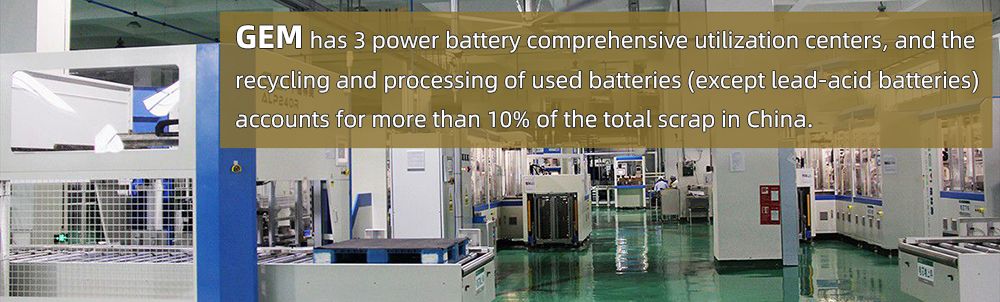
In terms of production capacity, GEM has three comprehensive utilization centers for power batteries, and the recycling and processing of used batteries (except lead-acid batteries) accounts for more than 10% of the total scrap in China. By 2025, the total amount of GEM power battery recycling is expected to exceed 250,000 tons. In February this year, GEM also signed a strategic cooperation agreement with Rongbai Technology to establish long-term close cooperation in the fields of power battery recycling, nickel resource smelting in other countries, and precursor product supply and sales.
In terms of SAIDEMAI, it just completed the A round of financing jointly conducted by Fosun Ruizheng Capital and Zhiying Investment on the 10th of this month. In terms of recycling channels, SAIDEMAI has reached in-depth strategic cooperation with many car companies, 4S stores, battery companies, new energy vehicle operators, and scrapped car dismantling companies.
In terms of production capacity, SAIDEMAI has a Tianjin factory with an annual production capacity of 12,000 tons in the first phase and 50,000 tons in the second phase. At the same time, SAIDEMAI also plans to open new battery recycling plants in Guangdong, Jiangsu, Chongqing and other places. In terms of Bangpu Cycle, as a subsidiary of CATL’s “professional counterpart”, the latest round of financing information is still in January 2020.
Strategic financing jointly promoted by SDIC Innovation, Ningde New Energy, and National Advanced Manufacturing Industry Investment Fund. In terms of production capacity, the first phase of the Bangpu Cycle project is scheduled to be completed and put into production on September 30 this year. At the same time, Bangpu Cycle has developed the core technology of “directional cycle”, so that the comprehensive recovery rate of core metal materials in used batteries can reach more than 99.3%.
Quzhou Huayou Resource Recycling Technology Co., Ltd. and Quzhou Huayou Cobalt New Materials Co., Ltd. under Huayou Cobalt also did not raise funds during the year. The latter has conducted two rounds of financing since its establishment. The latest round of financing took place in 2020, and it was invested by Huayou Cobalt through equity transfer of RMB 805 million. Before that, Huayou Cobalt also participated in SAIDEMAI’s seed round financing.
The future development of lithium battery recycling
The constant capital has added a lot of help to the popularity of the battery recycling track to a certain extent. The data shows that before 2020, the number of power battery recycling companies will remain below 800, but in 2021, the number of power battery recycling companies will begin to increase rapidly. Up to now, there are more than 3,000 battery recycling companies in China that are in operation/existing with a registered capital of more than 20 million RMB, but it should be noted that there are only 47 whitelisted companies previously announced by the Ministry of Industry and Information Technology.
It can be seen that most power lithium battery recycling companies in China do not have the corresponding qualifications.At the same time, unified standards for the lithium battery recycling industry need to be established urgently, and channel recycling and compliance issues also need to be resolved urgently. At present, the recycling technology of many small-scale enterprises is not mature, and there is still a long way to make the best use of them, and there are still many middlemen hoarding and speculating, which hinder the healthy development of the battery recycling industry.
From the perspective of the type of retired power batteries, as the two most mainstream technical routes in the field of power batteries, ternary lithium batteries have always become the relatively favored technical route of manufacturers due to their advantages of light weight, good performance and high energy density.
In the battery recycling process, because it can be split, smashed, and then mechanically processed into various precious metal materials, such as nickel, copper, cobalt, aluminum, etc., or other incidental products. Therefore, the ternary lithium battery also has a high recycling value.
But now, due to limited reserves of metal resources such as nickel and cobalt, as well as rising prices, coupled with technological advancements in lithium iron phosphate batteries, influenced by many factors such as safety performance and other indicators have been improved, lithium iron phosphate began to catch up and overtake.
According to the data, in August this year, the sales volume of new energy vehicles in China was 666,000, among which, the installed capacity of lithium iron phosphate batteries has reached 17.2GWh, accounting for 62% of the total installed capacity.
From January to August, the cumulative sales volume was 3.86 million units, of which the cumulative installed capacity of lithium iron phosphate batteries was 95.9GWh, accounting for 59.2% of the total installed capacity, both exceeding the installed capacity of ternary lithium batteries. And this is also the 15th consecutive month that lithium iron phosphate batteries have surpassed ternary lithium batteries.
In terms of battery recycling, since the beginning of this year, the average price of battery-grade lithium carbonate has remained high, and even exceeded the 500,000 RMB/ton mark several times. The average price of lithium hydroxide battery-grade micropowder has also risen all the way, approaching the 500,000 RMB/ton mark, and the rising price of raw materials has also made lithium iron phosphate recycling more useful.
At present, there are two main ways to recycle waste power batteries: cascade utilization and recycling. Among them, cascade utilization has high technical barriers and has not yet formed economies of scale. The lithium iron phosphate battery, relatively speaking, has more cycles, longer service life and less precious metal content, so it is more suitable for the recycling method of cascade utilization; The metal content of the ternary battery is relatively high, the cycle life is short, and the safety will be greatly reduced after the battery capacity decays, so it is more suitable for recycling.
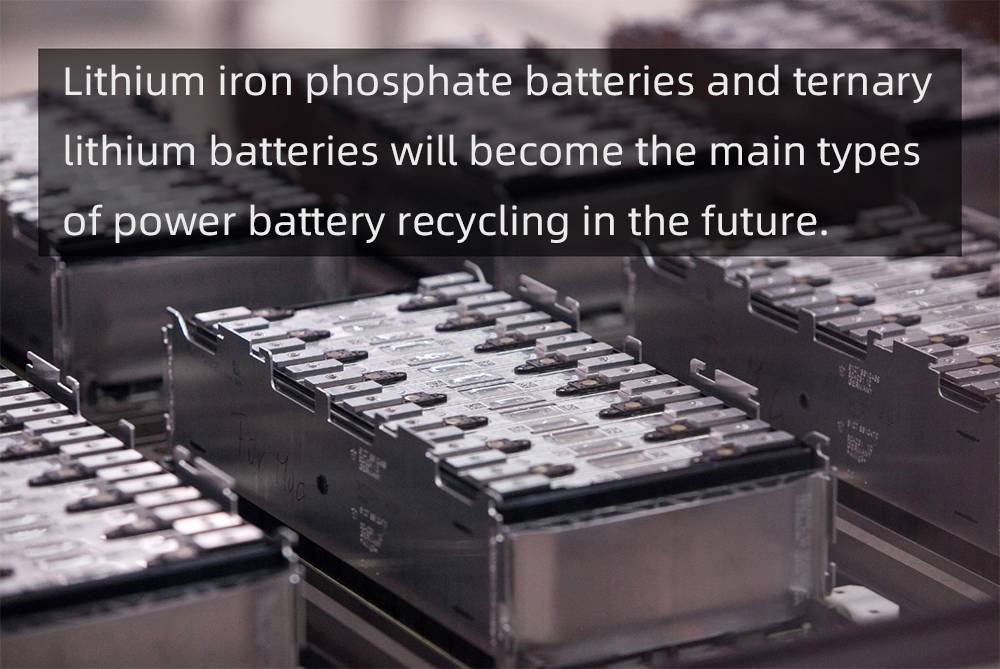
China’s lithium battery recycling market is a huge blue ocean. With the vigorous development of the new energy industry, lithium battery recycling will also enter the TWh (terawatt-hour) era. As decommissioned battery types suitable for the two recycling methods of cascade utilization and recycling respectively, lithium iron phosphate battery and ternary lithium battery will become the main types of power battery recycling in the future. Among them, the market share of lithium iron phosphate battery recycling is expected to continue to increase, and companies that deploy iron phosphate recycling may be expected to reap a wave of market dividends.