Skip to content


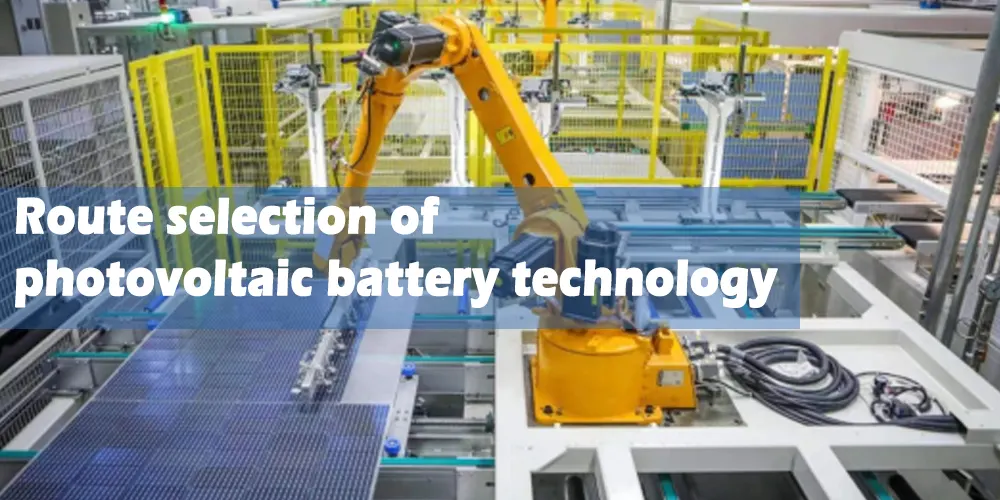
Route selection of photovoltaic battery technology
Throughout the development of the photovoltaic industry in the past ten years, battery technology has undergone frequent iterations, and cost reduction and efficiency increase have always been the main thread of industrial development. By pushing the photoelectric conversion efficiency to a higher level, P-type PERC cells quickly replaced the original BSF cells under policy opportunities, occupying an absolute position in the current photovoltaic cell market share.
Data shows that the market share of PERC crystalline silicon solar cells will reach 91.2% in 2021, and PERC+ cells are using efficiency-enhancing processes to extend the life cycle of the technology. CPIA predicts that before 2025, PERC batteries will remain the mainstream product in the market.
However, with the passage of time and technology upgrades, the photoelectric conversion efficiency of P-type PERC cell technology is gradually approaching the peak. In order to further improve battery efficiency and reduce battery costs, manufacturers have begun to look for a new generation of battery technology, and N-type silicon-based batteries have come to the forefront of the times with higher conversion efficiency.
According to the data, the theoretical limit efficiency of PERC cells is 24.5%, while the theoretical limit efficiencies of N-type cells such as HJT and TOPCon reach 28.5% and 28.7%, respectively. The transformation from P-type batteries to N-type batteries has gradually become the next development direction of the photovoltaic industry, especially TOPCon batteries and HJT batteries, which have successively started mass production and are moving towards commercialization.
2022 is regarded by the industry as the first year of commercialization of N-type photovoltaic cell technology. Although the mass production scale of HJT and TOPCon is far behind that of PERC, the development speed is extremely fast. It is estimated that by the end of 2023, China’s TOPCon battery production capacity will reach 305.9GW, accounting for 31.43% of the production capacity;
In terms of HJT batteries, according to statistics, the new planned production of HJT in 2023 and 2024 will be 61.8GW and 45.2GW respectively. If all of them reach production capacity according to the plan, China’s HJT production capacity will reach 68.7GW and 113.9GW in 2023 and 2024, respectively. However, at the beginning of the development of things, there will always be a fork in the road. The dispute over the technical route of TOPCon and HJT is becoming increasingly fierce.
The TNC technology stands out
In the process of rapid iteration of photovoltaic cell technology, companies that have achieved a relatively leading position will undoubtedly gain the dual advantages of increasing market share and technology premium. The choice of technical route is testing the strength of the company and the wisdom of decision makers.
Judging from the current layout of major manufacturers, top 10 TOPCon solar cell manufacturers in China such as JinkoSolar, Trina Solar, and Jolywood mainly aim at the TOPCon route; Players on the HJT route mainly are these top 10 HJT solar cell manufacturers in China include Risen Energy and Huasheng New Energy.
Some people in the industry believe that HJT technology is more friendly to companies below the second and third tiers or new technology industries, without the historical burden of production capacity. However, due to the difficulty in mass production of HJT technology, higher requirements are placed on the R&D capabilities of enterprises.
For example, Tong Wei, as the world’s leading dual leader in silicon materials + cells, has adopted a variety of strategies in the selection of technical routes, and has layouts in passivation contact cells, heterojunction cells, and back contact cells. . It is also the choice of most powerful companies.
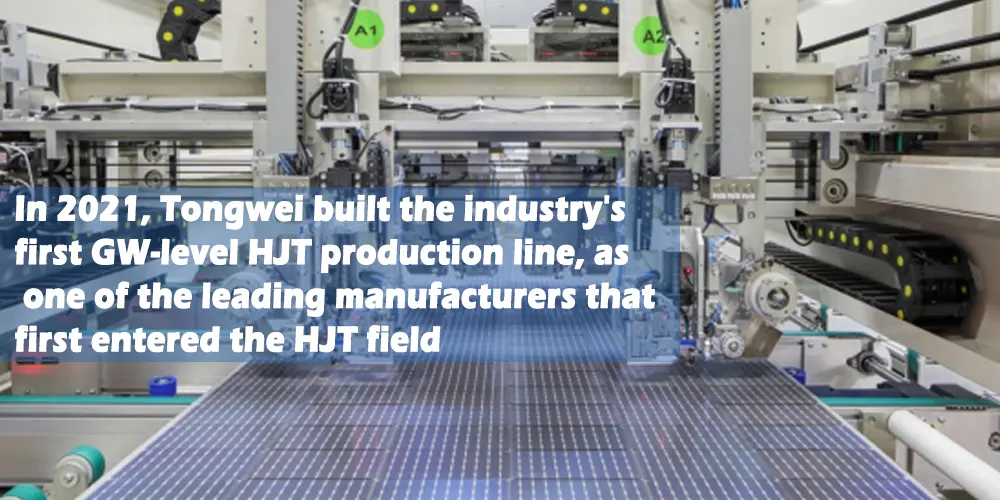
In 2021, Tongwei will build the industry’s first GW-level HJT production line. As one of the leading manufacturers that first entered the HJT field, Tongwei’s current HJT cell research and development efficiency has reached 25.67% (ISFH certification).
In the field of back contact battery technology, Tong Wei has also started relevant technical reserve work, and will launch competitive products in due course according to changes in market maturity such as customer needs, development and promotion of related equipment and raw material manufacturers.
It is worth mentioning that since 2020, Tong Wei has started to independently develop “TNC” technology, and is the first in the industry to start the development of 210mm-sized N-type passivation contact technology and successfully put into production a 1GW production line.
In November 2022, Tong Wei’s newly released “TNC” high-efficiency battery innovation technology will be listed among the top ten innovative technologies of “Zero Carbon China” in 2022. As an “upstart” launched by Tong Wei’s several generations of technology, TNC adopts the industry-leading PECVD method to deposit polysilicon, which can maximize the photoelectric conversion efficiency. It also has the advantages of fast deposition rate, small winding plating, long life of quartz parts, and high production capacity.
At present, the mass production conversion efficiency of batteries produced using Tongwei TNC technology has exceeded 25.1%. According to Tong Wei, the person in charge of component product development, TNC cells have performance advantages such as high bifaciality, low attenuation, better temperature coefficient, and good low-light response.
According to public information, the production of Tongwei TNC products is advancing rapidly. In addition to the 1GW pilot test line, the 9GW TNC mass production line has also been put into production.
Competition on the photovoltaic module side
The photovoltaic industry is still growing at a high speed, and new entrants are coming in one after another, especially the competition on the component side is becoming increasingly fierce. In the second half of 2022, Tongwei will enter the component market.
The ensuing question is whether Tong Wei, who has won in the field of silicon materials and cells, can make a name for himself in the module arena? The competition in the incremental market is ultimately about fighting for technology and production capacity.
For batteries, an increase in efficiency means an increase in component power. According to relevant personnel from Tongwei, the power of the Tongwei HJT module 66-type double-glass module has exceeded 700W, up to 720W. The successful application of copper interconnection technology has also greatly reduced the metallization cost of HJT.
But it should be noted that although the current HJT technology has high expectations from the market due to its advantages such as high conversion efficiency and low attenuation, it has not ushered in an explosion due to the high investment cost.
On the other hand, TNC components also do not fall behind. Through the introduction, taking the 182-size 72-type half-cut module produced by Tongwei as an example, the power has reached more than 575W. Compared with traditional PERC products, the power can be increased by more than 20W, and it has a bifacial rate about 10% higher than that of PERC.
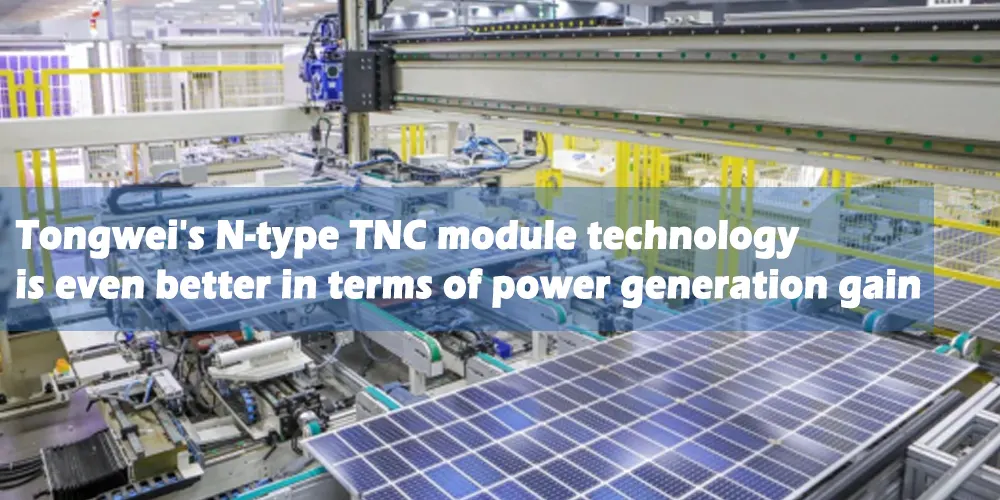
Thanks to this, Tongwei N-type TNC modules are superior in power generation gain. At the same time, Tongwei TNC’s high-efficiency photovoltaic modules are superior in terms of capacity and system cost. Compared with the same type of P-type PERC module, it can save more land area, and the price is very close to PERC.
All of these, whether it is power generation gain advantages, capacity advantages, or system cost advantages, Tongwei TNC high-efficiency photovoltaic modules can better meet the needs of multiple scenarios and create more power generation gains.
Entering the era of N-type batteries, various new and old forces have increased their layout, rushing all the way in new technologies and capacity expansion, aiming at the incremental market for photovoltaic modules.
The high-efficiency components produced by Tong wei TNC technology have already met the conditions for full mass production, and they are speeding up on the next-generation battery route to escort it into the component market.
In fact, it is not just Tong Wei. Under the general trend of photovoltaic industry integration and the incremental module market ushering in more entrants, the mastery and application of new technologies must be inseparable from reshaping the pattern – technology is king for the winner.