Skip to content


Advantages of silicon all-solid-state battery
Recently, alloy-type anodes (such as silicon, tin, aluminum, indium) that do not contain excessive lithium have attracted great interest. In particular, the silicon-based anode material has the highest theoretical specific capacity (4200 mAh g-1) and low potential (0.3V vs. Li+/Li) and is considered another potential anode for the next generation of solid state battery.
Figure (a) compares the key aspects of silicon-based and lithium-based all-solid-state battery systems, including cost, energy density, interface compatibility, processability, and more. First of all, in terms of resources and costs, Si is significantly competitive with Li.

For example, the annual production of silicon can reach 8 million tons at a price of only $2,100 / ton, while the annual production of lithium is only 82,000 tons, and the price of battery-grade lithium carbonate is as high as $17,000 / ton.
Secondly, the weight and volumetric energy density of silicon-based all-solid-state batteries are 356 Wh·kg-1 and 965 Wh·L-1, respectively, which is comparable to that of lithium-based all-solid-state batteries (410 Wh·kg-1 and 928 Wh·L-1). Moreover, silicon is thermodynamically stable with most all-solid electrolytes, while lithium metal reacts violently with all-solid electrolytes, especially sulfide type all-solid electrolytes.

(b)Development of silicon all-solid-state batteries from basic research to practical applications
Even more impressively, silicon can be mixed with all-solid-state electrolytes to enhance the internal ionic conductivity of silicon composite anodes. However, Li metal anodes are usually in contact with all-solid-state electrolytes through a “sheet-to-sheet” connection, resulting in a low critical current density (CCD) and ultimately severe Li dendrite growth.
Finally, high stacking pressure is usually applied in all-solid-state batteries to maintain close contact between electrodes and electrolytes, but it can also cause short circuits in lithium-based all-solid-state batteries.
In contrast, silicon-based all-solid-state batteries can accommodate the extra stacking pressure and operate at room temperature. Lithium-based all-solid-state batteries always require high temperatures to improve reaction kinetics. Therefore, silicon-based all-solid-state batteries are considered to be more promising alternatives to lithium-based all-solid-state batteries.
Notably, silicon-based all-solid-state batteries assembled with all-solid-state electrolytes show novel interfacial interactions and electrochemical-mechanical behaviors, which are more compatible and stable than those assembled with liquid electrolytes. Therefore, silicon-based all-solid-state batteries not only have reliable safety and low cost, but also alleviate the inherent electrochemical mechanical problems of silicon anodes.
Furthermore, silicon-based all-solid-state batteries with various designs (e.g., thin-film or micro-batteries and pouch batteries) are expected to satisfy different applications, such as micro-batteries for micro electro mechanical systems (MEMS) and pouch batteries for 3C electric products and electric vehicles, etc.

Development history of silicon all-solid-state battery
All-solid-state batteries are considered as promising conversion and storage devices due to their high energy density and reliable safety. Due to the comprehensive advantages of silicon anodes and all-solid-state electrolytes, the development trend of silicon-based lithium batteries is from liquid batteries to all-solid-state batteries.
In 1999, Neudecker et al. first used silicon tin oxynitride (SiTON) anodes and lithium phosphorus oxynitride (LiPON) electrolytes for thin-film batteries, which maintained high capacity.
In 2007, Notten et al. first proposed a 3D integrated structure all-solid-state battery with a silicon thin-film anode and a LiPON all-solid electrolyte, which exhibited a high energy density of about 5 mWh μm−1cm−2, which is higher than that of a planar solid-state thin film battery.
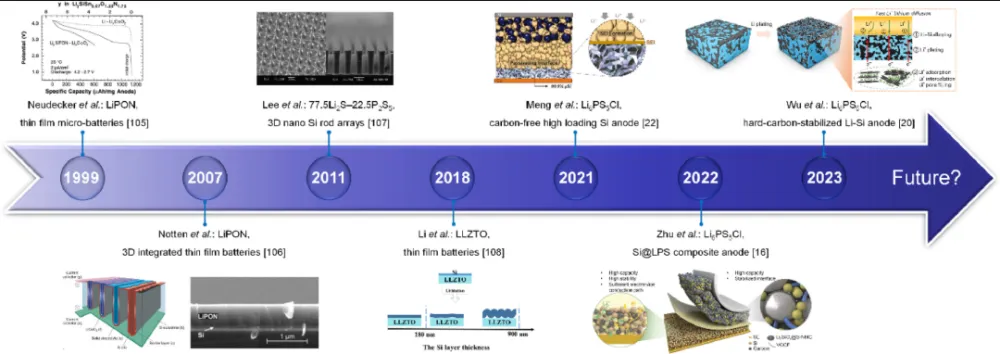
To improve the rate performance of batteries at room temperature, sulfide-type all-solid-state electrolytes are considered to be one of the most suitable candidate materials due to their high ionic conductivity, while LiPON only has a low ionic conductivity.
In 2011, Lee’s group constructed a silicon-based all-solid-state battery with a sulfide-type all-solid-state electrolyte of 77.5Li2S-22.5P2S5, and a 3D nano-silicon rod anode to accommodate volume expansion.
Stable capacity is provided with minimal decay in secondary cycles. Garnet-type LLZTO all-solid-state electrolytes with high ionic conductivity are also used in silicon-based all-solid-state batteries. Li||LLZTO||Si cells based on a 180nm silicon layer exhibited excellent cycle performance with over 85% capacity retention after 100 cycles.
However, thin-film electrodes or LiPON thin-film all-solid-state electrolytes are usually synthesized by physicochemical-deposition methods, which are complicated and difficult to manufacture on a large scale. Therefore, simple electrode preparation techniques have been gradually developed to improve production efficiency and reduce production costs.
Practical application of silicon all-solid-state battery
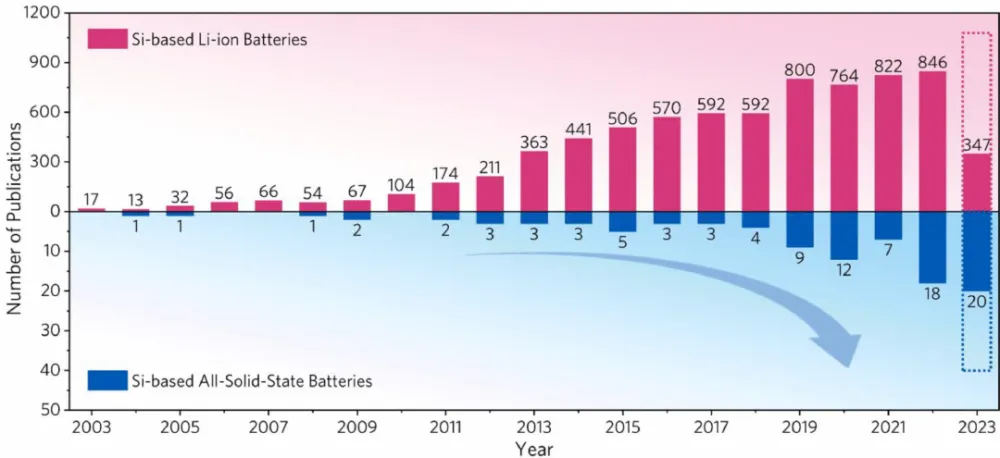
Due to the above-mentioned multiple advantages, silicon-based all-solid-state batteries have continuously attracted lithium ion battery company and people’s interest in recent years, as shown in the figure below, the number of related literature is also growing.
The huge volume expansion (>300%) of silicon anodes during lithiation leads to the practical application of silicon-based lithium batteries. During the lithiation/delithiation process, the sharp expansion/contraction can generate huge stress, leading to the formation of cracks and the pulverization of Si anode, which is called “mechanical pulverization”.
In addition, it leads to a disconnection of the electron/ion environment in the silicon anode, which is called “decay of the conductive environment”. Meanwhile, the significant volume change of the silicon anode during the long cycle life leads to the formation of an unstable SEI layer, termed “dynamic SEI reconstruction”.
Ultimately, Si-based lithium batteries suffer from severe irreversible capacity loss, low coulombic efficiency (CE), and formation of thick SEI layers. The aforementioned issues greatly degrade the electrochemical performance of silicon-based liquid batteries, eventually leading to battery failure in early cycles.
However, due to the existence of various electrolytes and the lack of related research, the failure mechanism of silicon-based all-solid-state batteries is still not systematic and in-depth.
In silicon-based all-solid-state batteries, new interfacial interactions are created between silicon anodes and all-solid-state electrolytes, in which chemically inert interfaces and “solid-solid” contact modes will create new failure mechanisms.
Due to the reduction of interfacial side reactions, the effect of “dynamic SEI reconstruction” may be weakened. In addition, the all-solid-state electrolyte has excellent mechanical properties, which can alleviate the problem caused by the volume expansion of silicon anodes.
However, due to the huge volume expansion and the “solid-solid” contact at the interface, high attention should be paid to the conductive environment of electrons and ions. Overall, self-assembled electrolytes provide a more stable environment for silicon anodes than liquid electrolytes, but the contact issue of silicon anodes with all-solid-state electrolytes should be noticed.
Therefore, the failure mechanism of silicon-based all-solid-state batteries needs to be further studied, and the in-situ or operation technology also needs to be further developed to provide guidance for the optimization strategy of silicon-based all-solid-state batteries.

In addition, all-solid-state electrolytes in silicon-based batteries also require high overall performance. For example, the thickness should be less than 20 μm; the electrochemical stability window should be higher than 5V for compatibility with high voltage battery cathodes; the ionic conductivity should be higher than 10-4S cm-1 at room temperature.
And high ion selectivity (the transfer number of lithium ions), high chemical stability, thermal stability, robust mechanical properties, low processing cost, facile device integration, and low electronic area specific resistance.
Unfortunately, it is difficult to find an ideal all-solid-state electrolyte that can meet all the above performance requirements and even maintain these properties during long-term cycling. So far, LiPON-type, sulfide-type, oxide-type, and polymer-type anodes have been proven to be compatible with silicon-based anodes.
Due to their extremely high ionic conductivity at room temperature, sulfide-type all-solid-state electrolytes have attracted great interest from most researchers. In addition, the good mechanical properties provide a flexible interface between the electrodes and the all-solid-state electrolyte and alleviate the volume expansion of Si particles.
However, the poor air stability and narrow electrochemical window of sulfide-based all-solid-state electrolytes limit their large-scale applications.
Polymer-based all-solid-state electrolytes are flexible and stable, but they have very limited low ionic conductivity at room temperature. Garnet-type all-solid-state electrolytes have high ionic conductivity at room temperature, however, their mechanical properties and interfacial impedance with electrodes are not ideal.
Although LiPON-type all-solid-state electrolytes have low ionic conductivity at room temperature, they are always deposited as thin films, resulting in low ionic conduction resistance throughout the electrolyte. However, limited by existing technologies, LiPON-type all-solid-state electrolytes can only be applied to small electronic products.
Optimization strategies for silicon all-solid-state battery
To solve the above problems, the researchers proposed the modification strategy of sulfide electrode, including doping and coating. In addition, the structure of the silicon anode can also be optimized to further improve the electrochemical performance of self-assembled cells. Many of the structural design strategies of silicon-based liquid cells are also applicable to assembled cells, such as nanostructures and composite structures.
However, these strategies may not be suitable for building high-quality load anodes and applying them to mass production. In order to meet the needs of practical applications, many studies have used high-voltage cathodes and silicon-based anodes to construct high-energy silicon-based all-solid-state batteries.
Due to the numerous advantages of silicon-based all-solid-state batteries, they are the most promising materials for next-generation energy storage systems.
Although there are some challenges before the practical application of silicon-based all-solid-state batteries, there are many relevant studies on liquid batteries, which can provide references for silicon-based all-solid-state batteries.
In addition, advanced research on silicon-based all-solid-state batteries has shown that they have great potential for practical applications. Therefore, it is worthwhile to further study the failure mechanisms and advanced strategies of silicon-based all-solid-state batteries to gain a deeper understanding and improve their electrochemical performance.
References
Challenges and opportunities towards silicon-based all-solid-state batteries. Energy Storage Materials. 2023, 102875.
DOI: 10.1016/j.ensm.2023.102875
https://doi.org/10.1016/j.ensm.2023.102875