The future prospects of lithium-sulfur batteries
In the context of global energy transition, while lithium batteries have received much attention in the battery field, their capacity and safety issues have led to continuous exploration for new alternatives. Sodium-ion batteries, with performance similar to lithium-ion batteries and lower cost (thanks to abundant sodium resources), have become an attractive choice. Aluminum-air batteries are continuously gaining attention due to their enormous energy density potential. Meanwhile, lithium-sulfur batteries, with their higher energy density, lighter weight, and better safety, have successfully attracted the interest of innovators and investors.
This article discusses the advantages of lithium-sulfur batteries, such as high energy density, low cost, and environmental friendliness, and their potential wide application in fields like electric vehicles and aerospace. However, it also highlights the need to overcome technical challenges like low conductivity to achieve comprehensive breakthroughs.
700Wh/Kg lithium-sulfur battery successfully developed
Recently, a lithium-sulfur battery with an energy density of 700Wh/Kg was successfully developed, which is three to five times that of currently popular lithium-ion batteries on the market, providing ideal battery soluton. The project, led by Foreign Member of the Chinese Academy of Engineering, Jiujun Zhang, took more than a decade to complete.
Experts state that electric vehicles equipped with lithium iron phosphate or ternary lithium batteries currently have a range of 400-600 kilometers. Under the same conditions, switching to lithium-sulfur batteries can increase the range to over 1200 kilometers, and if used in drones, the range can be tripled.

Compared to lithium iron phosphate and ternary lithium batteries, the difference in lithium-sulfur batteries lies in the use of sulfur as the cathode and metallic lithium as the anode, with a theoretical energy density of up to 2600Wh/kg. Sulfur has the advantages of being abundant, inexpensive, and environmentally friendly, leading many universities, research institutions, and companies worldwide to invest heavily in the development of lithium-sulfur batteries.
However, lithium-sulfur batteries still face issues such as extremely low conductivity, volume expansion (about 70% volume expansion during discharge), shuttle effect (intermediate discharge products pass through the separator and react directly with the Li anode), and Li anode safety (Li dendrites penetrating the separator and causing short circuits), which leave lithium battery manufacturers tangled.
These issues can be improved through strategies such as doping graphene oxide in the cathode material, forming a polymer protective layer on the anode, modifying the separator with a catalyst coating, and adding electrolyte additives to the sulfur.
Below, we will get to know lithium-sulfur batteries:
The principle of lithium-sulfur batteries
Lithium-sulfur batteries (Li-S batteries) consist of a sulfur composite cathode, a metallic lithium anode, and an electrolyte between them. They are secondary batteries that use sulfur as the cathode active material and lithium as the anode. The basic principle is based on the electrochemical reaction between sulfur and lithium.
During charging, lithium loses electrons to become lithium ions, migrating to the cathode through the electrolyte, while sulfur accepts electrons to be reduced to polysulfides. During discharge, polysulfides are oxidized, releasing electrons and lithium ions. The electrons perform work through an external circuit, and the lithium ions return to the anode through the electrolyte.
Energy density of lithium-sulfur batteries
Lithium-sulfur batteries have a very high theoretical energy density, exceeding 2600Wh/kg, far surpassing the widely used lithium-ion batteries (typically between 150 – 300Wh/kg). This allows lithium-sulfur batteries to store more energy under the same weight, providing longer range for devices such as electric vehicles.
Comparative advantages with current power batteries

High energy density: As mentioned earlier, the energy density advantage of lithium-sulfur batteries is significant, meeting consumer demands for longer range, reducing charging frequency, and increasing convenience.
Lower cost: Sulfur is an abundant and inexpensive element. Compared to expensive materials such as cobalt and nickel used in lithium-ion batteries, the raw material cost of lithium-sulfur batteries is lower, facilitating large-scale promotion and application.
Environmentally friendly: Sulfur mining and processing are relatively environmentally friendly, and the production and disposal of lithium-sulfur batteries have a smaller environmental impact.
Application scenarios
Electric vehicles: High energy density lithium-sulfur batteries can provide longer range for electric vehicles.
Aerospace: The lightweight and high-energy characteristics of lithium-sulfur batteries are attractive for weight-sensitive and high-energy-demand aerospace fields.
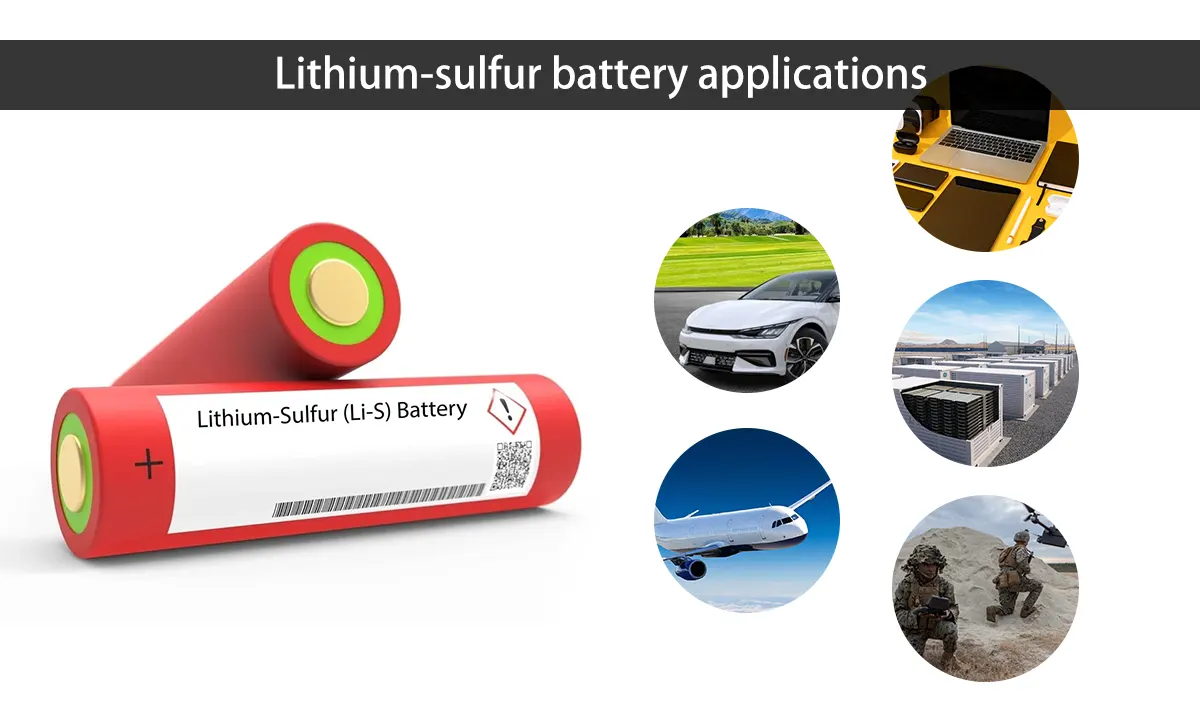
Portable electronic devices: For example, laptops, tablets, and smartphones can benefit from long lasting battery, enhancing user experience.
Smart grid storage: Helps balance supply and demand in the grid, improving stability and reliability.
Military field: Provides reliable energy support for military equipment.

Technical bottlenecks
Polysulfide shuttle effect: During charge and discharge, generated polysulfides dissolve in the electrolyte and shuttle between the cathode and anode, leading to loss of active material, reduced coulombic efficiency, and rapid capacity decay.
Poor conductivity of sulfur: Sulfur itself is an electronic insulator with extremely low conductivity, limiting battery rate performance and power density.
Volume expansion: During discharge, sulfur converts to lithium sulfide, resulting in significant volume expansion (about 80%), damaging electrode structure and affecting cycle stability.
Safety issues: Lithium-sulfur batteries may generate side reactions during charge and discharge, leading to heating, gas production, and other problems, affecting battery cell safety.
Electrolyte stability: Commonly used electrolytes may decompose upon contact with polysulfides, affecting battery cycle life.
Complex reaction mechanism: The reaction process of lithium-sulfur batteries is complex, involving multiple polysulfide transformations, posing challenges for precise control of battery performance and optimization design.
Solutions to the polysulfide shuttle effect
Cathode: Adding carbon, nano metal oxides, polymers, and binary metal sulfides to the cathode material to improve conductivity and adsorb intermediate polysulfides through pores or surface functional groups, inhibiting their dissolution and diffusion in the electrolyte, mitigating the shuttle effect.
Electrolyte: Using a tetrahydrofuran (THF)-based electrolyte diluted with low concentration and non-polar hexane (NH) to chemically and physically improve the energy density of lithium-sulfur batteries. This carefully designed electrolyte can achieve various improvements, such as promoting uniform lithium deposition, inhibiting polysulfide shuttle, and reducing the overall weight of lithium-sulfur batteries.
Separator: Introducing morpholine as a capture unit into polypropylene separators to inhibit polysulfide shuttle. Morpholine contains two heteroatoms, N and O, where the more electronegative O atom has concentrated charge and hard electron cloud; while the less electronegative N atom has dispersed charge and soft electron cloud. The combined effect of the two atoms achieves equivalent adsorption of polysulfides with different hardness.
Lithium anode: Inspired by coagulation and thrombolysis mechanisms, nitrogen-doped carbon quantum dots (N-CDs) are added to the electrolyte as additives. These function as lithium polysulfide coagulation factors, rapidly coagulating dissolved polysulfides to form an in-situ recoverable protective layer.
Common methods to improve the poor conductivity of sulfur in lithium-sulfur batteries
Composite with conductive materials: Combining sulfur with carbon materials (such as carbon nanotubes, graphene, porous carbon, etc.). Carbon materials have good conductivity, providing electron transport channels and increasing sulfur utilization.
Special structure design of the cathode: Fabricating sulfur nanostructures, such as nanospheres, nanowires, nanosheets, etc. Nanoscale dimensions shorten electron and ion transport distances, improving reaction kinetics. Constructing three-dimensional porous structures in the cathode increases the contact area between the electrode and the electrolyte, promoting charge transfer.
Optimization of electrode preparation processes: Using high-temperature treatment, chemical vapor deposition, and other methods to improve contact and bonding between sulfur and conductive materials, enhancing conductivity.
Electrolyte optimization: Choosing electrolytes with high ionic conductivity to promote ion transport in the electrode, indirectly improving sulfur conductivity.
Surface modification: Surface modification of sulfur or cathode materials, such as coating with conductive polymers, to improve conductivity.
Specific mechanisms of nanometal oxides improving sulfur conductivity in lithium-sulfur batteries
The poor conductivity of sulfur in lithium-sulfur batteries is mainly due to two reasons:
Sulfur itself has poor electronic conductivity.
The final product of the reaction is also an electronic insulator, which is not conducive to high-rate performance of the battery.
Nanometal oxides can improve sulfur conductivity in lithium-sulfur batteries through the following ways:
Forming composites with sulfur: Nanometal oxides can form composites with sulfur, such as nanometal oxide/sulfur composites or nanometal oxide@ sulfur core-shell structures. These composites can improve sulfur conductivity while inhibiting polysulfide dissolution and shuttle effect.
Serving as catalysts: Some nanometal oxides have good catalytic properties and can catalyze sulfur redox reactions, increasing reaction rate and efficiency, thereby improving battery performance.
Constructing three-dimensional conductive networks: Nanometal oxides can construct three-dimensional conductive networks, such as nanometal oxide nanowires, nanotubes, or nanosheets. These three-dimensional conductive networks provide good electron transport channels, improving sulfur conductivity, while also inhibiting polysulfide dissolution and shuttle effect.
Conclusion