Ambitious net-zero targets, reduced reliance on Russia’s fossil fuels, regulatory reforms and growing investor confidence will prompt Europe to deploy 42GW of energy storage by 2031, the study suggests.
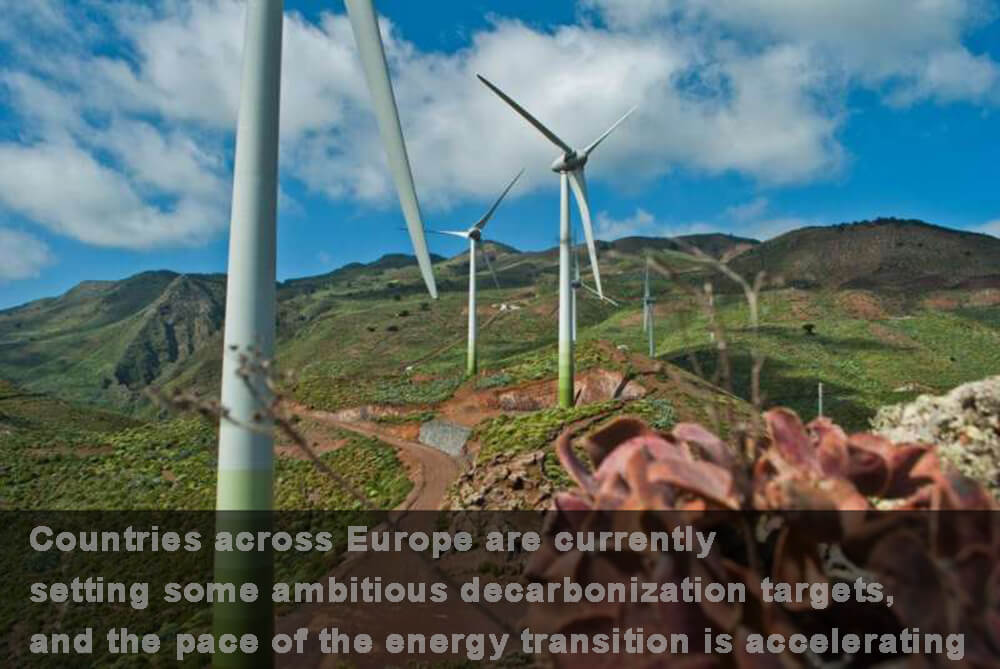
Countries across Europe are currently setting some ambitious decarbonization targets, and the pace of the energy transition is accelerating: in the wake of the Russia-Ukraine conflict, the European Commission has drawn up a “RePowerEU” plan to reduce Europe’s energy dependence on Russian gas by 2030.
The proposed plan would double the share of variable renewables in total electricity generation to more than 60% by 2030. From a powerwall battery for home energy storage to a grid scale energy storage, energy storage systems will play a key role in this rapid transition and provide vital power system flexibility. More and more countries and companies are planning and developing in the field of energy storage, you can read Top 10 energy storage battery companies to understand the situation of leading companies in the field of energy storage. As for those countries with large energy storage projects, this article will introduce them in detail.
In resent years, the emerging field of grid-scale energy storage in Europe is growing rapidly. According to forecasts, between now and 2031, the energy storage capacity of energy storage systems researched and deployed in Europe will increase by 20 times.
Drawing on insights from energy storage service providers, the study by Wood Mackenzie provides 10-year forecasts for 18 European countries, explores drivers and barriers to energy storage deployment, and highlights strategic points for industry players and governments.
Market size of grid-scale energy storage in European countries in 2023
Research shows that in 2022 alone, grid-scale energy storage demand in Europe will grow by 97% year-on-year to 2.8GW/3.3GWh. This reflects the emergence of energy storage systems as a mainstream energy technology.
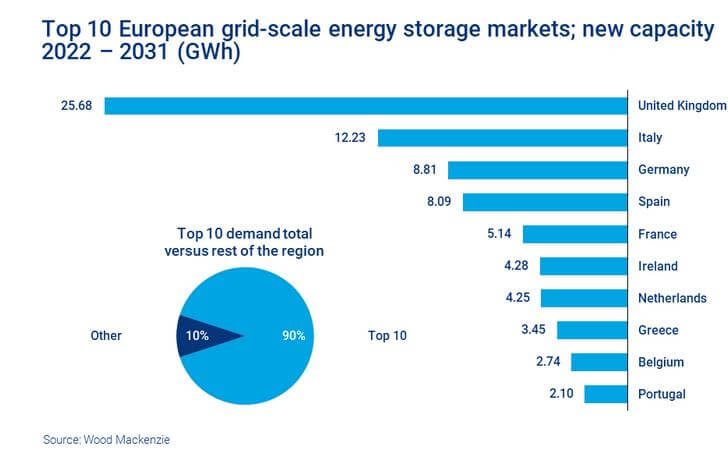
Over the next decade, the top 10 European markets will add 73 GWh of energy storage, equivalent to 90% of new deployments.The UK will retain its lead as the region’s leading grid-scale energy storage market by 2031, adding 1.5GW/1.8GWh in 2022 alone.
With investor confidence in the profitability of energy storage assets growing, the UK has the largest energy storage deployment pipeline in Europe, with 25 energy storage projects exceeding 100MW of capacity.The saturation of the fast-response ancillary market will tie the development of energy storage projects in the UK more closely to the growth of renewables, driving the deployment of long-duration storage systems from 2035.
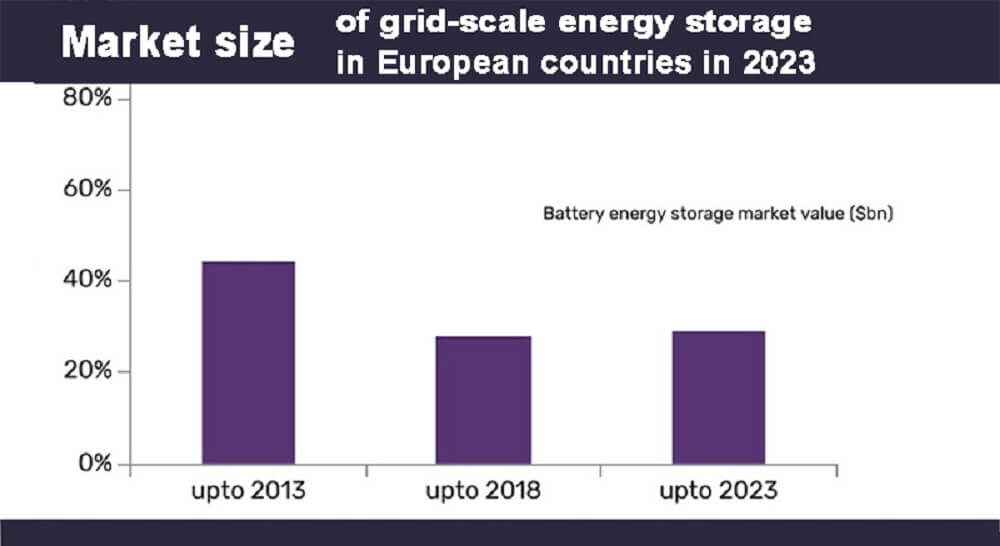
Ireland will be second in Europe with 0.31GW/0.37GWh of storage deployments in 2022. However, as the graph shows, Italy claims to be second overall for the decade to 2031.By 2030, Italy will be the second largest solar power market in Europe, after Spain. And this significant growth, coupled with high spot prices, limited interconnectivity, and favorable policy mechanisms such as new capacity market auctions, will drive growth in the grid-scale energy storage segment.
Germany ranks third in new grid-scale solar installations by 2031. However, adding up the energy storage capacity of grid-scale and user-side energy storage systems deployed in the country, Germany will be the leading energy storage market in Europe by 2031. The growth rate of the energy storage market in Europe varies widely.
Top 10 grid-scale energy storage European countries 2022-2031
Development forecast of the European grid-scale energy storage market from 2022 to 2031
1.United Kingdom: 25.68 GWh
2.Italy: 12.23 GWh
3.Germany: 8.81 GWh
4.Spain: 8.09 GWh
5.France: 5.14 GWh
6.Ireland: 4.28 GWh
7.Netherlands: 4.25 GWh
8. Greece: 3.45 GWh
9. Belgium: 2.74 GWh
10. Portugal: 2.10 GWh
Top 10 countries account for 90% of the grid scale energy storage market in Europe, and other countries only account for 10%.
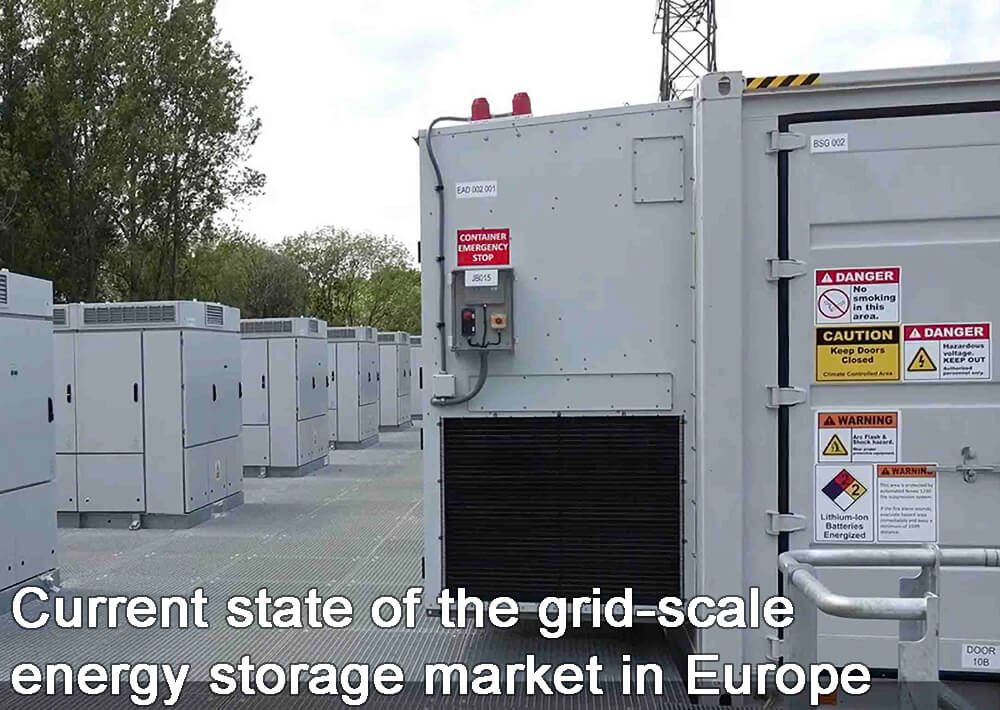
Current state of the grid-scale energy storage market in Europe
Commercial revenue remains the main source of income for grid-scale energy storage assets in Europe. While investor confidence is growing, significant challenges remain with the financing and licensing process. It is difficult for energy storage projects to ensure their lifetime profitability. The current business model relies heavily on volatile renewable electricity and ancillary market prices that do not fluctuate enough to ensure profitability. Energy storage system prices rose 7% in 2022, further increasing risk.
Ancillary market price increases in 2021 do prove that some risky business income can be obtained. However, in Wood Mackenzie’s forecast, 5.3GW of energy storage will be cancelled or significantly delayed due to challenges in the project financing and permitting process. Europe’s ambitious energy transition goals will change that. Currently, ancillary services are the main application for grid-scale projects.
But doubling the installed capacity of wind and solar power in Europe by 2031 will open up new energy storage applications – and energy trading as a major source of revenue. This shift will bring more certainty to the construction of energy storage projects and incentivize investment in long-duration energy storage systems.
Virtual power plants (VPPs) will also play a key role in improving the economics of energy storage systems. Their increased scale will help energy storage asset owners gain value-add opportunities. Rising prices for cobalt, nickel and lithium are driving battery prices higher in 2022. Battery prices rose the most among all components of energy storage systems due to increased raw material costs.
However, global investment in raw material supply and processing should ease cost pressures by the end of 2024. While some energy storage projects have experienced delays due to battery supply constraints, deployment growth has remained strong.
Policies and regulations key to unlocking 42GW of energy storage in Europe
For energy storage to reach its potential, policy hurdles do need to be overcome. The three main barriers to deploying grid-scale energy storage systems in almost all European countries are:
• Missing or outdated definitions of energy storage systems lead to their classification as load or generation facilities. This can lead to double charging of the energy storage system or the imposition of unnecessary grid charges.
• Policy designs and requirements originally developed for conventional power sources may result in restricted access to flexibility and balance markets (eg auxiliary markets). This limits the value stacking opportunities for energy storage in Europe.
• Lack of revenue-generating mechanisms to support the energy storage business case is a further constraint.
Most regulatory hurdles will be resolved by 2031 as demand for flexibility surges and concerns over security of supply increase.