Development progress of 500 wh kg battery
In 2021, Enpower announced 520wh kg lithium metal pouch battery
Although CATL released the condensed matter battery during the Shanghai Auto Show in April, claiming that the energy density of the battery cell can reach up to 500 wh kg battery, but others were the first to realize the 500 wh kg battery. Enpower successfully developed a 520wh kg lithium metal battery as early as October 2021.
Using lithium metal electrode interface control technology and unique electrolyte/mass formula, the capacity is 3.6Ah, the weight is about 26.5g, the average voltage is 3.85V, and the working voltage range is 3.0-4.3V.
Amprius announced 500 wh kg silicon-based pouch battery in early 2023
Amprius announced its newly developed lithium battery in March 2023. After testing by a third-party laboratory, the energy density exceeded 500 wh kg battery. At 30% SOC, the volumetric energy density is as high as 1300wh/L.

This cell uses a silicon-based anode, the working voltage range is 2.4-4.37V, and the cathode is also a high-nickel ternary. However, due to its low voltage, only 3.45V, the specific energy of >500 wh kg battery needs to be more than 65% of the mass of the cathode material.
Its positive surface density is very high, resulting in poor rate performance, the discharge rate is 0.1C, and the charge cut-off rate is only 0.01C. Moreover, due to the small size of the battery cell and the high mass ratio of the current collector copper foil and aluminum foil, it is likely that the technology of composite copper foil and composite aluminum foil is used to reduce weight, so as to better increase the mass ratio of the cathode active material.
In April 2023, CATL announced the 500 wh kg condensed matter battery
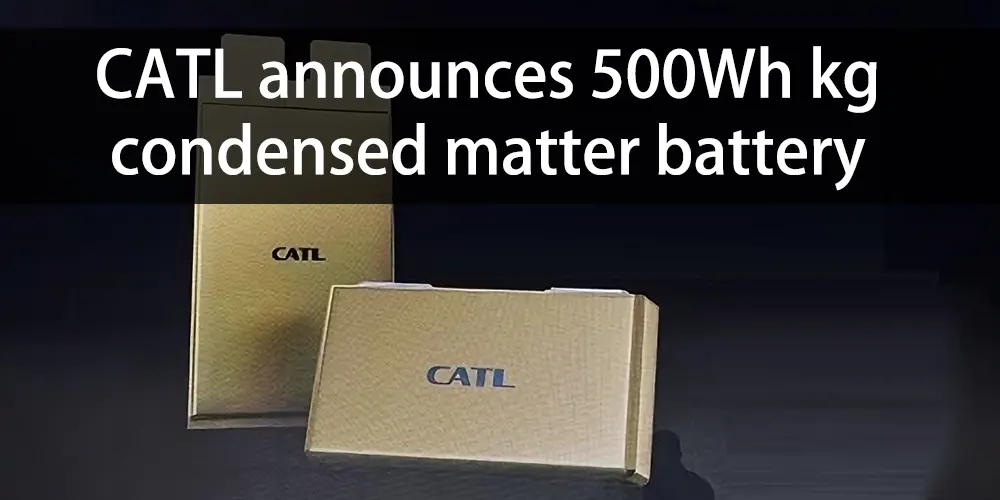
CATL released the condensed matter battery at the Shanghai Auto Show in April 2023, with a maximum energy density of 500wh/kg, combining high-power bionic condensed-state electrolytes, high specific energy cathode, new anode, separators and optimized production processes.
Literally understood, the new type of anode and the optimization of the production process, if the specific energy of 500wh/kg is to be achieved, there is a high probability that lithium metal anode will be used. Condensed matter batteries, said to be lithium polymer battery, are to be applied to electric aircraft, safety first, and the safety of high-nickel ternary batteries is worrying.
To achieve the energy density of 500 wh kg battery, in addition to high-nickel ternary, high-voltage lithium cobaltate and high-capacity lithium-rich manganese are also optional routes. The safety performance of the former may be worse than high nickel, and the latter is slightly better.
Through a series of analysis and modification by experts, the first discharge gram capacity of lithium-rich manganese material reached 300mAh/g, the average voltage was around 3.45V, and the theoretical specific capacity of the material reached 1035wh/kg.
As long as the cathode material accounts for more than 50%, the energy density of a full battery of 500 wh kg battery can be achieved. Although the density of lithium-rich manganese materials is a little lower than that of ternary materials, it is relatively easy to achieve 50% mass ratio.
Research value of 500 wh kg battery
The 500 wh kg battery needs to be realized through extreme optimization of materials and battery design.
In terms of materials, the current lithium battery cathode materials are all in the form of Li+M+Oxide: First, because the anode does not contain lithium, there must be lithium in the cathode material. Secondly, because it is a redox reaction, there must be a variable valence state, so there must be a transition metal.
Lithium and transition metals are both positive, and the valence of transition metals is relatively high, generally around +3, so at least 2 O atoms are needed. In this way, the suitable cathode material must be at least LiMO2. Therefore, in the case of a maximum transfer of 1 mole of Li, the gram capacity of the layered material is the highest, and it is the first choice for high specific energy batteries.
As a comparison, the spinel material LiMn2O4 is equivalent to transferring only 0.5 mole of lithium (Li0.5MnO2), and the theoretical capacity is low. However, LiFePO4 increases the weight of PO2, so the theoretical specific capacity is also relatively low. It has been known through the previous analysis that the high-voltage LCO and the high-capacity high-nickel ternary in the layered material can achieve an energy density of 500wh/kg.
However, the safety of these two materials is very poor. The temperature of thermal decomposition and oxygen release will be below 150°C, and the maximum temperature of thermal runaway can reach above 800°C. Therefore, although high specific energy can be achieved, high safety cannot be guaranteed, and new material systems need to be developed.
Experts have proposed that multi-electron and light elements are important directions for lithium-ion batteries to achieve high specific energy. Lithium-rich manganese-based materials achieve high capacity through polyatomic transfer, and in fact we can also achieve high capacity by using lighter elements. The most radical of this route is the lithium-air battery, that is, the reaction of Li with O2, but its reversibility is particularly poor.
In summary, even without considering commercial value, the research and development of 500 wh kg battery has a lot of academic value. It can continuously expand the boundaries of high-capacity materials and improve the deficiencies of materials through research and development to achieve high specific energy, low cost, and high safety battery systems.
The application prospect of 500 wh kg battery
with the support of CTP technology, the cruising range of pure electric vehicles has exceeded 1000km. Among them, the Jikrypton 001 Kirin battery version is ready to be delivered, with an energy of 140kwh and a battery life of 1032km. The specific energy of the battery cell is 285wh/kg, and the energy density of the battery pack is about 205wh/kg.
It can be seen that the specific energy of the battery cell is less than 300wh/kg, which already meets the requirements of the battery life of electric vehicles for thousands of miles. For electric vehicles, on the premise of meeting the battery life, cost and safety are more important to consumers. In other words, as long as the basic needs are met, the battery life is enough.
Continuing to increase battery life on this basis will have diminishing marginal effects and will not significantly improve user experience. Even if the 500 wh kg battery guarantees high specific energy and high safety, it is difficult to balance cost, power, cycle life, etc., so the hope of car use is relatively slim.
In addition to automotive use, 3C electronic products are also very important application scenarios of 500 wh kg battery. The small pouch batteries developed by companies such as Enpower and Amprius are also closer to 3C usage scenarios. However, the 3C scene in top 10 3C consumer lithium battery manufacturers pays more attention to the volume energy density, so the prospect of silicon-based materials is better than that of lithium metal.

In addition, civil and military aircrafts are the most suitable application scenarios for 500 wh kg battery, which do not require high volume-to-capability but high mass-to-energy requirements. In addition, civil manned aircraft (eVOLT) is also an important market, including flying cars.
Farasis has cooperated with internationally renowned electric aircraft manufacturers as early as 2021. The battery products for eVTOL have been mass-produced, equipped with 285wh/kg batteries. The flight time is 43 minutes, the flight speed is 320km/h, and the flight distance is 250km. The flight test of the manned electric aircraft has been completed.
CATL announced in April 2023 that the energy density of the company’s condensed matter battery is as high as 500 wh kg battery, and it is cooperating in the development of the civil electric manned aircraft project.
These companies are mainly using ternary lithium battery. Because eVOLT values factors such as safety, low temperature performance, energy density, and instantaneous charge and discharge rate. Starting from these points, the ternary can be matched.
Conclusion
The 500 wh kg battery is a must for the advanced battery routes of China, the United States, Japan and other countries, and corresponding progress has been made so far. Although the probability of a 500 wh kg battery being applied in the field of power batteries is very low, a lot of knowledge and experience will be accumulated during the development process.
It can pave the way for the next generation of high specific energy batteries, and can also be used in existing systems to reduce costs and improve safety. The commercialization of 500 wh kg battery can make up for the lack of energy density and help lithium batteries soar in the vast sky.