Skip to content



Looking forward to 2023, the global energy transformation is the general trend, and the average level of electricity prices is also on the rise. Saving electricity bills and ensuring electricity consumption are the core motivations for American users to equip residential energy storage.
With the improvement of the economics of residential energy storage and the continuation of policy subsidies, the US household storage market is expected to further expand in the future.
Independent energy storage is included in the scope of ITC credits
In August 2022, the United States passed the IRA Act, which will include independent energy storage in the scope of ITC credits for the first time.
Before the introduction of the IRA Act, photovoltaic power generation and its distribution storage projects in the United States generally enjoyed a 30% ITC tax exemption, that is, 30% of the value-added tax generated by the refund of investment, but energy storage must be paired with photovoltaics to enjoy ITC subsidies.
With the implementation of the IRA bill, independent energy storage is included in the scope of ITC tax credit subsidies, and the dependence of energy storage installations on photovoltaics will be greatly reduced, which will help promote the rapid growth of the US energy storage market.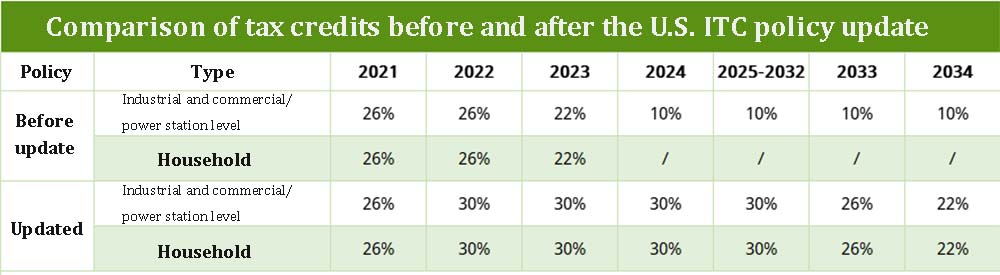
In addition, the ITC subsidy has been postponed for ten years, and the credit has been further strengthened. The IRA Act extends the validity of the ITC subsidy until 2033 and divides the credit into base credit + additional credit.
Among them, the basic credit amount has increased from the previous 26% to 30%, which was previously declining year by year. Tax credits have been further strengthened, and the economics of US residential energy storage projects are expected to further improve.
Drivers and economics of the US household savings market
According to industry estimates, the average household storage installed capacity in the United States is 10kW~15kW components, 9.6kW inverters, and 13~15kWh batteries, which are about 30% less than in Europe as a whole. The whole set of optical storage system including installation costs about 20,000 US dollars.
In terms of installation drivers, subsidies are the number one driver. A $20,000 energy storage system can be subsidized by $6,000-7,000.
After counting the subsidy, the cost can be paid back within 4-5 years, and the subsequent use is equivalent to free electricity. In the case of stable electricity, it can also be very economical. Why not do it?
In addition, states with good light conditions such as Texas, Florida, and Arizona are expected to introduce subsidies from the second half of this year to the first half of next year.
The demand for household storage in various states will explode rapidly under the subsidy. Texas alone has more than 3 million household storage spaces. If it is optimistically estimated, it will nearly double every year by 2025.
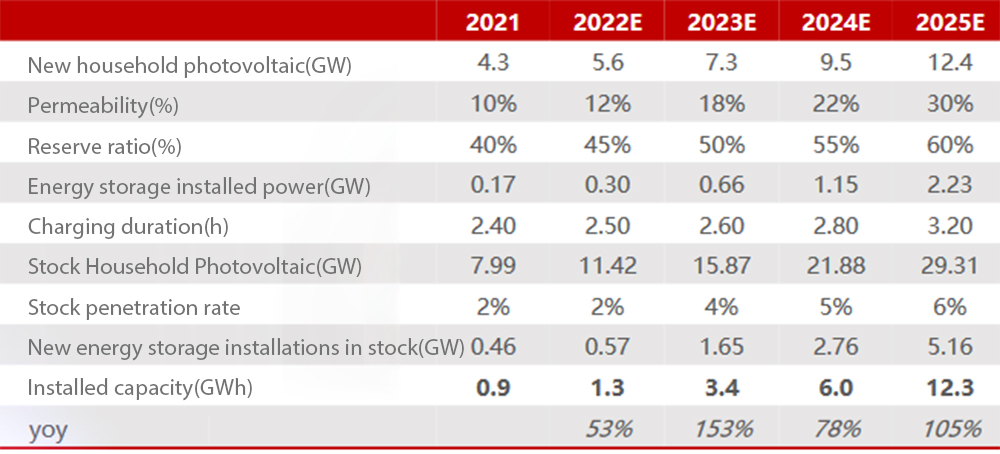
Residential energy storage installed in the United States
According to estimates, from 2022 to 2025, the installed capacity of household photovoltaics in the United States will reach 5.6, 7.3, 9.5, and 12.4GWh, and its energy storage penetration rate is expected to reach 12%, 18%, 22%, and 30%, respectively.
According to the power ratio of 45%, 50%, 55%, and 60%, and the charging and discharging time of 2.5, 2.6, 2.8, and 3.2 hours, the stock penetration rate is 2%, 4%, 5%, and 6%, respectively.
It is calculated that the installed capacity of residential energy storage in the United States will reach 1.3, 3.4, 6, and 12.3GWh respectively, and the CAGR will be 110% from 2022 to 2025.
US residential storage installed capacity is expected to double
In 2022Q2, the installed capacity of household storage in the United States reached 375MWh, breaking the historical quarterly installed capacity record set in Q1, with a quarter-on-quarter increase of +12%.
In 22Q2, the newly installed capacity of household storage in the United States accounted for 12% of the total new installed capacity.
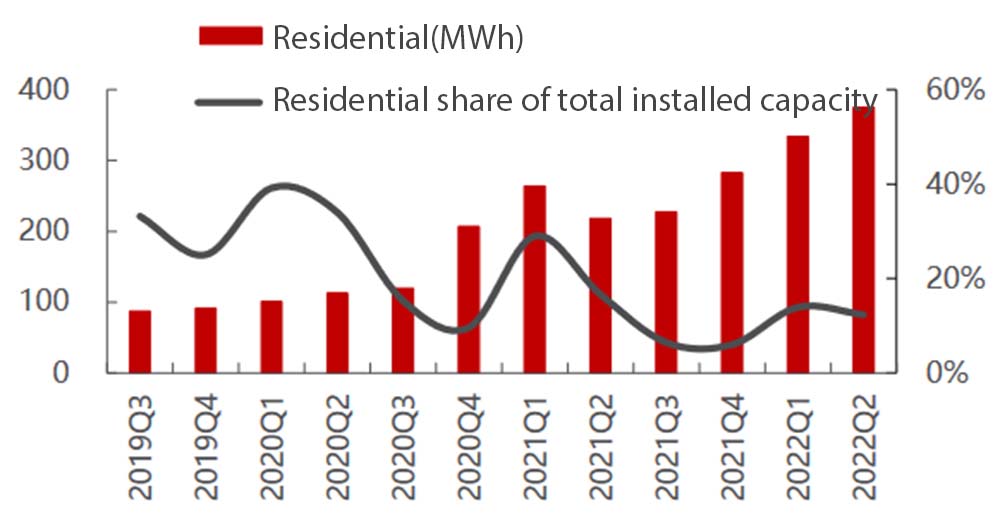
2019Q3-2022Q2 historical installed capacity of US residential storage
Some organizations predict that the newly installed capacity of household storage in the United States will reach 3-4GWh in 2022, and it is expected to double in 2023 to 6-8GWh.
Although the US household savings started later than Europe, its population, economy, and living conditions determine that its market space is much larger than that of Europe, and it is expected to double every year by 2025 under the promotion of subsidies.
Competitive landscape of the US household savings market
In terms of product types, the US market is more inclined to all-in-one machines or inverters + batteries of the same brand, which requires high brand awareness. The self-owned brands of Chinese companies are still in their infancy in the United States.
The biggest gap lies in brand awareness and the lack of promotion by local professional teams. However, with the high demand in the United States and the contradictions in the supply chain, it is expected that there will be demand for products, and the brand is not so important.
| Split machine | ●End products are separate energy storage battery systems, converters, and battery and converter brands are sold to installers ●The installer integrates the installation for the customer; the customer independently chooses the brand of the battery system and converter ●User purchase cost is relatively lower than all-in-one machine, flexible installation and expansion |
| All-in-one machine | ●Energy storage battery and converter integrated into one device ●All-in-one machine brand merchants sell and install as a whole, and provide overall after-sales service ●The product positioning is relatively high-end, and the premium is high |
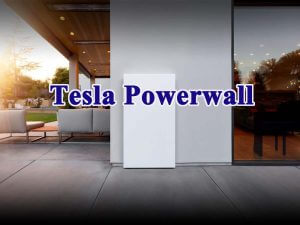
It is reported that one of the top 10 powerwall manufacturers in the world Tesla has 80,000 household orders before the outage, ranking first with a market share of more than 60%, followed by LG with a market share of 20%. After Tesla sold out, the cumulative market share of LG, Panasonic, Enphase, and Generac accounted for 60% to 70%.
In addition, CATL in top 10 lithium ion battery manufacturers in China has continued to break through in the North American market and has successively become one of the main suppliers of energy storage system products for Tesla and Fluence.
At the same time, it has established cooperation with Primergy, FlexGen and other well-known American energy storage companies to provide industrial energy storage system product support for Southern California Edison and Texas.
US household storage market supply chain
At present, Chinese companies mainly participate in the upstream manufacturing link of the US household storage market.
Most Chinese companies enter the US market through OEM cooperation with other national brands. Mainly participate in the key links in the upstream of the industrial chain – batteries, PACKs and inverters.
Some manufacturers with larger scales and more mature products are also trying to integrate downwards, focusing on localization, establishing service points, creating their own brands, and obtaining premium prices.

Chinese manufacturers mainly participate in the upstream link of US household storage
In terms of batteries, 60% of the batteries in the US residential storage market supply chain come from China. In terms of batteries, Enphase uses lithium iron phosphate battery packs manufactured in China; LG and Panasonic both have their own ternary lithium batteries;
Generac shifted from Panasonic’s ternary battery module to a domestic company’s OEM; South Korea’s Q-cell brand turned to Hangzhou Solax as an OEM.
In terms of inverters, LG has inverter products in the United States; Generac adopts the acquired PIKA brand; more than half of households in California use micro-inverters for photovoltaics, and Enphase accounts for a high proportion;
Q-cell uses batteries and inverters from Hangzhou Ailuo. The continued improvement of the US household savings market is becoming a new opportunity for Chinese companies.