Skip to content



How bifacial solar panels work
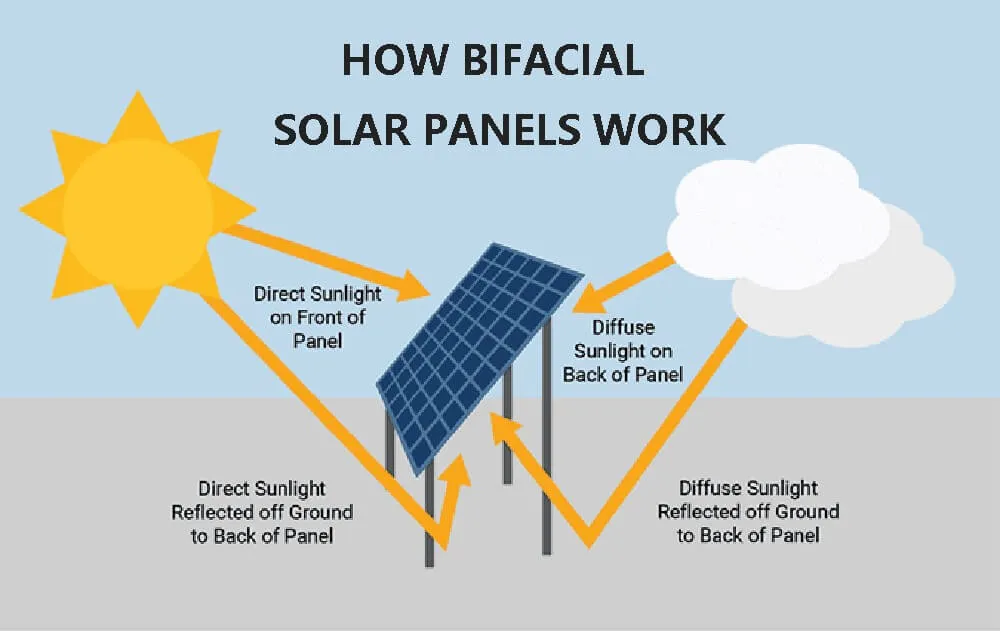
By capturing albedo and direct sunlight, each bifacial solar panel produces an increased amount of electricity, which means fewer solar panels need to be installed. Unlike single-sided solar panels, bifacial solar panels are made of clear glass that allows some light to pass through and reflect off the surface below.
To further increase the amount of light that passes through, bifacial solar panels use glass instead of metal frames or grid lines to hold them. The glass is tempered glass to reduce scratches. Otherwise, bifacial solar panels work exactly like other photovoltaic panels, using crystalline silicon to absorb sunlight and convert it into electricity. The back side of a bifacial solar panel typically shares its circuitry with the front side, increasing efficiency without adding circuitry.
Single-sided solar panels vs bifacial solar panels
According to research, bifacial solar panels produce 9% more electricity than single sided panels. As with the more efficient single-sided panels, this means fewer panels and associated hardware such as panel mounts, inverters and cables need to be installed, reducing hardware and labor costs. Solar pv industry is less efficient at higher temperatures, which provides another advantage for bifacial solar panels.
Since bifacial solar panels are made of glass and do not have the heat-absorbing aluminum backing of single-sided panels, they operate at cooler temperatures, which increases efficiency. Bifacial solar panels don’t need to be grounded because they don’t have a metal frame that could conduct electricity. And because the construction of bifacial solar panels makes them more durable, they often come with longer warranties. In cloudy climates, bifacial solar panels rely more on diffuse solar radiation.
Or anywhere with less direct sunlight and a high percentage of indirect diffuse sunlight, bifacial solar panels are more efficient than single-sided panels. For the same reason, bifacial solar panels are more efficient for longer periods of the day, when there is still diffuse sunlight, but not directly on the panels.

Bifacial solar panels can also better benefit from solar trackers to track the sun throughout the day. One study showed that, through tracking, power generation was 27% higher than single-sided panels and 45% higher than fixed-tilt bifacial solar panels. Another study with similar results determined that bifacial solar panels on solar trackers could reduce electricity costs by 16%.
Where bifacial solar panels are usually installed
Bifacial solar panels work best above highly reflective surfaces like sand, concrete or snow. In general, bifacial solar panels are less suitable for residential roofs for a number of reasons. To reduce shadows beneath them, bifacial solar panels often need to be positioned higher from the reflective surface below, so they cannot be installed close to the roof surface. Even if it could, a dark roof would absorb light rather than reflect it. Bifacial solar panels are also heavier, which makes them more difficult to install and limits their use cases.
Older roofs may also not be able to support the added weight or support structures needed to accommodate bifacial solar panels. Finally, bifacial solar panels are more expensive and have higher labor costs, making the higher total upfront cost prohibitive for many small-scale residential customers. However, other surfaces are ideal locations. Flat-roof buildings painted in lighter colors can be fitted with bifacial solar panels, as can car park canopies, pool patios, decks, pergolas, porches, awnings and other shade structures.

Ground systems covered with lightweight materials such as concrete, sand, gravel or tile are also strong candidates for bifacial solar panels. Utility-scale and community solar farms have adopted bifacial solar panels faster because their installation design and siting options are not limited to rooftops. In these cases, the levelized cost of bifacial solar panels can be 2-6% lower than that of monofacial panels.
Bifacial solar panels require a higher stand than single-sided solar panels, so they can more easily be part of an agricultural pv system that combines farming with solar power. Crops can be more easily grown around higher mounts, while grazing cows and sheep can benefit from the shade provided by the panels, making the land 60% more productive by combining these two features.
The future of bifacial solar panels
Unlike other attempts to improve the efficiency of solar panels, such as perovskite solar cell manufacturers, bifacial solar panels technology now exists, can be deployed on a large scale, and can be deployed quickly. As the urgency of action on climate change becomes clearer, bifacial solar panels technology is one of the most effective means of reducing carbon emissions in the energy sector.

While bifacial solar panels are not suitable for every roof or even every ground installation, their increased efficiency allows utility-scale solar developers to achieve a faster return on investment, attracting investors looking for short-term gains. Compared to single-sided panels, bifacial solar panels have a smaller footprint, enabling apartment building owners to efficiently bring solar power to their tenants and allowing community solar farms to be built where customers need them without the need for Massive power transmission upgrades. Bifacial solar panels are a futuristic technology.
For more related articles, please refer to solar panel battery, solar panel recycling companies in the world, solar panel recycling.
Bifacial solar panels FAQs