Skip to content

Lithium battery electrode sheet design
To reduce electrode sheet defects, we must first understand the electrode sheet design of lithium batteries. Lithium battery electrode is a coating composed of particles, evenly coated on the metal current collector. Lithium ion battery electrode sheet coating can be seen as a composite material, mainly composed of three parts:
(1) Active substance particles;
(2) The composition phase (carbon colloidal phase) in which the conductive agent and the binder are mixed with each other;
(3) The pores which are filled with electrolyte.
The volume relationship of each phase is expressed as: porosity + volume fraction of active material + volume fraction of carbon gel phase = 1
The design of the lithium battery electrode sheet is very important. The following is an introduction to the design of the lithium battery electrode sheet.

● Battery design capacity and surface density of electrode sheet
The battery design capacity can be calculated by the following formula:
Battery design capacity = surface density of coating × proportion of active material × gram capacity of active material × coating area of electrode sheet
The surface density of the coating is a key design parameter. When the compaction density remains constant, the increase of the surface density of the coating means that the thickness of the electrode sheet increases, the electron transmission distance increases, and the electronic resistance increases, but the increase is limited.
In a thick electrode sheet, the increase in the migration resistance of lithium ions in the electrolyte is the main reason affecting the rate characteristics. Considering the porosity and the tortuousness of the pores, the migration distance of ions in the pores is many times longer than that of the electrode sheet thickness.
● Capacity ratio of negative electrode to positive electrode (N/P)

N/P should be greater than 1.0, generally 1.04~1.20. This is mainly for safety design to prevent lithium ions on the negative electrode side from being precipitated without receiving sources. The design should consider process capabilities, such as coating deviation. However, when the N/P is too large, the irreversible capacity loss of the battery will result in a low battery capacity and a decrease in battery energy density.
For the lithium titanate negative electrode, an excess positive electrode design is adopted, and the battery capacity is determined by the capacity of the lithium titanate negative electrode.
Excessive design of the positive electrode is beneficial to improve the high-temperature performance of the battery: the high-temperature gas mainly comes from the negative electrode. When the positive electrode is excessively designed, the potential of the negative electrode is lower, and it is easier to form an SEI film on the surface of lithium titanate.
● Coating density and porosity
In the production process of lithium ion battery company, the coating compaction density of the battery electrode sheet = the surface density of the coating after rolling / the thickness of the electrode sheet after rolling – the original thickness of the metal foil / (1 + foil elongation)
Considering that the metal foil is stretched when the electrode sheet is rolled, the surface density of the coating after rolling is calculated by the following formula.
Coating surface density after rolling = coating coating surface density/(1+foil elongation)
As mentioned above, the coating is composed of active material phase, carbon gel phase and pores, and the porosity can be calculated by the following formula.
Porosity=1-(coating compacted density/coating average density).
Among them, the average density of the coating is:

The lithium battery electrode is a coating composed of powder particles. Due to the rough surface and irregular shape of the powder particles, there must be pores between the particles when they are piled up, and some particles themselves have cracks and pores. Therefore, the volume of the powder includes the volume of the powder itself, the pores between the powder particles and the pores inside the particles.
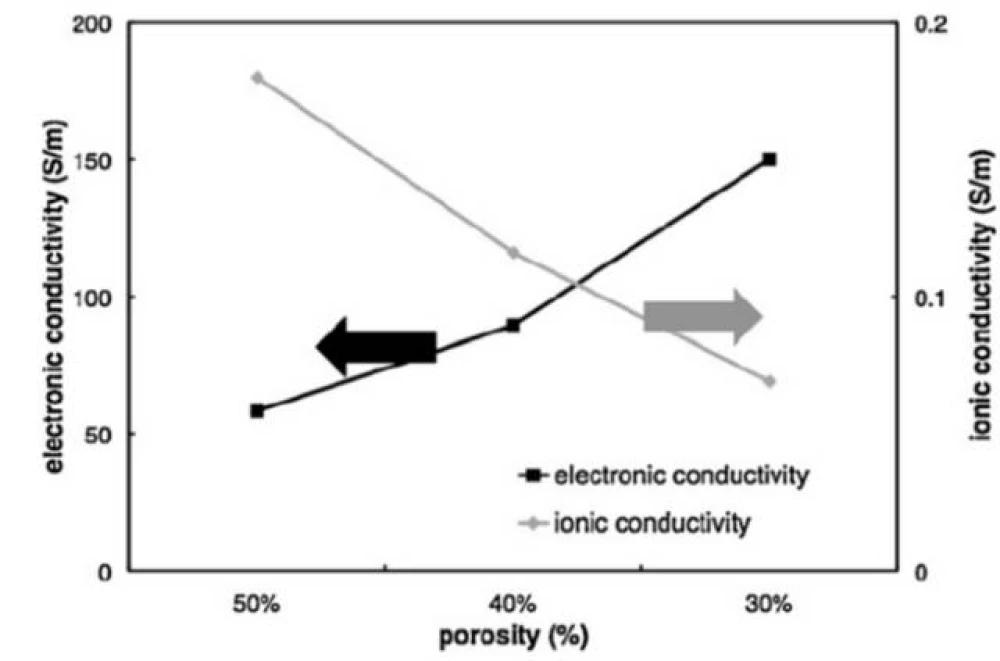
The electrolyte is filled in the pores of the porous electrode, and lithium ions are conducted through the electrolyte in the pores, and the conductivity of lithium ions is closely related to the porosity. Therefore, the larger the porosity, the higher the volume fraction of the electrolyte phase, and the higher the effective conductivity of lithium ions.
In the positive electrode sheet, electrons are transported through the carbon colloidal phase, and the volume fraction of the carbon colloidal phase and the tortuosity of the carbon colloidal phase directly determine the effective conductivity of the electrons.
The porosity and the volume fraction of the carbon colloidal phase are contradictory. A large porosity will inevitably lead to a decrease in the volume fraction of the carbon colloidal phase.
Therefore, the effective conduction characteristics of lithium ions and electrons are also contradictory, as shown in the figure below. As the porosity decreases, the effective conductivity of lithium ions decreases, while the effective conductivity of electrons increases. In electrode design, the balance of the two is also critical.
Common defects of electrode sheet

Agglomeration
As shown in Figure (a, b). Such defects can occur if the slurry is not stirred uniformly or if the coating feed rate is not stable. The agglomeration of binder and carbon black conductive agent will result in low active ingredient content and light weight electrode sheet.
Pinholes
As shown in Figure (c, d). These defective areas are not coated and are usually created by air bubbles in the slurry. They reduce the amount of active material and expose the current collector to the electrolyte, thereby reducing the electrochemical capacity.
Metal particles
As shown in Figure (e, f). The metal particles introduced in the slurry or equipment or the environment, the metal particles is very harmful to the lithium batteries, which is the best rechargeable batteries. Larger-sized metal particles directly pierce the separator, causing a short circuit between the positive and negative electrodes, which is a physical short circuit.
In addition, when metal particles is mixed into the positive electrode, the potential of the positive electrode rises after charging, the metal dissolves, diffuses through the electrolyte, and then precipitates on the surface of the negative electrode, eventually piercing the separator and forming a short circuit, which is a chemical dissolution short circuit.
The most common metal foreign objects on the battery factory site are Fe, Cu, Zn, Al, Sn, SUS, etc.
Non-uniform coating
As shown in Figure (g, h). If the slurry is not stirred sufficiently, streaks are likely to appear when the particle size is large, resulting in uneven coating, which will affect the consistency of battery capacity, or even streaks without coating at all, which will affect both capacity and safety.
Electrode sheet defect detection method
At present, in the process of preparing battery electrode sheets, more and more online inspection technologies are adopted, so as to effectively identify the manufacturing defects of products, eliminate defective products, and reduce the defective rate.
On-line inspection technologies commonly used in electrode sheet manufacturing include slurry characteristic inspection, electrode sheet quality inspection, and size inspection. For example:

● The online viscometer is directly installed in the coating storage tank to detect the rheological characteristics of the slurry in real time and the stability of the slurry;
● Use X-rays or β-rays to directly measure the surface density of the coating in the coating process, which has high measurement accuracy, but has large radiation, high equipment prices and troublesome maintenance;
● Laser online thickness measurement technology is applied to measure the thickness of electrode sheet, the measurement accuracy can reach ±1. 0μm, and it can also display the measured thickness and thickness change trend in real time, which is convenient for data traceability and analysis;
● Use CCD vision technology to detect the surface defects of the electrode sheet, that is, use a linear array CCD to scan the measured object, process the image in real time and analyze the defect category, and realize the non-destructive online detection of the surface defects of the electrode sheet.
Electrode sheet defect detection technology
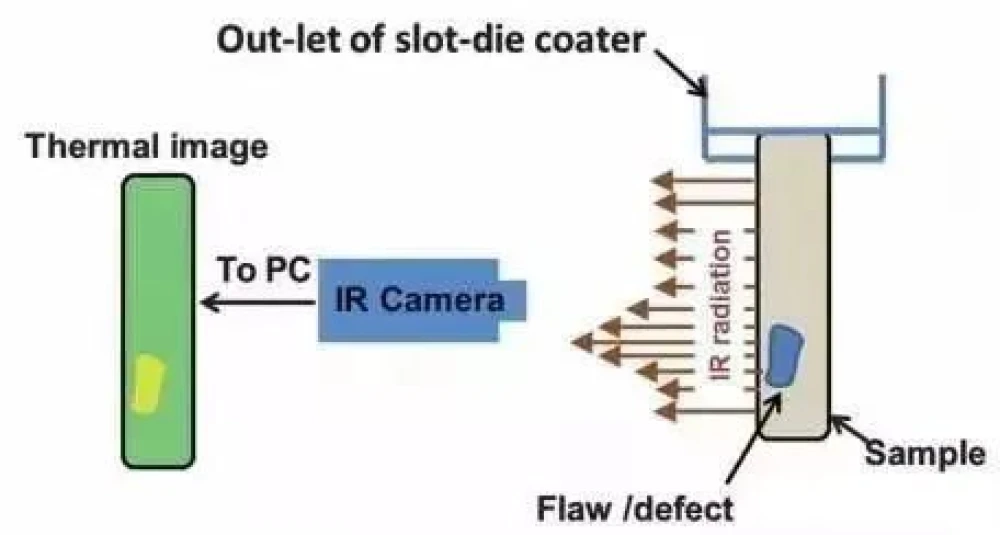
Infrared (IR) thermography is used to detect tiny defects on dry electrode sheets that can damage the performance of Li-ion batteries. Infrared is an electromagnetic wave that has the same nature as radio waves and visible light.
The technology of using a special electronic device to convert the temperature distribution of the surface of an object into an image visible to the human eye, and displaying the temperature distribution of the object’s surface in different colors is called infrared thermal imaging technology, and this electronic device is called an infrared camera. All objects above absolute zero (-273°C) emit infrared radiation.
As shown in the figure below, the infrared thermal imaging camera (IR Camera) uses the infrared detector and the optical imaging objective lens to receive the infrared radiation energy distribution pattern of the measured target object and reflect it on the photosensitive element of the infrared detector to obtain an infrared thermal image, which corresponds to the thermal distribution field on the surface of the object.
When there is a defect on the surface of the object, the temperature will shift in this area. Therefore, this technology can also be used to detect defects on the surface of the object, especially suitable for some defects that cannot be distinguished by optical detection means.
When the lithium ion battery dry electrode sheet is detected online, first the electrode sheet is irradiated by a flash lamp, and the surface temperature changes, and then the surface temperature is detected by a thermal imager.
Impact of electrode sheet defects on battery performance
(1) Influence on battery rate capacity and coulombic efficiency
Agglomerations in the positive electrode sheet coating can increase battery capacity, but will reduce Coulombic efficiency. Pinholes in the cathode coating reduce the Coulombic efficiency, leading to poor rate performance, especially at high current densities. Non-uniform coatings show poor rate performance.
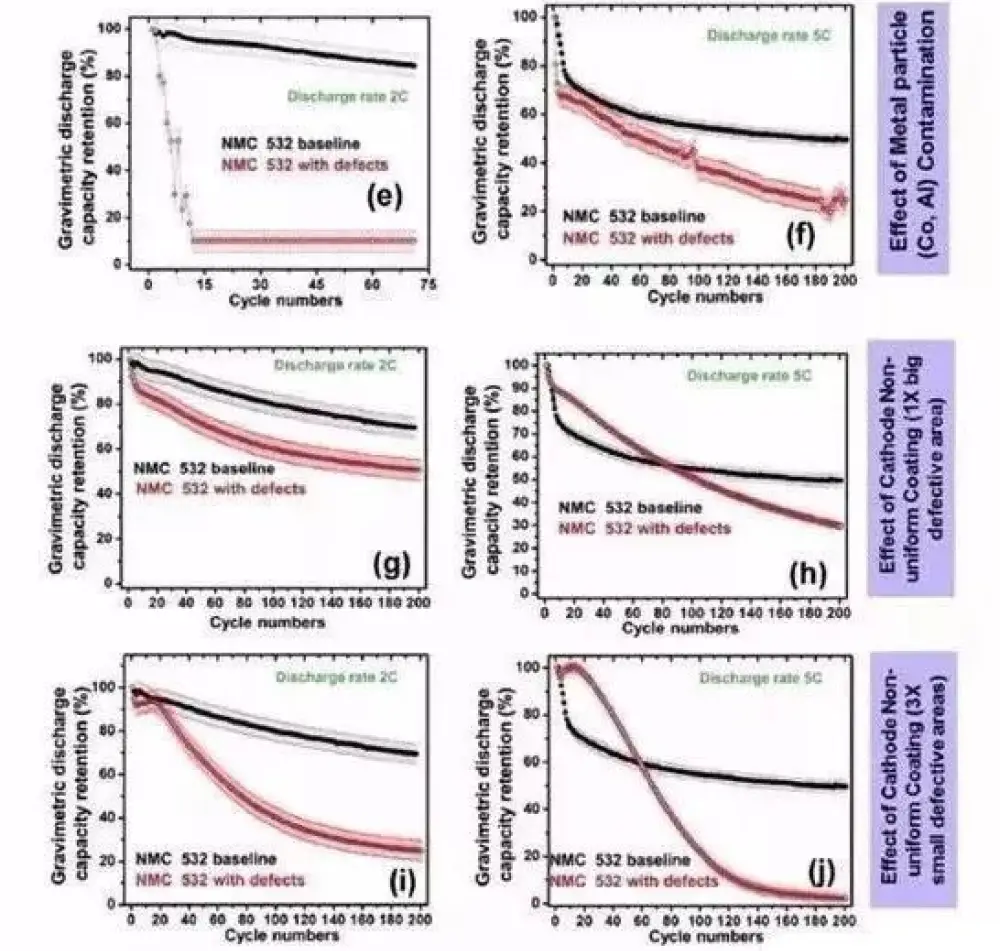
Metal particle contamination may cause micro-short circuits and thus may greatly reduce battery capacity. The capacity of the battery is significantly reduced when the negative electrode has foil leakage, but the reduction in gram capacity is not obvious, and the effect on the Coulombic efficiency is not large.

(2) Influence on battery rate cycle performance
The figure below shows the effect of surface defects on the electrode sheet on the battery rate cycle:
Agglomeration: At 2C, the 200-cycle capacity retention rate of the non-defective electrode sheet battery is 70%, and the defective battery is 12%. At 5C cycle, the 200-cycle capacity retention rate of the non-defective electrode sheet battery is 50%, and the defective battery is 14%.
Pinholes: The capacity decay is obvious, but not as fast as the aggregate defect decay, and the 200-cycle capacity maintenance rates of 2C and 5C are 47% and 40%, respectively.
Metal particles: The capacity of the metal particles is almost 0 after several cycles, and the capacity of the metal particles Al foil 5C cycle fades significantly.
Leakage foil stripes: under the same leakage foil area, compared with one large size stripe (200 cycle capacity retention rate of 47% at 5C cycle), the battery capacity decay of multiple small size stripes is faster (200 cycle capacity retention rate of 7% at 5C cycle). This shows that the greater the number of stripes, the greater the impact on the battery cycle.
References: [1]Non-destructive evaluation of slot-die-coated lithium secondary batteryelectrodes by in-line laser caliper and IR thermography methods[J]. ANALYTICALMETHODS. 2014, 6(3): 674-683.[2]Effect of electrode manufacturing defects on electrochemical performance oflithium-ion batteries: Cognizance of the battery failure sources[J]. Journal of Power Sources. 2016, 312: 70-79.